



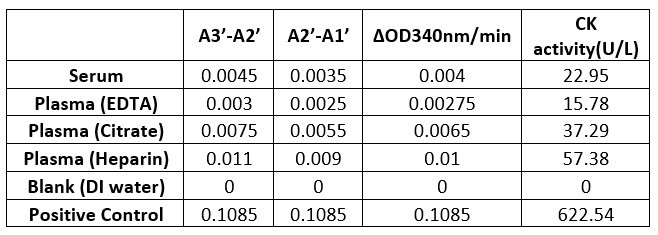
Creatine Kinase Activity Assay is a rapid, simple, reproducible, and standardized method for measuring total CK activity in biological samples. CK catalyzes the reversible phosphorylation of ADP, in the presence of creatine phosphate, to form ATP and creatine. The enzyme hexokinase (HK) uses the ATP produced to phosphorylate glucose, generating ADP and glucose-6-phosphate (G6P). G6P is then oxidized to 6-phosphogluconate, resulting in the production of NADH. The rate of NADH formation, measured at 340nm, is directly proportional to CK activity.
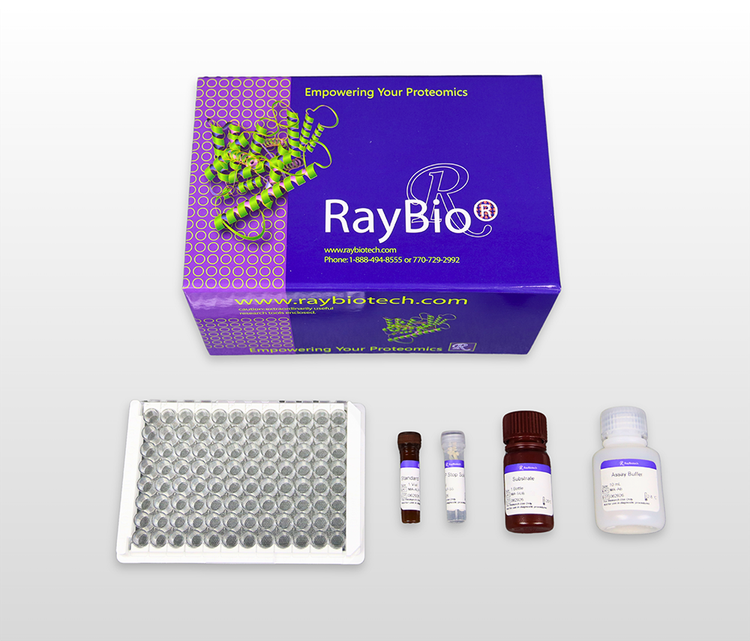

Creatine Kinase Activity Assay
Creatine Kinase Activity Assay
Contact Us for Bulk Request
Product Description
Specifications
| Size | 1 Plate Kit, 2 Plate Kit, 5 Plate Kit |
| Compatible Sample Types | Plasma, Serum, Tissue Lysates, Cell Lysates |
| Quantitative/Semi-Quantitative | Quantitative |
| Research Area | Cardiovascular Disease, Energy Metabolism |
| Shipping Type | Blue ice |
| Storage | -20°C |
Related Products
Recombinant Human Creatine Kinase B (CKB) Protein, Transfected HEK293 Cell Lysate
$144.00
Recombinant Human Creatine Kinase, M-Type (CKM) Protein, HEK293 Lysate
$144.00
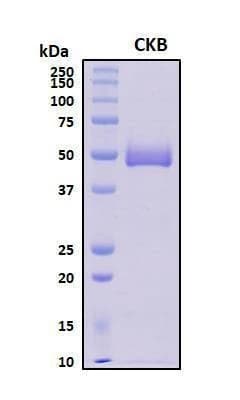
Recombinant Human Creatine Kinase B (CKB) Protein, Transfected HEK293 Cell Culture Supernatant
$124.00
Introduction
Creatine Kinase (CK), also known as creatine phosphokinase (CPK), is an enzyme that catalyzes the reversible phosphorylation of creatine by ATP to form phosphocreatine and ADP. Phosphocreatine is the primary storage form of high-energy phosphate in muscle tissue. There are three different CK isoenzymes: CK-BB (CPK-1), which is primarily produced by the brain and lungs; CK-MB (CPK-2), which is primarily produced by heart muscle; and CK-MM (CPK-3), which is primarily produced by skeletal muscle.
Under normal circumstances, healthy individuals have very low levels of CK in their blood. Clinically, CK levels are often measured in emergency patients with chest pain and acute renal failure. An elevation of CK levels indicates muscle damage and has been linked to conditions such as injury, rhabdomyolysis, myocardial infarction, myositis, myocarditis, malignant hyperthermia and neuroleptic malignant syndrome. Conversely, lower levels may suggest alcoholic liver disease and rheumatoid arthritis.
The RayBio® Creatine Kinase Activity Assay Kit provides a rapid (5-minute), convenient method of detecting total creatine kinase activity in biological samples. The assay is based on enzyme-coupled reactions in which CK converts phosphocreatine and ADP to creatine and ATP, the generated ATP is used to phosphorylate glucose by hexokinase (HK) to generate glucose-6-phosphate, which is then oxidized by NADP in the presence of glucose-6-phosphate dehydrogenase. The resulting NADPH is proportional to the CK activity in the sample and is measured at 340 nm.
Kit Components
| Component | Size / Description |
|---|---|
| Microplate (Item A) | One 96-well (12 strips x 8 wells) plate |
| Enzyme Solution | 20 mL |
| Buffer Solution | 4 mL |
| Sample Buffer | 10 mL |
| Creatine Kinase Positive Control | 20 µl |
Additional Materials Required
- Microplate reader capable of measuring absorbance at 340 nm at 37°C
- 1:1 (v/v) ethanol:ethyl acetate
- Precision pipettes to deliver 2 µl to 1 ml volumes
- Distilled or deionized water
- Tubes to prepare sample dilutions
Assay Procedure Summary
- Prepare Reaction Solution according to Section VI Reagent Preparation, Step A
- Prepare Positive Control according to Section VI Reagent Preparation, Step B
- Pipette 200ul of Reaction Solution into the appropriate wells of the 96-well plate and incubate at 37°C for five minutes. (samples, blanks, and positive controls are recommended to be run in duplicate)
- Transfer 10ul of Sample, Blank (deionized water), and Positive Control to each well filled with Reaction Solution, mix and incubate at 37°C for two minutes.
- After two minutes, read and record the absorbance (A1) at 340nm 37°C. Repeat readings every minute for the next two minutes at 37°C (A2, A3).
Storage
The entire kit may be stored at -20°C for up to 6 months from the date of shipment. Avoid repeated freeze-thaw cycles.
documents
citations
Targeting cellular senescence in dystrophin-/-/utrophin-/-double knockout mice improves musculoskeletal health and increases lifespan
- Species:
- Mouse
- Sample Type:
- Serum (mdx mice, ruxolitinib vs vehicle)
- Year:
- 2025
- Journal Name:
- Pharmacological Research
- PubMed ID:
- 41173171
Influence of ApoE genotype on doxorubicin-induced cognitive impairment in juvenile rats
- Species:
- Rat
- Sample Type:
- Serum
- Year:
- 2025
- Journal Name:
- Scientific Reports
- PubMed ID:
- 41436539