

Cyclin D1 (AP)

Cat# MBS6122201-0,1mL
Size : 0.1mL
Brand : MyBiosource
Contact local distributor :

Phone : +1 850 650 7790
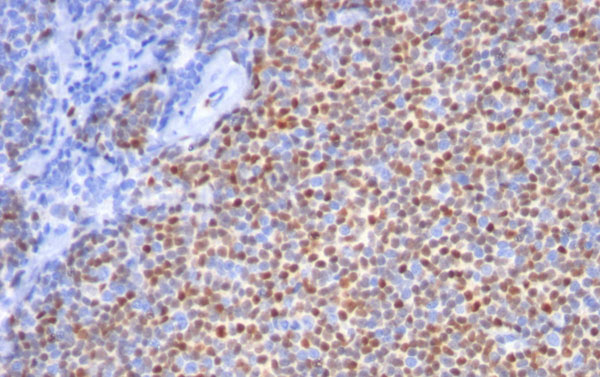
Immunohistochemistry of formalin-fixed, paraffin-embedded human mantle cell lymphoma stained with using peroxidase-conjugate and DAB chromogen. Note nuclear staining of tumor cells. Immunohistochemical staining of formalin/paraffin tissues is enhanced by unmasking of the target epitope by boiling the tissue sections in 10mM citrate buffer, pH 6.0, for 10min followed by cooling at room temp for 20min.
Cyclin D1 (CCND1) Antibody – Mouse Monoclonal
For Research Use Only. Not for use in diagnostic procedures. Catalog #: MBS6122201MBS6122201 is an antibody targeting CCND1. Also known as Cyclin D1 (AP). Reactive in Human, Monkey, Mouse, Rat. Host: Mouse. More details
Product Overview
Online Datasheet in PDFProduct Name
Cyclin D1 (CCND1), Monoclonal Antibody
Full Product Name
Cyclin D1 (AP)
Product Gene Name
anti-CCND1 antibody
Clonality
Monoclonal
Isotype
IgG2a,k
Clone Number
DCS-6
Host
Mouse
Species Reactivity
Human, Monkey, Mouse, Rat
Form/Format
Supplied as a liquid in 10mM PBS. No preservative added. BSA-Free. Labeled with Alkaline Phosphatase (AP).
Purity/Purification
Purified by Protein A/G Affinity Chromatography.
Specificity
Recognizes human cyclin D1. Species Crossreactivity: monkey, mouse and rat.
Preparation and Storage
May be stored at 4 degree C before opening. DO NOT FREEZE! Stable at 4 degree C as an undiluted liquid. Dilute only prior to immediate use. Stable for 12 months after receipt. For maximum recovery of product, centrifuge the original vial after thawing and prior to removing the cap. Further dilutions can be made in assay buffer. Freezing alkaline phosphatase conjugates will result in a substantial loss of activity.
Molecular Weight
33,729 Da
OMIM
168461
Immunogen
Recombinant protein corresponding to full length human cyclin D1. SwissProt Accession #: P24385.
Conjugate
AP
Positive Control
T47D, ZR75, BT474, SKBR3, MCF-7, MDA-MB-453, HT29, Ramos, Jurkat or A431 cells.
Product Categories/Family for anti-CCND1 antibody
Antibodies; Cyclin
Applications Tested/Suitable for anti-CCND1 antibody
ELISA (EIA), Immunohistochemistry (IHC) Paraffin, Western Blot (WB)
Application Notes for anti-CCND1 antibody
IHC-P: Requires HIER using sodium citrate buffer pH6.0 prior to staining.
Applications are based on unconjugated antibody.
Applications are based on unconjugated antibody.
Immunohistochemistry (IHC) of anti-CCND1 antibody
Immunohistochemistry of formalin-fixed, paraffin-embedded human mantle cell lymphoma stained with using peroxidase-conjugate and DAB chromogen. Note nuclear staining of tumor cells. Immunohistochemical staining of formalin/paraffin tissues is enhanced by unmasking of the target epitope by boiling the tissue sections in 10mM citrate buffer, pH 6.0, for 10min followed by cooling at room temp for 20min.
Product References and Citations for anti-CCND1 antibody
1. Lukas J, et. al. Oncogene, 1994, 9(3):707-18. 2. Gillett C, et. al. Cancer Research, 1994, 54(7):1812-7. 3. Bartkova J, et. al. Journal of Pathology, 1994, 172(3):237-45.
Other Notes
Small volumes of anti-CCND1 antibody vial(s) may occasionally become entrapped in the seal of the product vial during shipment and storage. If necessary, briefly centrifuge the vial on a tabletop centrifuge to dislodge any liquid in the container`s cap. Certain products may require to ship with dry ice and additional dry ice fee may apply.
Additional Details
NCBI/Uniprot data below describe general gene information for CCND1. It may not necessarily be applicable to this product.
NCBI Official Full Name
G1/S-specific cyclin-D1
NCBI Official Synonym Full Names
cyclin D1
NCBI Official Symbol
CCND1
NCBI Official Synonym Symbols
BCL1; PRAD1; U21B31; D11S287E
UniProt Protein Name
G1/S-specific cyclin-D1
UniProt Synonym Protein Names
B-cell lymphoma 1 protein; BCL-1; BCL-1 oncogene; PRAD1 oncogene
Protein Family
G1/S-specific cyclin
UniProt Gene Name
CCND1
UniProt Synonym Gene Names
BCL1; PRAD1; BCL-1
UniProt Entry Name
CCND1_HUMAN
NCBI Protein Information
G1/S-specific cyclin-D1; B-cell CLL/lymphoma 1; B-cell lymphoma 1 protein; BCL-1 oncogene; PRAD1 oncogene
UniProt Comments for CCND1
CCND1: a member of the highly conserved cyclin family, whose members are characterized by a dramatic periodicity in protein abundance through the cell cycle. Cyclins function as regulators of CDK kinases. Forms a complex with and functions as a regulatory subunit of CDK4 or CDK6, whose activity is required for cell cycle G1/S transition. This protein has been shown to interact with tumor suppressor protein Rb and the expression of this gene is regulated positively by Rb.
Protein type: Cell cycle regulation; Nuclear receptor co-regulator; Activator; Oncoprotein
Chromosomal Location of Human Ortholog: 11q13
Cellular Component: nucleoplasm; tight junction; membrane; transcriptional repressor complex; cyclin-dependent protein kinase holoenzyme complex; intracellular; nucleus; cytosol
Molecular Function: protein binding; enzyme binding; histone deacetylase binding; protein complex binding; cyclin-dependent protein kinase regulator activity; transcription corepressor activity; protein kinase binding; transcription factor binding; protein kinase activity
Biological Process: lactation; G1 DNA damage checkpoint; fat cell differentiation; establishment and/or maintenance of chromatin architecture; re-entry into mitotic cell cycle; positive regulation of cyclin-dependent protein kinase activity; negative regulation of Wnt receptor signaling pathway; positive regulation of mammary gland epithelial cell proliferation; negative regulation of epithelial cell differentiation; negative regulation of transcription from RNA polymerase II promoter; Wnt receptor signaling pathway through beta-catenin; protein amino acid phosphorylation; response to magnesium ion; response to vitamin E; Leydig cell differentiation; response to iron ion; response to X-ray; response to corticosterone stimulus; response to drug; Notch signaling pathway; organ regeneration; transcription, DNA-dependent; unfolded protein response; mammary gland epithelial cell proliferation; response to organic nitrogen; liver development; response to ethanol; cell division; response to estrogen stimulus; mitotic cell cycle; positive regulation of protein amino acid phosphorylation; response to calcium ion; response to DNA damage stimulus; G1/S transition of mitotic cell cycle
Disease: Von Hippel-lindau Syndrome; Myeloma, Multiple
Show more Protein type: Cell cycle regulation; Nuclear receptor co-regulator; Activator; Oncoprotein
Chromosomal Location of Human Ortholog: 11q13
Cellular Component: nucleoplasm; tight junction; membrane; transcriptional repressor complex; cyclin-dependent protein kinase holoenzyme complex; intracellular; nucleus; cytosol
Molecular Function: protein binding; enzyme binding; histone deacetylase binding; protein complex binding; cyclin-dependent protein kinase regulator activity; transcription corepressor activity; protein kinase binding; transcription factor binding; protein kinase activity
Biological Process: lactation; G1 DNA damage checkpoint; fat cell differentiation; establishment and/or maintenance of chromatin architecture; re-entry into mitotic cell cycle; positive regulation of cyclin-dependent protein kinase activity; negative regulation of Wnt receptor signaling pathway; positive regulation of mammary gland epithelial cell proliferation; negative regulation of epithelial cell differentiation; negative regulation of transcription from RNA polymerase II promoter; Wnt receptor signaling pathway through beta-catenin; protein amino acid phosphorylation; response to magnesium ion; response to vitamin E; Leydig cell differentiation; response to iron ion; response to X-ray; response to corticosterone stimulus; response to drug; Notch signaling pathway; organ regeneration; transcription, DNA-dependent; unfolded protein response; mammary gland epithelial cell proliferation; response to organic nitrogen; liver development; response to ethanol; cell division; response to estrogen stimulus; mitotic cell cycle; positive regulation of protein amino acid phosphorylation; response to calcium ion; response to DNA damage stimulus; G1/S transition of mitotic cell cycle
Disease: Von Hippel-lindau Syndrome; Myeloma, Multiple
Precautions
All of MyBioSource's Products are for scientific laboratory research purposes and are not for diagnostic, therapeutics, prophylactic or in vivo use. Through your purchase, you expressly represent and warrant to MyBioSource that you will properly test and use any Products purchased from MyBioSource in accordance with industry standards. MyBioSource and its authorized distributors reserve the right to refuse to process any order where we reasonably believe that the intended use will fall outside of our acceptable guidelines.
Disclaimer
While every efforts were made to ensure the accuracy of the information provided in this datasheet, MyBioSource will not be liable for any omissions or errors contained herein. MyBioSource reserves the right to make changes to this datasheet at any time without prior notice.
It is the responsibility of the customer to report product performance issues to MyBioSource within 30 days of receipt of the product. Please visit our Terms & Conditions page for more information.
It is the responsibility of the customer to report product performance issues to MyBioSource within 30 days of receipt of the product. Please visit our Terms & Conditions page for more information.
Product Note
Select online data sheet information is drawn from bioinformatics databases, occasionally resulting in ambiguous or non-relevant product information. It is the responsibility of the customer to review, verify, and evaluate the information to make sure it matches their requirements before purchasing the kit. Our ELISA Kit assays are dynamic research tools and sometimes they may be updated and improved. If the format of this assay is important to you then please request the current manual or contact our technical support team with a presales inquiry before placing an order. We will confirm the current details of the assay. We cannot guarantee the sample manual posted online is the most current manual, it is intended to serve as an example only. Please refer to the instructions For Use provided with the assay kit for precise details.
Product PubMed Publications
Products associated with anti-CCND1 antibody
| Reference Product | PubMed Publications |
|---|---|
| CDK4 antibody | >1807 publications with CCND1 and CDK4 |
| CDKN1A antibody | >1289 publications with CCND1 and CDKN1A |
| CTNNB1 antibody | >1196 publications with CCND1 and CTNNB1 |
| CDKN1B antibody | >1017 publications with CCND1 and CDKN1B |
| PCNA antibody | >797 publications with CCND1 and PCNA |
| CDK6 antibody | >464 publications with CCND1 and CDK6 |
| STAT3 antibody | >394 publications with CCND1 and STAT3 |
| SP1 antibody | >89 publications with CCND1 and SP1 |
| RB1 antibody | >86 publications with CCND1 and RB1 |
| RELA antibody | >82 publications with CCND1 and RELA |
Pathways associated with anti-CCND1 antibody
| Products by Pathway | Pathway Diagram |
|---|---|
| AMPK Signaling Pathway antibodies | AMPK Signaling Pathway Diagram |
| AMPK Signaling Pathway antibodies | AMPK Signaling Pathway Diagram |
| ATF-2 Transcription Factor Network Pathway antibodies | ATF-2 Transcription Factor Network Pathway Diagram |
| Acute Myeloid Leukemia Pathway antibodies | Acute Myeloid Leukemia Pathway Diagram |
| Acute Myeloid Leukemia Pathway antibodies | Acute Myeloid Leukemia Pathway Diagram |
| Androgen Receptor Signaling Pathway antibodies | Androgen Receptor Signaling Pathway Diagram |
| Bladder Cancer Pathway antibodies | Bladder Cancer Pathway Diagram |
| Bladder Cancer Pathway antibodies | Bladder Cancer Pathway Diagram |
| C-MYB Transcription Factor Network Pathway antibodies | C-MYB Transcription Factor Network Pathway Diagram |
| Cell Cycle Pathway antibodies | Cell Cycle Pathway Diagram |
Diseases associated with anti-CCND1 antibody
| Disease Name | Pubmed Publications |
|---|---|
| Neoplasms Antibodies | >8174 publications with CCND1 and Neoplasms |
| Carcinoma Antibodies | >3393 publications with CCND1 and Carcinoma |
| Breast Neoplasms Antibodies | >1520 publications with CCND1 and Breast Neoplasms |
| Neoplasms, Experimental Antibodies | >786 publications with CCND1 and Neoplasms, Experimental |
| Cell Transformation, Neoplastic Antibodies | >763 publications with CCND1 and Cell Transformation, Neoplastic |
| Colorectal Neoplasms Antibodies | >680 publications with CCND1 and Colorectal Neoplasms |
| Leukemia Antibodies | >662 publications with CCND1 and Leukemia |
| Liver Diseases Antibodies | >553 publications with CCND1 and Liver Diseases |
| Liver Neoplasms Antibodies | >532 publications with CCND1 and Liver Neoplasms |
| Lung Neoplasms Antibodies | >531 publications with CCND1 and Lung Neoplasms |
Organs/Tissues associated with anti-CCND1 antibody
| Organ/Tissue Name | Pubmed Publications |
|---|---|
| Blood Antibodies | >1075 publications with CCND1 and Blood |
| Liver Antibodies | >975 publications with CCND1 and Liver |
| Vascular Antibodies | >861 publications with CCND1 and Vascular |
| Lung Antibodies | >821 publications with CCND1 and Lung |
| Muscle Antibodies | >739 publications with CCND1 and Muscle |
| Bone Antibodies | >631 publications with CCND1 and Bone |
| Lymph Node Antibodies | >551 publications with CCND1 and Lymph Node |
| Lymph Antibodies | >545 publications with CCND1 and Lymph |
| Brain Antibodies | >536 publications with CCND1 and Brain |
| Prostate Antibodies | >525 publications with CCND1 and Prostate |