DNMT1 ELISA Kit (Mouse)

Cat# OKEH06944
Size : 96Wells
Brand : Aviva Systems Biology
Contact local distributor :

Phone : +1 850 650 7790
DNMT1 ELISA Kit (Mouse) (OKEH06944)
| Datasheets/Manuals | Printable datasheet for DNMT1 ELISA Kit (Mouse) (OKEH06944) |
|---|
| Predicted Species Reactivity | Mouse|Mus musculus | ||||||||||||||||||||||
|---|---|---|---|---|---|---|---|---|---|---|---|---|---|---|---|---|---|---|---|---|---|---|---|
| Application | ELISA-Sandwich | ||||||||||||||||||||||
| ELISA Kit Detection Method | Colorimetric, OD 450 nm | ||||||||||||||||||||||
| ELISA Kit Duration | ~3 Hours | ||||||||||||||||||||||
| ELISA Kit Principle | Aviva Systems Biology Dnmt1 ELISA Kit (Mouse) (OKEH06944) is based on standard sandwich enzyme-linked immuno-sorbent assay technology. An antibody specific for Dnmt1 has been pre-coated onto a 96-well plate (12 x 8 Well Strips) and blocked. Standards or test samples are added to the wells, incubated and removed. A biotinylated detector antibody specific for Dnmt1 is added, incubated and followed by washing. Avidin-Peroxidase Conjugate is then added, incubated and unbound conjugate is washed away. An enzymatic reaction is produced through the addition of TMB substrate which is catalyzed by HRP generating a blue color product that changes to yellow after adding acidic stop solution. The density of yellow coloration read by absorbance at 450 nm is quantitatively proportional to the amount of sample Dnmt1 captured in the well. | ||||||||||||||||||||||
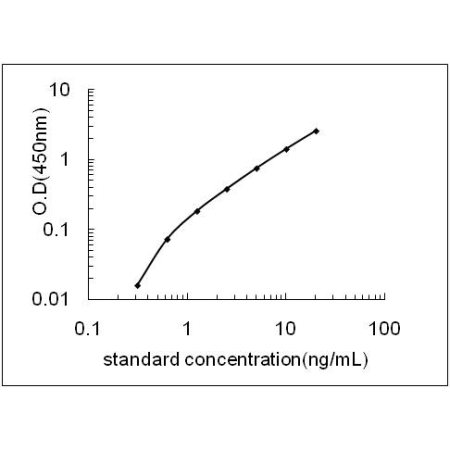
| ELISA Kit Range | 0.312-20ng/mL | ||||||||||||||||||||||
| ELISA Kit Recovery | Mean recovery when spiking into matrix = 92% | ||||||||||||||||||||||
| ELISA Kit Reproducibility | Intra-assay reproducibility was evaluated with 20 replicates of 3 samples representing low, middle and high level LIPC. Inter-assay reproducibility was evaluated with 3 samples representing low, middle and high level LIPC using 8 replicates on each of 3 plates. Intra-Assay CV <6.9% Inter-Assay CV <9.0% | ||||||||||||||||||||||
| ELISA Kit Component |
| ||||||||||||||||||||||
| Reconstitution and Storage | Store as indicated in product manual. | ||||||||||||||||||||||
| Sample Type | Serum, Plasma, Tissue Homogenates | ||||||||||||||||||||||
| Sensitivity | 0.165 ng/mL | ||||||||||||||||||||||
| Specificity | Natural and recombinant Mouse DNA (cytosine-5)-methyltransferase 1 | ||||||||||||||||||||||
| Assay Info | Assay Methodology: Quantitative Sandwich ELISA |
| Gene Symbol | Dnmt1 |
|---|---|
| Gene Full Name | DNA methyltransferase (cytosine-5) 1 |
| Alias Symbols | Cxxc9, DNA (cytosine-5)-methyltransferase 1, DNA methyltransferase MmuI, DNA MTase MmuI, Dnmt, Dnmt1o, m.MmuI, MCMT, Met-1, Met1, MommeD, MommeD2, MTa, MTase. |
| NCBI Gene Id | 13433 |
| Protein Name | DNA (cytosine-5)-methyltransferase 1 |
| Description of Target | Methylates CpG residues. Preferentially methylates hemimethylated DNA. Associates with DNA replication sites in S phase maintaining the methylation pattern in the newly synthesized strand, that is essential for epigenetic inheritance. Associates with chromatin during G2 and M phases to maintain DNA methylation independently of replication. It is responsible for maintaining methylation patterns established in development. DNA methylation is coordinated with methylation of histones. Mediates transcriptional repression by direct binding to HDAC2. In association with DNMT3B and via the recruitment of CTCFL/BORIS, involved in activation of BAG1 gene expression by modulating dimethylation of promoter histone H3 at H3K4 and H3K9. Probably forms a corepressor complex required for activated KRAS-mediated promoter hypermethylation and transcriptional silencing of tumor suppressor genes (TSGs) or other tumor-related genes in colorectal cancer (CRC) cells (By similarity). Also required to maintain a transcriptionally repressive state of genes in undifferentiated embryonic stem cells (ESCs) (By similarity). Associates at promoter regions of tumor suppressor genes (TSGs) leading to their gene silencing (By similarity). Promotes tumor growth (By similarity). |
| Uniprot ID | P13864 |
| Protein Accession # | NP_001186360 |
| Nucleotide Accession # | NM_001199431 |