

Epidermal Growth Factor Receptor, phosphorylated (Tyr1068) Blocking Peptide (erbB, EGFR),

Cat# MBS658816-0,1mg
Size : 0.1mg
Brand : MyBiosource
Contact local distributor :

Phone : +1 850 650 7790
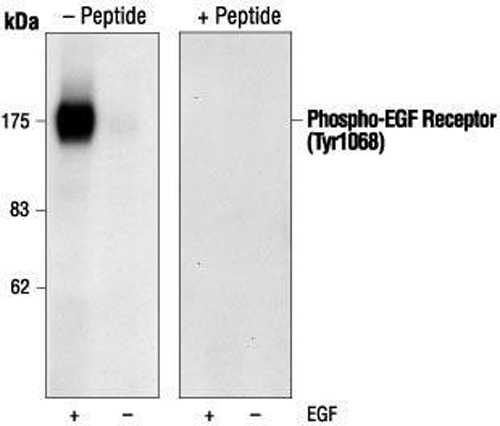
Western blot analysis of EGF stimulated and unstimulated A431 cell lysates, using Phospho-EGF Receptor (Tyr1068) Antibody (left) and the same antibody pretreated with specific phospho-peptide (right).
Epidermal Growth Factor Receptor, Phosphorylated (Tyr1068) Blocking Peptide (Erbb, EGFR) Peptide – Synthetic Peptide, PurifiedPurified Purity
For Research Use Only. Not for use in diagnostic procedures. Catalog #: MBS658816Epidermal growth factor (EGF) receptor is a 170kD single-pass transmembrane tyrosine kinase. Ligand binding to this receptor results in receptor dimerization, autophosphorylation (in trans), activation of various downstream signaling molecules and lysosomal… More details
Product Overview
Online Datasheet in PDFProduct Name
Epidermal Growth Factor Receptor (EGFR), Peptide
Full Product Name
Epidermal Growth Factor Receptor, phosphorylated (Tyr1068) Blocking Peptide (erbB, EGFR)
Product Gene Name
EGFR peptide
Form/Format
Supplied as a lyophilized powder.
Purity/Purification
Purified
Purified
Purified
Specificity
This is a synthetic blocking peptide for the antibody E3375-53A centered around the phosphorylated Tyrosine 1068.
Preparation and Storage
Lyophilized powder may be stored at 4 degree C for short-term only. Reconstitute to nominal volume by adding sterile 40-50% glycerol and store at -20 degree C. Reconstituted product is stable for 12 months at -20 degree C. For maximum recovery of product, centrifuge the original vial after thawing and prior to removing the cap. Further dilutions can be made in assay buffer.
Molecular Weight
134,277 Da
Chromosome Location
Chromosome: 7; NC_000007.13 (55086678..55279262). Location: 7p12
OMIM
131550
Product Categories/Family for EGFR peptide
Molecular Biology; MB-Receptors
Applications Tested/Suitable for EGFR peptide
ELISA (EL/EIA), Western Blot (WB)
Application Notes for EGFR peptide
Suitable for use in ELISA, Western Blot or for antigen applications in immunological protocols.
Other Notes
Small volumes of EGFR peptide vial(s) may occasionally become entrapped in the seal of the product vial during shipment and storage. If necessary, briefly centrifuge the vial on a tabletop centrifuge to dislodge any liquid in the container`s cap. Certain products may require to ship with dry ice and additional dry ice fee may apply.
Searchable Terms for EGFR purchase
MBS658816 is a peptide targeting EGFR. Also known as Epidermal Growth Factor Receptor, phosphorylated (Tyr1068) Blocking Peptide (erbB, EGFR).
Additional Details
NCBI/Uniprot data below describe general gene information for EGFR. It may not necessarily be applicable to this product.
NCBI Official Full Name
epidermal growth factor receptor
NCBI Official Synonym Full Names
epidermal growth factor receptor
NCBI Official Symbol
EGFR
NCBI Official Synonym Symbols
ERBB; HER1; mENA; ERBB1; PIG61
UniProt Protein Name
Epidermal growth factor receptor
UniProt Synonym Protein Names
Proto-oncogene c-ErbB-1; Receptor tyrosine-protein kinase erbB-1
Protein Family
Epidermal growth factor receptor
UniProt Gene Name
EGFR
UniProt Synonym Gene Names
ERBB; ERBB1; HER1
UniProt Entry Name
EGFR_HUMAN
NCBI Protein Information
epidermal growth factor receptor; proto-oncogene c-ErbB-1; cell growth inhibiting protein 40; cell proliferation-inducing protein 61; receptor tyrosine-protein kinase erbB-1; avian erythroblastic leukemia viral (v-erb-b) oncogene homolog
NCBI Summary for EGFR
The protein encoded by this gene is a transmembrane glycoprotein that is a member of the protein kinase superfamily. This protein is a receptor for members of the epidermal growth factor family. EGFR is a cell surface protein that binds to epidermal growth factor. Binding of the protein to a ligand induces receptor dimerization and tyrosine autophosphorylation and leads to cell proliferation. Mutations in this gene are associated with lung cancer. Multiple alternatively spliced transcript variants that encode different protein isoforms have been found for this gene. [provided by RefSeq, Jul 2010]
Show more UniProt Comments for EGFR
Function: Receptor tyrosine kinase binding ligands of the EGF family and activating several signaling cascades to convert extracellular cues into appropriate cellular responses. Known ligands include EGF, TGFA/TGF-alpha, amphiregulin, epigen/EPGN, BTC/betacellulin, epiregulin/EREG and HBEGF/heparin-binding EGF. Ligand binding triggers receptor homo- and/or heterodimerization and autophosphorylation on key cytoplasmic residues. The phosphorylated receptor recruits adapter proteins like GRB2 which in turn activates complex downstream signaling cascades. Activates at least 4 major downstream signaling cascades including the RAS-RAF-MEK-ERK, PI3 kinase-AKT, PLCgamma-PKC and STATs modules. May also activate the NF-kappa-B signaling cascade. Also directly phosphorylates other proteins like RGS16, activating its GTPase activity and probably coupling the EGF receptor signaling to the G protein-coupled receptor signaling. Also phosphorylates MUC1 and increases its interaction with SRC and CTNNB1/beta-catenin. Ref.29 Ref.36 Ref.37 Ref.39 Ref.40 Ref.41 Ref.47 Ref.64 Ref.68 Ref.69 Ref.70 Ref.77 Ref.79Isoform 2 may act as an antagonist of EGF action. Ref.29 Ref.36 Ref.37 Ref.39 Ref.40 Ref.41 Ref.47 Ref.64 Ref.68 Ref.69 Ref.70 Ref.77 Ref.79
Catalytic activity: ATP + a [protein]-L-tyrosine = ADP + a [protein]-L-tyrosine phosphate. Ref.70 Ref.73 Ref.74 Ref.75 Ref.76 Ref.77
Enzyme regulation: Endocytosis and inhibition of the activated EGFR by phosphatases like PTPRJ and PTPRK constitute immediate regulatory mechanisms. Upon EGF-binding phosphorylates EPS15 that regulates EGFR endocytosis and activity. Moreover, inducible feedback inhibitors including LRIG1, SOCS4, SOCS5 and ERRFI1 constitute alternative regulatory mechanisms for the EGFR signaling. Ref.38 Ref.42 Ref.56 Ref.74
Subunit structure: Binding of the ligand triggers homo- and/or heterodimerization of the receptor triggering its autophosphorylation. Heterodimer with ERBB2. Interacts with ERRFI1; inhibits dimerization of the kinase domain and autophosphorylation. Part of a complex with ERBB2 and either PIK3C2A or PIK3C2B. Interacts with GRB2; an adapter protein coupling the receptor to downstream signaling pathways. Interacts with GAB2; involved in signaling downstream of EGFR. Interacts with STAT3; mediates EGFR downstream signaling in cell proliferation. Interacts with RIPK1; involved in NF-kappa-B activation. Interacts (autophosphorylated) with CBL; involved in EGFR ubiquitination and regulation. Interacts with SOCS5; regulates EGFR degradation through TCEB1- and TCEB2-mediated ubiquitination and proteasomal degradation. Interacts with PRMT5; methylates EGFR and enhances interaction with PTPN6. Interacts (phosphorylated) with PTPN6; inhibits EGFR-dependent activation of MAPK/ERK. Interacts with COPG1; essential for regulation of EGF-dependent nuclear transport of EGFR by retrograde trafficking from the Golgi to the ER. Interacts with TNK2; this interaction is dependent on EGF stimulation and kinase activity of EGFR. Interacts with PCNA; positively regulates PCNA. Interacts with PELP1. Interacts with MUC1. Interacts with AP2M1. Interacts with FER. May interact with EPS8; mediates EPS8 phosphorylation. Interacts (via SH2 domains) with GRB2, NCK1 and NCK2. Interacts with ATX2. Interacts with GAREM. Interacts (ubiquitinated) with ANKRD13A/B/D; the interaction is direct and may regulate EGFR internalization after EGF stimulation. Ref.29 Ref.33 Ref.34 Ref.37 Ref.38 Ref.39 Ref.40 Ref.41 Ref.42 Ref.45 Ref.47 Ref.49 Ref.50 Ref.51 Ref.56 Ref.57 Ref.60 Ref.64 Ref.65 Ref.66 Ref.68 Ref.69 Ref.74 Ref.76 Ref.77 Ref.78 Ref.79
Subcellular location: Cell membrane; Single-pass type I membrane protein. Endoplasmic reticulum membrane; Single-pass type I membrane protein. Golgi apparatus membrane; Single-pass type I membrane protein. Nucleus membrane; Single-pass type I membrane protein. Endosome. Endosome membrane. Note: In response to EGF, translocated from the cell membrane to the nucleus via Golgi and ER. Endocytosed upon activation by ligand. Ref.47 Ref.49 Ref.56 Ref.60 Ref.66 Ref.68 Ref.77Isoform 2: Secreted Ref.47 Ref.49 Ref.56 Ref.60 Ref.66 Ref.68 Ref.77.
Tissue specificity: Ubiquitously expressed. Isoform 2 is also expressed in ovarian cancers. Ref.48
Post-translational modification: Phosphorylation at Ser-695 is partial and occurs only if Thr-693 is phosphorylated. Phosphorylation at Thr-678 and Thr-693 by PRKD1 inhibits EGF-induced MAPK8/JNK1 activation. Dephosphorylation by PTPRJ prevents endocytosis and stabilizes the receptor at the plasma membrane. Autophosphorylation at Tyr-1197 is stimulated by methylation at Arg-1199 and enhances interaction with PTPN6. Autophosphorylation at Tyr-1092 and/or Tyr-1110 recruits STAT3. Dephosphorylated by PTPN1 and PTPN2. Ref.17 Ref.25 Ref.27 Ref.32 Ref.37 Ref.44 Ref.56 Ref.63 Ref.65 Ref.73 Ref.74 Ref.76 Ref.77Monoubiquitinated and polyubiquitinated upon EGF stimulation; which does not affect tyrosine kinase activity or signaling capacity but may play a role in lysosomal targeting. Polyubiquitin linkage is mainly through 'Lys-63', but linkage through 'Lys-48', 'Lys-11' and 'Lys-29' also occurs. Deubiquitination by OTUD7B prevents degradation.Methylated. Methylation at Arg-1199 by PRMT5 stimulates phosphorylation at Tyr-1197. Ref.64
Involvement in disease: Lung cancer (LNCR) [MIM:211980]: A common malignancy affecting tissues of the lung. The most common form of lung cancer is non-small cell lung cancer (NSCLC) that can be divided into 3 major histologic subtypes: squamous cell carcinoma, adenocarcinoma, and large cell lung cancer. NSCLC is often diagnosed at an advanced stage and has a poor prognosis.Note: The gene represented in this entry is involved in disease pathogenesis.
Sequence similarities: Belongs to the protein kinase superfamily. Tyr protein kinase family. EGF receptor subfamily.Contains 1 protein kinase domain.
Show more Catalytic activity: ATP + a [protein]-L-tyrosine = ADP + a [protein]-L-tyrosine phosphate. Ref.70 Ref.73 Ref.74 Ref.75 Ref.76 Ref.77
Enzyme regulation: Endocytosis and inhibition of the activated EGFR by phosphatases like PTPRJ and PTPRK constitute immediate regulatory mechanisms. Upon EGF-binding phosphorylates EPS15 that regulates EGFR endocytosis and activity. Moreover, inducible feedback inhibitors including LRIG1, SOCS4, SOCS5 and ERRFI1 constitute alternative regulatory mechanisms for the EGFR signaling. Ref.38 Ref.42 Ref.56 Ref.74
Subunit structure: Binding of the ligand triggers homo- and/or heterodimerization of the receptor triggering its autophosphorylation. Heterodimer with ERBB2. Interacts with ERRFI1; inhibits dimerization of the kinase domain and autophosphorylation. Part of a complex with ERBB2 and either PIK3C2A or PIK3C2B. Interacts with GRB2; an adapter protein coupling the receptor to downstream signaling pathways. Interacts with GAB2; involved in signaling downstream of EGFR. Interacts with STAT3; mediates EGFR downstream signaling in cell proliferation. Interacts with RIPK1; involved in NF-kappa-B activation. Interacts (autophosphorylated) with CBL; involved in EGFR ubiquitination and regulation. Interacts with SOCS5; regulates EGFR degradation through TCEB1- and TCEB2-mediated ubiquitination and proteasomal degradation. Interacts with PRMT5; methylates EGFR and enhances interaction with PTPN6. Interacts (phosphorylated) with PTPN6; inhibits EGFR-dependent activation of MAPK/ERK. Interacts with COPG1; essential for regulation of EGF-dependent nuclear transport of EGFR by retrograde trafficking from the Golgi to the ER. Interacts with TNK2; this interaction is dependent on EGF stimulation and kinase activity of EGFR. Interacts with PCNA; positively regulates PCNA. Interacts with PELP1. Interacts with MUC1. Interacts with AP2M1. Interacts with FER. May interact with EPS8; mediates EPS8 phosphorylation. Interacts (via SH2 domains) with GRB2, NCK1 and NCK2. Interacts with ATX2. Interacts with GAREM. Interacts (ubiquitinated) with ANKRD13A/B/D; the interaction is direct and may regulate EGFR internalization after EGF stimulation. Ref.29 Ref.33 Ref.34 Ref.37 Ref.38 Ref.39 Ref.40 Ref.41 Ref.42 Ref.45 Ref.47 Ref.49 Ref.50 Ref.51 Ref.56 Ref.57 Ref.60 Ref.64 Ref.65 Ref.66 Ref.68 Ref.69 Ref.74 Ref.76 Ref.77 Ref.78 Ref.79
Subcellular location: Cell membrane; Single-pass type I membrane protein. Endoplasmic reticulum membrane; Single-pass type I membrane protein. Golgi apparatus membrane; Single-pass type I membrane protein. Nucleus membrane; Single-pass type I membrane protein. Endosome. Endosome membrane. Note: In response to EGF, translocated from the cell membrane to the nucleus via Golgi and ER. Endocytosed upon activation by ligand. Ref.47 Ref.49 Ref.56 Ref.60 Ref.66 Ref.68 Ref.77Isoform 2: Secreted Ref.47 Ref.49 Ref.56 Ref.60 Ref.66 Ref.68 Ref.77.
Tissue specificity: Ubiquitously expressed. Isoform 2 is also expressed in ovarian cancers. Ref.48
Post-translational modification: Phosphorylation at Ser-695 is partial and occurs only if Thr-693 is phosphorylated. Phosphorylation at Thr-678 and Thr-693 by PRKD1 inhibits EGF-induced MAPK8/JNK1 activation. Dephosphorylation by PTPRJ prevents endocytosis and stabilizes the receptor at the plasma membrane. Autophosphorylation at Tyr-1197 is stimulated by methylation at Arg-1199 and enhances interaction with PTPN6. Autophosphorylation at Tyr-1092 and/or Tyr-1110 recruits STAT3. Dephosphorylated by PTPN1 and PTPN2. Ref.17 Ref.25 Ref.27 Ref.32 Ref.37 Ref.44 Ref.56 Ref.63 Ref.65 Ref.73 Ref.74 Ref.76 Ref.77Monoubiquitinated and polyubiquitinated upon EGF stimulation; which does not affect tyrosine kinase activity or signaling capacity but may play a role in lysosomal targeting. Polyubiquitin linkage is mainly through 'Lys-63', but linkage through 'Lys-48', 'Lys-11' and 'Lys-29' also occurs. Deubiquitination by OTUD7B prevents degradation.Methylated. Methylation at Arg-1199 by PRMT5 stimulates phosphorylation at Tyr-1197. Ref.64
Involvement in disease: Lung cancer (LNCR) [MIM:211980]: A common malignancy affecting tissues of the lung. The most common form of lung cancer is non-small cell lung cancer (NSCLC) that can be divided into 3 major histologic subtypes: squamous cell carcinoma, adenocarcinoma, and large cell lung cancer. NSCLC is often diagnosed at an advanced stage and has a poor prognosis.Note: The gene represented in this entry is involved in disease pathogenesis.
Sequence similarities: Belongs to the protein kinase superfamily. Tyr protein kinase family. EGF receptor subfamily.Contains 1 protein kinase domain.
Precautions
All of MyBioSource's Products are for scientific laboratory research purposes and are not for diagnostic, therapeutics, prophylactic or in vivo use. Through your purchase, you expressly represent and warrant to MyBioSource that you will properly test and use any Products purchased from MyBioSource in accordance with industry standards. MyBioSource and its authorized distributors reserve the right to refuse to process any order where we reasonably believe that the intended use will fall outside of our acceptable guidelines.
Disclaimer
While every efforts were made to ensure the accuracy of the information provided in this datasheet, MyBioSource will not be liable for any omissions or errors contained herein. MyBioSource reserves the right to make changes to this datasheet at any time without prior notice.
It is the responsibility of the customer to report product performance issues to MyBioSource within 30 days of receipt of the product. Please visit our Terms & Conditions page for more information.
It is the responsibility of the customer to report product performance issues to MyBioSource within 30 days of receipt of the product. Please visit our Terms & Conditions page for more information.
Product Note
Select online data sheet information is drawn from bioinformatics databases, occasionally resulting in ambiguous or non-relevant product information. It is the responsibility of the customer to review, verify, and evaluate the information to make sure it matches their requirements before purchasing the kit. Our ELISA Kit assays are dynamic research tools and sometimes they may be updated and improved. If the format of this assay is important to you then please request the current manual or contact our technical support team with a presales inquiry before placing an order. We will confirm the current details of the assay. We cannot guarantee the sample manual posted online is the most current manual, it is intended to serve as an example only. Please refer to the instructions For Use provided with the assay kit for precise details.
Product PubMed Publications
Pathways associated with EGFR peptide
| Products by Pathway | Pathway Diagram |
|---|---|
| AGE/RAGE Pathway antibodies | AGE/RAGE Pathway Diagram |
| Adaptive Immune System Pathway antibodies | Adaptive Immune System Pathway Diagram |
| Adherens Junction Pathway antibodies | Adherens Junction Pathway Diagram |
| Adherens Junction Pathway antibodies | Adherens Junction Pathway Diagram |
| AhR Pathway antibodies | AhR Pathway Diagram |
| Alpha6-Beta4 Integrin Signaling Pathway antibodies | Alpha6-Beta4 Integrin Signaling Pathway Diagram |
| Androgen Receptor Signaling Pathway antibodies | Androgen Receptor Signaling Pathway Diagram |
| Arf6 Signaling Events Pathway antibodies | Arf6 Signaling Events Pathway Diagram |
| Axon Guidance Pathway antibodies | Axon Guidance Pathway Diagram |
| Bladder Cancer Pathway antibodies | Bladder Cancer Pathway Diagram |
Diseases associated with EGFR peptide
| Disease Name | Pubmed Publications |
|---|---|
| Neoplasms Antibodies | >13708 publications with EGFR and Neoplasms |
| Carcinoma Antibodies | >7768 publications with EGFR and Carcinoma |
| Lung Neoplasms Antibodies | >4087 publications with EGFR and Lung Neoplasms |
| Adenocarcinoma Antibodies | >3117 publications with EGFR and Adenocarcinoma |
| Kidney Diseases Antibodies | >2875 publications with EGFR and Kidney Diseases |
| Small Cell Lung Carcinoma Antibodies | >2763 publications with EGFR and Small Cell Lung Carcinoma |
| Carcinoma, Non-Small-Cell Lung Antibodies | >2730 publications with EGFR and Carcinoma, Non-Small-Cell Lung |
| Breast Neoplasms Antibodies | >2290 publications with EGFR and Breast Neoplasms |
| Disease Progression Antibodies | >2287 publications with EGFR and Disease Progression |
| Carcinoma, Squamous Cell Antibodies | >2135 publications with EGFR and Carcinoma, Squamous Cell |
Organs/Tissues associated with EGFR peptide
| Organ/Tissue Name | Pubmed Publications |
|---|---|
| Lung Antibodies | >5484 publications with EGFR and Lung |
| Kidney Antibodies | >3994 publications with EGFR and Kidney |
| Vascular Antibodies | >2081 publications with EGFR and Vascular |
| Brain Antibodies | >1686 publications with EGFR and Brain |
| Skin Antibodies | >1024 publications with EGFR and Skin |
| Liver Antibodies | >1007 publications with EGFR and Liver |
| Heart Antibodies | >873 publications with EGFR and Heart |
| Muscle Antibodies | >589 publications with EGFR and Muscle |
| Prostate Antibodies | >588 publications with EGFR and Prostate |
| Stomach Antibodies | >415 publications with EGFR and Stomach |