FKBP51 Antibody

Cat# OASE00055
Size : 100ug
Brand : Aviva Systems Biology
Contact local distributor :

Phone : +1 850 650 7790
FKBP511 Antibody (OASE00055)
| Datasheets/Manuals | Printable datasheet for FKBP511 Antibody (OASE00055) |
|---|---|
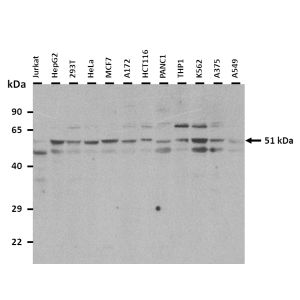
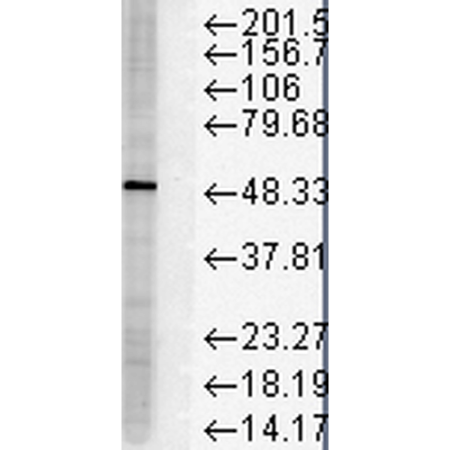
| COA Datasheet | A 1:2000 dilution was sufficient for detection of FKBP51 in ~50 µg total protein using WB analysis. |
| Predicted Species Reactivity | Dog|Hamster|Human|Mouse|Rabbit|Rat |
|---|---|
| Clonality | Monoclonal |
| Clone | Hi51B |
| Isotype | IgG1 |
| Host | Mouse |
| Conjugation | Unconjugated |
| Application | ICC,IF,WB |
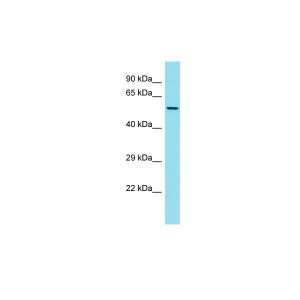
| Additional Information | Background Info: Detects an ~51kDa protein representing FKBP51 in cell lysate. Also detects FKBP51 in whole tissue extracts from rat kidney and rat and mouse testes. |
| :: | Scientific Background: Hsp90 is crucial to cellular signaling by its regulation of the folding, activity, and stability of a wide range of client proteins. These client protein complexes may also contain one or more cochaperones (1). One class of Hsp90-binding cochaperone is composed of proteins with a characteristic tetratricopeptide repeat (TPR) domain that forms an Hsp90 binding site. Among the TPR cochaperones of Hsp90 are Hop/Sti1, protein phosphatase PP5, and members of both the FK506- and cyclosporin A-binding families of immunophilins (2). FK506-binding protein 51 (FKBP51) and FKBP52 are large molecular weight immunophilins that are part of the mature glucocorticoid receptor (GR) heterocomplex (3). The N terminal domain of each protein binds FK506 and has peptidyl-prolyl isomerase (PPIase) activity that converts prolyl peptide bonds within target proteins from cis- to trans- proline. The C-terminal domains contain the TPR repeats involved in protein-protein interactions with the Hsp90 (4). Although FKBP52 and FKBP51 share ~75% sequence similarity, they affect hormone binding by glucocorticoid receptor in opposing manners and have different Hsp90-binding characteristics (3). FK506 binding protein 51 kDa (FKBP51 or otherwise referred to as FKBP54) has been identified as a progestininducible gene. This protein is predominantly expressed in murine T cells but in humans, it is abundantly expressed in numerous tissues at levels many times higher than FKBP12. The FKBP51 gene is known to be induced by glucocorticoids (5). |
| :: | Certificate of Analysis: A 1:2000 dilution was sufficient for detection of FKBP51 in ~50ug total protein using WB analysis. |
| Reconstitution and Storage | -20°C |
| Immunogen | Synthetic peptide corresponding to the residues of human FKBP51 |
| Purification | Protein G Purified |
| Concentration | 1 mg/ml |
| Specificity | Detects ~51kDa. |
| Dilution | WB (1:2000), ICC/IF (1:1000); optimal dilutions for assays should be determined by the user. |
| Storage Buffer | PBS, 50% glycerol, 0.09% sodium azide |
| Description | HSP90 is crucial to cellular signaling by its regulation of the folding, activity, and stability of a wide range of client proteins. These client protein complexes may also contain one or more cochaperones (1). One class of HSP90-binding cochaperone is composed of proteins with a characteristic tetratricopeptide repeat (TPR) domain that forms an HSP90 binding site. Among the TPR cochaperones of HSP90 are Hop/Sti1, protein phosphatase PP5, and members of both the FK506- and cyclosporin A-binding families of immunophilins (2). FK506-binding protein 51 (FKBP51) and FKBP52 are large molecular weight immunophilins that are part of the mature glucocorticoid receptor (GR) heterocomplex (3). The N terminal domain of each protein binds FK506 and has peptidyl-prolyl isomerase (PPIase) activity that converts prolyl peptide bonds within target proteins from cis- to trans- proline. The C-terminal domains contain the TPR repeats involved in protein-protein interactions with the HSP90 (4). Although FKBP52 and FKBP51 share ~75% sequence similarity, they affect hormone binding by glucocorticoid receptor in opposing manners and have different HSP90-binding characteristics (3). FK506 binding protein 51 kDa (FKBP51 or otherwise referred to as FKBP54) has been identified as a progestininducible gene. This protein is predominantly expressed in murine T cells but in humans, it is abundantly expressed in numerous tissues at levels many times higher than FKBP12. The FKBP51 gene is known to be induced by glucocorticoids (5). |
| Reference | 1. Cheung-Flynn J., Roberts P.J., Riggs D.L., and Smith D.F.(2003) J. Biol. Chem. 278(19): 17388-17394. 2. Davies T.H., Ning Y.N., and Sanchez E.R. (2002) J Biol. Chem. 277 (7): 4597-4600. 3. Wu B. et al. (2004) Proc. Natl. Acad. Sci. USA. 101(22): 8348-8353. 4. Denny W.B., Prapapanich V., Smith D.F., and Scammell J.G. (2005) Endocrinology 146(7): 3194-3201. 5. Hubler T.R. et al. (2003) Endocrinology 144(6): 2380- 2387. |
|---|---|
| Gene Symbol | FKBP5 |
| Gene Full Name | FKBP prolyl isomerase 5 |
| Alias Symbols | 51 kDa FK506-binding protein, 51 kDa FKBP, 54 kDa progesterone receptor-associated immunophilin, AIG6, androgen-regulated protein 6, FF1 antigen, FK506 binding protein 5, FK506-binding protein 5, FKBP-51, FKBP51, FKBP54, HSP90-binding immunophilin, P54, peptidyl-prolyl cis-trans isomerase FKBP5, peptidylprolyl cis-trans isomerase, PPIase, PPIase FKBP5, Ptg-10, rotamase, T-cell FK506-binding protein. |
| NCBI Gene Id | 2289 |
| Protein Name | Peptidyl-prolyl cis-trans isomerase FKBP5|peptidyl-prolyl cis-trans isomerase FKBP5 isoform 1 [Homo sapiens] |
| Description of Target | Immunophilin protein with PPIase and co-chaperone activities. Component of unligated steroid receptors heterocomplexes through interaction with heat-shock protein 90 (HSP90). Plays a role in the intracellular trafficking of heterooligomeric forms of steroid hormone receptors maintaining the complex into the cytoplasm when unliganded. |
| Uniprot ID | Q13451 |
| Protein Accession # | https://www.ncbi.nlm.nih.gov/protein/NP_001139247.1 |