



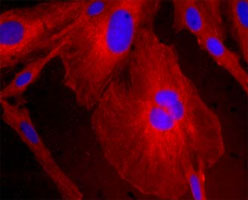
Immunofluorescence
The CCF-STTG1 cell line was fixed with 5% acetic acid methanol solution for 30 minutes followed by 5% bovine serum PBS blocking. Cells were permeabilized by 0.1% Triton X PBS for 15 minutes prior to staining with GFAP monoclonal antibody, clone SB61b (CY3) (Cat # MAB5899). Cells were then fixed and the slide was mounted with DAPI-Fluormount-G.
- Specifications
Product Description
Mouse monoclonal antibody raised against recombinant GFAP.
Immunogen
Recombinant protein corresponding to human GFAP.
Host
Mouse
Reactivity
Human
Specificity
human GFAP (~ 50 KDa).
Form
Liquid
Conjugation
HRP
Concentration
Lot specific
Isotype
IgG2b, kappa
Recommend Usage
The optimal working dilution should be determined by the end user.
Storage Buffer
In PBS, pH 7.4 (50% glycerol)
Storage Instruction
Store at 4°C. For long term storage store at -20°C.
Aliquot to avoid repeated freezing and thawing. - Applications
Immunohistochemistry (Frozen sections)
Immunofluorescence
The CCF-STTG1 cell line was fixed with 5% acetic acid methanol solution for 30 minutes followed by 5% bovine serum PBS blocking. Cells were permeabilized by 0.1% Triton X PBS for 15 minutes prior to staining with GFAP monoclonal antibody, clone SB61b (CY3) (Cat # MAB5899). Cells were then fixed and the slide was mounted with DAPI-Fluormount-G.Western Blot
- Gene Info — GFAP
Entrez GeneID
2670Gene Name
GFAP
Gene Alias
FLJ45472
Gene Description
glial fibrillary acidic protein
Gene Ontology
HyperlinkGene Summary
This gene encodes one of the major intermediate filament proteins of mature astrocytes. It is used as a marker to distinguish astrocytes from other glial cells during development. Mutations in this gene cause Alexander disease, a rare disorder of astrocytes in the central nervous system. Alternative splicing results in multiple transcript variants encoding distinct isoforms. [provided by RefSeq
Other Designations
-
- Interactomes
- Diseases
- Publication Reference
- Expression of vimentin and glial fibrillary acidic protein in human developing spinal cord.
Lukas Z, Draber P, Bucek J, Dráberova E, Viklicky V, Staskova Z.
The Histochemical Journal 1989 Dec; 21(12):693.
Application:IF, IHC-Fr, WB-Ti, Human, CG/343 MG cells, Human brain, Human embryo, Human spinal cord, U333 cells.
- Expression of vimentin and glial fibrillary acidic protein in human developing spinal cord.
- Literature Request
