

Biovalley > Hsp60 Antibody
Hsp60 Antibody

Cat# OASE00018
Size : 200ug
Contact local distributor :

Phone : +1 850 650 7790
Brand : Aviva Systems Biology
Contact local distributor :
Phone : +1 850 650 7790
Hsp60 Antibody (OASE00018)
| Datasheets/Manuals | Printable datasheet for Hsp60 Antibody (OASE00018) |
|---|---|
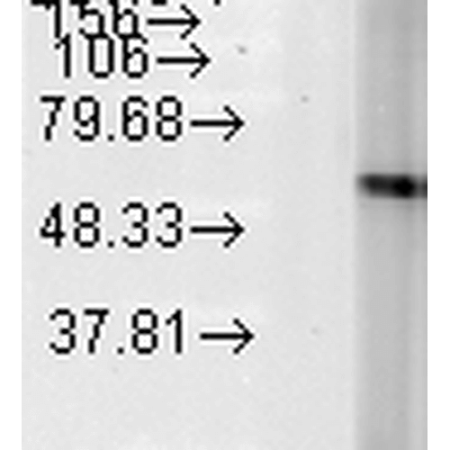
| COA Datasheet | 0.25 µg/ml of SMC-111 was sufficient for detection of HSP60 in 10 µg of heat shocked HeLa cell lysate by colorimetric immunoblot analysis using goat anti-mouse IgG as the secondary antibody. |
| Predicted Species Reactivity | Bacteria|Bovine|Chicken|Dog|Escherichia coli|Fish|Guinea Pig|Hamster|Helicobacter pylori|Human|Insect|Monkey|Mouse|Plant|Porcine|Rabbit|Rat|Salmonella typhimurium|Spinach|Three-spined Stickleback|Trichinella spiralis|Whitefly|Yeast |
|---|---|
| Clonality | Monoclonal |
| Clone | LK2 |
| Isotype | IgG1 |
| Host | Mouse |
| Conjugation | Unconjugated |
| Application | FC,IHC,WB |
| Additional Information | Background Info: Detects an ~60kDa protein corresponding to the molecular mass of Hsp60 on SDS PAGE immunoblots. |
| :: | Scientific Background: In both prokaryotic and eukaryotic cells, the misfolding and aggregation of proteins during biogenesis and under conditions of cellular stress are prevented by molecular chaperones. Members of the HSP60 family of heat shock proteins are some of the best characterized chaperones. Hsp60, also known as Cpn60 or GroEl, is an abundant protein synthesized constitutively in the cell that is induced to a higher concentration after brief cell shock. It is present in many species and exhibits a remarkable sequence homology among various counterparts in bacteria, plants, and mammals with more than half of the residues identical between bacterial and mammalian Hsp60 (1-3). Whereas mammalian Hsp60 is localized within the mitochondria, plant Hsp60, or otherwise known as Rubisco-binding protein, is located in plant chloroplasts. It has been indicated that these proteins carry out a very important biological function due to the fact that Hsp60 is present in so many different species. The common characteristics of the Hsp60s from the divergent species are i) high abundance, ii) induction with environmental stress such as heat shock, iii) homo-oligomeric structures of either 7 or 14 subunits which reversibly dissociate in the presence of Mg2+ and ATP, iv) ATPase activity and v) a role in folding and assembly of oligomeric protein structures (4). These similarities are supported by recent studies where the single-ring human mitochondrial homolog, Hsp60 with its co-chaperonin, Hsp10 were expressed in a E. coli strain, engineered so that the groE operon is under strict regulatory control. This study has demonstrated that expression of Hsp60-Hsp10 was able to carry out all essential in vivo functions of GroEL and its co-chaperonin, GroES (5). Another important function of Hsp60 and Hsp10 is their protective functions against infection and cellular stress. Hsp60 has however been linked to a number of autoimmune diseases, as well as Alzheimer's, coronary artery diseases, MS, and diabetes (6-9). |
| :: | Certificate of Analysis: 0.25ug/mL was sufficient for detection of Hsp60 in10ug of heat shocked HeLa cell lysate by colorimetric immunoblot analysis using goat anti-mouse IgG as the secondary antibody. |
| Reconstitution and Storage | -20°C |
| Immunogen | Recombinant human HSP60 |
| Purification | Protein G Purified |
| Concentration | 1 mg/ml |
| Specificity | Detects ~60kDa. |
| Dilution | WB (1:4000), IHC (1:100); optimal dilutions for assays should be determined by the user. |
| Storage Buffer | PBS, 50% glycerol, 0.09% sodium azide |
| Description | In both prokaryotic and eukaryotic cells, the misfolding and aggregation of proteins during biogenesis and under conditions of cellular stress are prevented by molecular chaperones. Members of the HSP60 family of heat shock proteins are some of the best characterized chaperones. HSP60, also known as Cpn60 or GroEl, is an abundant protein synthesized constitutively in the cell that is induced to a higher concentration after brief cell shock. It is present in many species and exhibits a remarkable sequence homology among various counterparts in bacteria, plants, and mammals with more than half of the residues identical between bacterial and mammalian HSP60 (1-3). Whereas mammalian HSP60 is localized within the mitochondria, plant HSP60, or otherwise known as Rubisco-binding protein, is located in plant chloroplasts. It has been indicated that these proteins carry out a very important biological function due to the fact that HSP60 is present in so many different species. The common characteristics of the HSP60s from the divergent species are i) high abundance, ii) induction with environmental stress such as heat shock, iii) homo-oligomeric structures of either 7 or 14 subunits which reversibly dissociate in the presence of Mg2+ and ATP, iv) ATPase activity and v) a role in folding and assembly of oligomeric protein structures (4). These similarities are supported by recent studies where the single-ring human mitochondrial homolog, HSP60 with its co-chaperonin, HSP10 were expressed in a E. coli strain, engineered so that the groE operon is under strict regulatory control. This study has demonstrated that expression of HSP60-HSP10 was able to carry out all essential in vivo functions of GroEL and its co-chaperonin, GroES (5). Another important function of HSP60 and HSP10 is their protective functions against infection and cellular stress. HSP60 has however been linked to a number of autoimmune diseases, as well as Alzheimer's, coronary artery diseases, MS, and diabetes (6-9). |
| Reference | 1. Hartl, F.U. (1996) Nature 381: 571-579. 2. Bukau, B. and Horwich, A.L. (1998) Cell 92: 351-366. 3. Hartl, F.U. and Hayer-Hartl, M. (2002) Science 295: 1852- 1858. 4. Jindal, S., et al. (1989) Molecular and Cellular Biology 9: 2279-2283. 5. La Verda, D., et al (1999) Infect Dis. Obstet. Gynecol. 7: 64-71. 6. Itoh, H. et al. (2002) Eur. J. Biochem. 269: 5931-5938. 7. Gupta, S. and Knowlton, A.A. J. Cell Mol Med. 9: 51-58. 8. Deocaris, C.C. et al. (2006) Cell Stress Chaperones 11: 116-128. 9. Lai, H.C. et al. (2007) Am. J. Physiol. Endocrinol. Metab. 292: E292-E297. 10. Gao, Y.L., et al (1995) J. of Immunology 154: 3548-3556. 11. Neuer, A., et al (1997) European Society for Human Reproduction and Embryology 12(5):925-929. 12. Bason, C., et al (2003) Lancet 362(9400): 1971-1977. |
|---|---|
| Gene Symbol | HSPD1 |
| Gene Full Name | heat shock protein family D (Hsp60) member 1 |
| Alias Symbols | 60 kDa chaperonin, 60 kDa heat shock protein, mitochondrial, chaperonin 60, CPN60, epididymis secretory sperm binding protein, GROEL, heat shock 60kDa protein 1 (chaperonin), Heat shock protein 60, heat shock protein 65, HLD4, HSP-60, HSP60, HSP65, HuCHA60, mitochondrial matrix protein P1, P60 lymphocyte protein, short heat shock protein 60 Hsp60s1, SPG13. |
| NCBI Gene Id | 3329 |
| Protein Name | 60 kDa heat shock protein, mitochondrial|60 kDa heat shock protein, mitochondrial [Homo sapiens] |
| Description of Target | Chaperonin implicated in mitochondrial protein import and macromolecular assembly. Together with Hsp10, facilitates the correct folding of imported proteins. May also prevent misfolding and promote the refolding and proper assembly of unfolded polypeptides generated under stress conditions in the mitochondrial matrix (PubMed:1346131, PubMed:11422376). The functional units of these chaperonins consist of heptameric rings of the large subunit Hsp60, which function as a back-to-back double ring. In a cyclic reaction, Hsp60 ring complexes bind one unfolded substrate protein per ring, followed by the binding of ATP and association with 2 heptameric rings of the co-chaperonin Hsp10. This leads to sequestration of the substrate protein in the inner cavity of Hsp60 where, for a certain period of time, it can fold undisturbed by other cell components. Synchronous hydrolysis of ATP in all Hsp60 subunits results in the dissociation of the chaperonin rings and the release of ADP and the folded substrate protein (Probable). |
| Uniprot ID | P10809 |
| Protein Accession # | https://www.ncbi.nlm.nih.gov/protein/NP_002147.2 |
Protein interactions
| Name | # of Products |
|---|---|
| ALDH2 | 23 |
| ALK | 102 |
| AMFR | 164 |
| APP | 257 |
| BAK1 | 70 |
| CA2 | 30 |
| CASP | 8 |
| CASP3 | 324 |
| CASP9 | 126 |
| CD4 | 497 |
| CDK9 | 249 |
| DHFR | 16 |
| EBNA-LP | 380 |
| FHIT | 16 |
| HDAC5 | 906 |
| HIST2H2BE | 111 |
| HNRNPH1 | 126 |
| HSPD1 | 127 |
| HSPE1 | 25 |
| ICT1 | 287 |
| ITGA3 | 86 |
| ITGB1 | 292 |
| MAPK6 | 386 |
| MYC | 816 |
| PCK1 | 184 |
| PPP2R1A | 165 |
| PPP2R1B | 151 |
| PPP2R2C | 42 |
| PRKACA | 388 |
| PRNP | 113 |
| PSMA3 | 438 |
| RASA1 | 218 |
| RPAP1 | 52 |
| SIRT1 | 310 |
| SIRT3 | 58 |
| SPG20 | 67 |
| SRRM2 | 277 |
| STUB1 | 399 |
| SUMO4 | 252 |
| TLR1 | 73 |
| UBC | 7030 |
| YWHAG | 596 |
Biological pathways
| Name | # of Products |
|---|---|
| Activation of cysteine-type endopeptidase activity involved in apoptotic process | 193 |
| B cell cytokine production | 8 |
| B cell proliferation | 243 |
| Chaperone-mediated protein complex assembly | 17 |
| De novo protein folding | 14 |
| Interspecies interaction between organisms | 817 |
| Isotype switching to IgG isotypes | 8 |
| MyD88-dependent toll-like receptor signaling pathway | 331 |
| Negative regulation of apoptotic process | 538 |
| Positive regulation of apoptotic process | 225 |
| Positive regulation of interferon-alpha production | 52 |
| Positive regulation of interferon-gamma production | 108 |
| Positive regulation of interleukin-10 production | 69 |
| Positive regulation of interleukin-12 production | 171 |
| Positive regulation of interleukin-6 production | 149 |
| Positive regulation of macrophage activation | 30 |
| Positive regulation of T cell activation | 121 |
| Positive regulation of T cell mediated immune response to tumor cell | 12 |
| Protein maturation | 17 |
| Protein refolding | 34 |
| Protein stabilization | 177 |
| Response to unfolded protein | 117 |
| T cell activation | 158 |
Biological process
| Name | # of Products |
|---|---|
| Activation of cysteine-type endopeptidase activity involved in apoptotic process | 100 |
| ATP catabolic process | 92 |
| B cell activation | 26 |
| B cell cytokine production | 2 |
| B cell proliferation | 22 |
| Cell death | 133 |
| Chaperone-mediated protein complex assembly | 10 |
| De novo protein folding | 4 |
| Interspecies interaction between organisms | 281 |
| Isotype switching to IgG isotypes | 2 |
| MyD88-dependent toll-like receptor signaling pathway | 65 |
| Negative regulation of apoptotic process | 356 |
| Positive regulation of apoptotic process | 239 |
| Positive regulation of interferon-alpha production | 11 |
| Positive regulation of interferon-gamma production | 61 |
| Positive regulation of interleukin-10 production | 32 |
| Positive regulation of interleukin-12 production | 39 |
| Positive regulation of interleukin-6 production | 63 |
| Positive regulation of macrophage activation | 18 |
| Positive regulation of T cell activation | 28 |
| Positive regulation of T cell mediated immune response to tumor cell | 3 |
| Protein maturation | 8 |
| Protein refolding | 11 |
| Protein stabilization | 64 |
| Response to unfolded protein | 47 |
| T cell activation | 68 |
Cellular components
| Name | # of Products |
|---|---|
| Cell surface | 369 |
| Coated pit | 38 |
| Coated vesicle | 2 |
| Cyclin-dependent protein kinase activating kinase holoenzyme complex | 6 |
| Cytoplasm | 4549 |
| Cytosol | 1868 |
| Early endosome | 107 |
| Extracellular space | 884 |
| Lipopolysaccharide receptor complex | 5 |
| Mitochon | 2 |
| Mitochondrial inner membrane | 251 |
| Mitochondrial matrix | 185 |
Protein function
| Name | # of Products |
|---|---|
| ATP binding | 2814 |
| ATPase activity | 285 |
| Cell surface binding | 163 |
| Chaperone binding | 213 |
| DNA replication origin binding | 28 |
| Lipopolysaccharide binding | 102 |
| Nucleotide binding | 3928 |
| P53 binding | 139 |
| Protein binding | 12191 |
| Single-stranded DNA binding | 136 |
| Unfolded protein binding | 252 |
Diseases
| Name | # of Products |
|---|---|
| Disease mutation | 5332 |
| Hereditary spastic paraplegia | 43 |
| Leukodystrophy | 62 |
| Neurodegeneration | 458 |
-
 Hspd1 Antibody - C-terminal region (ARP61107_P050)Catalog #: ARP61107_P050Species Tested: Human, Mouse, RatApplication: WBFormat: Liquid. Purified antibody supplied in 1x PBS buffer with 0.09% (w/v) sodium azide and 2% sucrose.
-
 Anti-HSP65 (mycobacterial) (3F7) Antibody (OAED00202)Catalog #: OAED00202Clone: 3F7Application: WBFormat: Liquid. PBS with 0.09% sodium azide.
-
 Anti-HSP60 Antibody (OAED00190)Catalog #: OAED00190Application: Immunohistochemistry|Immunoprecipitation|Western blotFormat: Liquid. PBS, pH 7.2, with 50% glycerol and 0.09% sodium azide.
-
 Anti-HSP60 (LK-1) Antibody (OAED00171)Catalog #: OAED00171Clone: LK-1Application: Enzyme-linked immunosorbent assay|Flow cytometry|Immunofluorescence|Immunoprecipitation|Western blot
-
 Hsp60 Antibody (OASE00016)Catalog #: OASE00016Conjugation: UnconjugatedClone: LK1Application: ELISA,FC,ICC,IF,IHC,IP,WB