Human AKT1 Antibody : APC (Phospho-Ser473)

Cat# OAAQ00013-100tests
Size : 100Tests
Brand : Aviva Systems Biology
Contact local distributor :

Phone : +1 850 650 7790
Human AKT1 Antibody : APC (Phospho-Ser473)
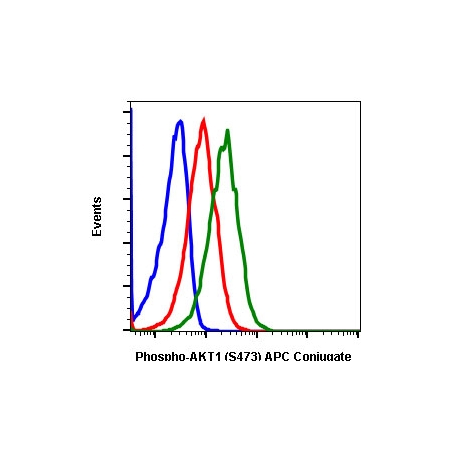
Human AKT1 Antibody : APC (Phospho-Ser473) (OAAQ00013)
| Datasheets/Manuals | Printable datasheet for OAAQ00013 |
|---|
| Tested Species Reactivity | Human, Mouse |
|---|---|
| Predicted Species Reactivity | Mouse, Rat |
| Product Format | Liquid. 1X PBS, 0.09% NaN3, 0.2% BSA. |
| Clonality | Monoclonal |
| Clone | AktS473-C7 |
| Isotype | Rabbit IgG1k |
| Host | Rabbit |
| Conjugation | APC: Allophycocyanin |
| Application | FC |
| Reconstitution and Storage | 2-8C |
| Immunogen | A synthetic phospho-peptide corresponding to residues surrounding Ser473 of human phospho Akt1 |
| Purification | Protein A+G |
| Target Post-Translational Modification | Phospho-Ser473 |
| Application Info | For flow cytometric staining, the suggested use of this reagent is 5 uL per million cells or 5 uL per 100 uL of staining volume. It is recommended that the reagent be titrated for optimal performance for each application. |
| Reference | 1. Franke TF, et al. (1997) Cell 88: 435-7. 2. Burgering, B.M. and Coffer, P.J. (1995) Nature 376: 599-602. 3.Franke TF, et al. (1995) Cell 81: 727-36. 4. Alessi DR, et al. (1996) EMBO J 15: 6541-51. 5. Sarbassov DD, et al. (2005) Science 307: 1098-101. 6. Jacinto E, et al. (2006) Cell 127: 125-37. 7. Cardone MH, et al. (1998) Science 282: 1318-21. 8. Brunet A, et al. (1999) Cell 96: 857-68. 9. Zimmermann S and Moelling K, (1999) Science 286: 1741-4. 10. Cantley LC and Neel BG (1999) Proc Natl Acad Sci USA 96: 4240-5. 11. Vlahos CJ, et al. (1994) J Biol Chem 269: 5241-8. 12. Hajduch E, et al. (2001) FEBS Lett 492: 199-203. 13. Cross DA, et al. (1995) Nature 378: 785-9. 14. Diehl JA, et al. (1998) Genes Dev 12: 3499-511. 15. Gesbert F, et al. (2000) J Biol Chem 275: 39223-30. 16. Zhou BP, et al. (2001) Nat Cell Biol 3: 245-52. 17. Navé BT, et al. (1999) Biochem J 344: 427-31. 18. Inoki K, et al. (2002) Nat Cell Biol 4: 648-57. 19. Manning BD, et al. (2002) Mol Cell 10: 151-62. |
|---|---|
| Gene Symbol | AKT1 |
| Gene Full Name | AKT serine/threonine kinase 1 |
| Alias Symbols | AKT, PKB, RAC, PRKBA, PKB-ALPHA, RAC-ALPHA |
| NCBI Gene Id | 207 |
| Protein Name | RAC-alpha serine/threonine-protein kinase |
| Description of Target | The serine-threonine protein kinase encoded by the AKT1 gene is catalytically inactive in serum-starved primary and immortalized fibroblasts. AKT1 and the related AKT2 are activated by platelet-derived growth factor. The activation is rapid and specific, and it is abrogated by mutations in the pleckstrin homology domain of AKT1. It was shown that the activation occurs through phosphatidylinositol 3-kinase. In the developing nervous system AKT is a critical mediator of growth factor-induced neuronal survival. Survival factors can suppress apoptosis in a transcription-independent manner by activating the serine/threonine kinase AKT1, which then phosphorylates and inactivates components of the apoptotic machinery. Mutations in this gene have been associated with the Proteus syndrome. Multiple alternatively spliced transcript variants have been found for this gene. |
| Uniprot ID | P31749 |
| Protein Accession # | NP_001014431.1 |
| Nucleotide Accession # | NM_001014431.1 |