

Human Soluble protein-100,S-100 ELISA Kit

Cat# CSB-E08067h-96T
Size : 96T
Brand : Cusabio
Contact local distributor :

Phone : +1 850 650 7790
 SDS
| Size | 96T,5×96T,10×96T |
Product Details
Target Name
S100 calcium binding protein A1
Associated names
Bpb ELISA Kit; NEF ELISA Kit; Protein S100-A1 ELISA Kit; S-100 protein alpha chain ELISA Kit; S-100 protein subunit alpha ELISA Kit; S100 alpha ELISA Kit; S100 beta ELISA Kit; S100 calcium binding protein A1 ELISA Kit; S100 calcium binding protein B ELISA Kit; S100 calcium-binding protein A1 ELISA Kit; S100 protein alpha polypeptide ELISA Kit; S100A ELISA Kit; s100a1 ELISA Kit; S100B ELISA Kit; S100beta ELISA Kit; S10A1_HUMAN ELISA Kit
Abbreviation
Uniprot No.
Species
Homo sapiens (Human)
Sample Types
serum, plasma, tissue homogenates
Detection Range
0.156 ng/mL-10 ng/mL
Sensitivity
0.039 ng/mL
Assay Time
1-5h
Sample Loading Volume
50-100ul
Detection Wavelength
450 nm
Research Area
Signal Transduction
Assay Principle
quantitative
Measurement
Sandwich
Precision
| Intra-assay Precision (Precision within an assay): CV%<8% | ||||||
| Three samples of known concentration were tested twenty times on one plate to assess. | ||||||
| Inter-assay Precision (Precision between assays): CV%<10% | ||||||
| Three samples of known concentration were tested in twenty assays to assess. | ||||||
Linearity
| To assess the linearity of the assay, samples were spiked with high concentrations of human S-100 in various matrices and diluted with the Sample Diluent to produce samples with values within the dynamic range of the assay. | ||||||
| Sample | Serum(n=4) | |||||
| 1:1 | Average % | 93 | ||||
| Range % | 90-96 | |||||
| 1:2 | Average % | 102 | ||||
| Range % | 97-107 | |||||
| 1:4 | Average % | 87 | ||||
| Range % | 82-90 | |||||
| 1:8 | Average % | 100 | ||||
| Range % | 97-103 | |||||
Recovery
| The recovery of human S-100 spiked to levels throughout the range of the assay in various matrices was evaluated. Samples were diluted prior to assay as directed in the Sample Preparation section. | ||||||
| Sample Type | Average % Recovery | Range | ||||
| Serum (n=5) | 95 | 89-98 | ||||
| EDTA plasma (n=4) | 97 | 90-100 | ||||
Typical Data
| These standard curves are provided for demonstration only. A standard curve should be generated for each set of samples assayed. | |||||||||||||||||||||||||||||||||||||||||||||||||||||||||||||||
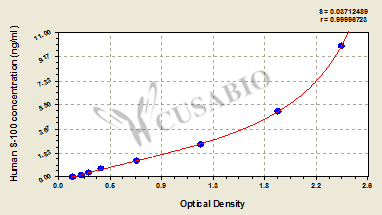
| |||||||||||||||||||||||||||||||||||||||||||||||||||||||||||||||
ELISA Data Analysis
Troubleshooting
and FAQs
and FAQs
Storage
Store at 2-8°C. Please refer to protocol.
Shelf Life
6 months
Description
This Human S100A1 ELISA Kit was designed for the quantitative measurement of Human S100A1 protein in serum, plasma, tissue homogenates. It is a Sandwich ELISA kit, its detection range is 0.156 ng/mL-10 ng/mL and the sensitivity is 0.039 ng/mL.
Citations
- W Jiang, Z Zhang, Y Fan, L Zhou, R Wang, T Hu,Journal of Affective Disorders,2026
- J Song,Ecotoxicology and environmental safety,2022
- S Arnason,European journal of clinical microbiology & infectious diseases,2022
- Cao YH.et al,Medicine (Baltimore),2017
Customer Reviews and Q&A
There are currently no reviews for this product.
Target Background
Function
(From Uniprot)
(From Uniprot)
Small calcium binding protein that plays important roles in several biological processes such as Ca(2+) homeostasis, chondrocyte biology and cardiomyocyte regulation. In response to an increase in intracellular Ca(2+) levels, binds calcium which triggers conformational changes. These changes allow interactions with specific target proteins and modulate their activity. Regulates a network in cardiomyocytes controlling sarcoplasmic reticulum Ca(2+) cycling and mitochondrial function through interaction with the ryanodine receptors RYR1 and RYR2, sarcoplasmic reticulum Ca(2+)-ATPase/ATP2A2 and...
Gene References into Functions
- Data suggest that TRPM4 exhibits binding sites for calmodulin (CaM) and S100 calcium-binding protein A1 (S100A1) located in very distal part of TRPM4 N-terminus. (TRPM4 = transient receptor potential cation channel subfamily M member 4)
- Data found that S100A1 was upregulated in hepatocellular carcinoma (HCC) tissues, and its upregulation was associated with large tumor size, low differentiation, and shorter survival rates. Further results supports the hypothesis that S100A1 functions as an oncogene and may be a biomarker for the prognosis of patients with HCC. S100A1 exerted its oncogenic function by interacting with LATS1 and activating Hippo pathway.
- The results indicate that changes in the circulating level of S100A1 protein occur in metabolic syndrome patients. The strong correlation between serum zinc-alpha2-glycoprotein and S100A1 might suggest that production or release of these two proteins could be related mechanistically.
- The results indicated that S100A1 enhanced the ovarian cancer cell proliferation and migration.
- found that S100B plays a crucial role in blocking the interaction site between RAGE V domain and S100A1. A cell proliferation assay WST-1 also supported our results. This report could potentially be useful for new protein development for cancer treatment
- Study provides evidence that mir-363 and its target S100A1 are under the regulatory function of FOXD2-AS1 aggravating nasopharyngeal carcinoma carcinogenesis.
- X-ray crystal structure of human calcium-bound S100A1 has been reported.
- a molecular mechanism for the potential regulation of TRPM1 by S100A1
- Data suggest that calcium signaling plays important role in prevention of protein misfolding; complexes of S100A1 and STIP1 are key players in this pathway; the stoichiometry of S100A1/STIP1 interaction appears to be three S100A1 dimers plus one STIP1 monomer; each S100A1-STIP1-binding interaction is entropically driven. (S100A1 = S100 calcium binding protein A1; STIP1 = stress-induced-phosphoprotein 1) [REVIEW]
- Data suggest that three dimers of S100A1 (S100 calcium binding protein A1) associate with one molecule of STIP1 (stress-inducible phosphoprotein 1) in a calcium-dependent manner; individual STIP1 TPR (tetratricopeptide repeat) domains, TPR1, TPR2A and TPR2B, bind a single S100A1 dimer with significantly different affinities; TPR2B domain possesses highest affinity for S100A1.
- Results identified amino acids motif in S100A1 for protein binding to 2-oxohistidine which appears to be an evolutionarily conserved capacity from bacteria to human.
- a correlation between S100B + A1-positive Human Articular Chondrocytes in monolayer culture and their neochondrogenesis capacity in pellet culture, is reported.
- In line with these observations, rhesus monkey rhadinovirus infection resulted in rapid degradation of SP100, followed by degradation of PML and the loss of ND10 structures, whereas the protein levels of ATRX and DAXX remained constant.
- High Serum protein S100 levels are associated with postoperative delirium after off-pump coronary artery bypass surgery.
- molecular dynamics simulations of S100A1 in the apo/holo (Ca(2+)-free/bound) states, is reported.
- The relationship between the degree of infiltration by S100-positive (S100+) dendritic cells and prognostic factors, including histological subtype, histological grade, peritumor inflammatory infiltration, and stromal desmoplasia, were examined.
- In this review, we aim to describe the molecular basis and regulatory function of S100A1--{REVIEW}
- Patients with acute myocardial infarction (MI) showed significantly increased S100A1 serum levels. S100A1 signaling in cardiac fibroblasts occurs through endosomal TLR4/MyD88.
- hypoxia-induced MiR-138 is an essential mediator of EC dysfunction via its ability to target the 3'UTR of S100A1.
- It was suggested that S100A1 and S100B be used as markers to develop potency assays for cartilage regeneration cell therapies, and as a redifferentiation readout in monolayer cultures aiming to investigate stimuli for chondrogenic induction.
- Twenty-seven out of thirty-two (84.38%) cases of serous ovarian carcinoma were found to express S100A1. S100A1 expression was observed in one out of the two mucinous and three out of the six endometroid ovarian carcinomas.
- The triple mutation Arg852/Lys859/Arg860 exhibited significant disruption of the binding of S100A1 to TRPC6 implicating their involvement in the binding site.
- For autopsy material, all human cases of definite myocardial infarction and suspected early infarction showed well-defined areas without S100A1 staining.
- This study showed that overexpression of S100A10, may play a role in irritable bowel syndrome, and that the IL10-819 CC is a candidate genotype for irritable bowel syndrome and ulcerative colitis.
- In this review we will focus on the roles of S100A proteins in intracellular and extracellular calcium signalling and homeostasis.
- the increased calcium binding affinity of S100A1 upon thionylation arises, most probably, from rearrangement of the hydrophobic core in its apo form
- Report downregulation of S100A1 expression in critical limb ischemia impairs postischemic angiogenesis via compromised proangiogenic endothelial cell function and nitric oxide synthase regulation.
- S-Nitrosylation of S100A1 increases Ca(2+) binding and tunes the overall protein conformation.
- Uremia clearance using NHD is accompanied by improvement in LV strain, rotation, reduction in mass and volume index. Dialysis downregulates genes for cardiomyocyte apoptosis and fibrosis and upregulates S100A1, which may improve LV contractility.
- Calmodulin and S100A1 protein interact with N terminus of TRPM3 channel.
- The three-dimensional structure of human apo(calcium free)S100A1 protein was determined by NMR spectroscopy
- Thermodynamics of zinc binding to human S100A2
- S100A1, S100A2, S100A4, S100A6 and S100B interacted with MDM2 (2-125).
- A single phenyl-Sepharose column was sufficient for the purification of human S100A11 whereas HiTrap Q anion exchange followed by phenyl-Sepharose columns were required for the purification of S100A1.
- The expression of S100A1 was low in benign melanocytic tumours and increased in malignant melanomas
- S100A1B and S100BB are increased in urine collected from asphyxiated newborns who will develop hypoxic-ischemic encephalopathy (HIE) since first urination, and their measurement may be useful to early predict HIE.
- S100A1 is a specific and sensitive immunohistochemical marker to differentiate nephrogenic adenoma from prostatic adenocarcinoma
- The presence of the S100A1 in myocardial sarcoplasmic reticulum and myofibrils may be related to the known target proteins for S100A1 at these sites.
- Impaired cardiac contractility response to hemodynamic stress in S100A1-deficient mice.
- identification of the S100A1 C terminus (amino acids 75-94) and hinge region (amino acids 42-54) to differentially enhance sarcoplasmic reticulum Ca2+ release with a nearly 3-fold higher activity of the C terminus
- S100A1 has a reglatory role in the contraction-relaxation cycle in the human heart
- S100A1 protein serves as a cardioprotective factor in vitro
- identified S100A1, but not calmodulin or other S100 proteins, as a potent molecular chaperone and a new member of the Hsp70/Hsp90 multichaperone complex
- Synapsins and S100A1 interact in nerve terminals where coexpresssed; S100A1 cannot bind SV-associated synapsin I and may function as a cytoplasmic store of monomeric synapsin I; synapsin dimerization and interaction with S100A1 are mutually exclusive
- Results demonstrate that restoration of S100A1 protein levels in failing myocardium by gene transfer may be a novel therapeutic strategy for the treatment of heart failure.
- This study provides the first evidence that intracellular S100A1, depending on its subcellular location, modulates cardiac Ca2+-turnover via different Ca2+-regulatory proteins.
- S100A1 was expressed in 2/15 clear cell RCCs, 11/15 papillary RCCs, 7/8 oncocytomas and in 0/7 chromophobe RCCs.
- the three-dimensional structure of calcium-bound S100A1 was determined by multidimensional NMR spectroscopy and compared to the previously determined structure of apo-S100A1
- S-100 protein expression in tumour cells was associated with significantly decreased survival
- analysis of the different reactivity pattern of S100A1 in the external auditory canal cholesteatoma
Subcellular Location
Cytoplasm. Sarcoplasmic reticulum. Mitochondrion.
Protein Families
S-100 family
Tissue Specificity
Highly prevalent in heart. Also found in lesser quantities in skeletal muscle and brain.
Database Links
HGNC:
OMIM:
KEGG:
STRING:
UniGene: