A synthetic phospho-peptide corresponding to residues surrounding Tyr701 of human phospho Stat1
Purification
Protein A+G
Target Post-Translational Modification
Phospho-Tyr701
Application Info
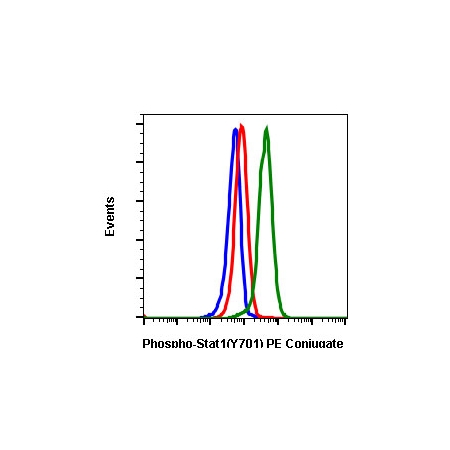
For flow cytometric staining, the suggested use of this reagent is 5 uL per million cells or 5 uL per 100 uL of staining volume. It is recommended that the reagent be titrated for optimal performance for each application.
Ramana CV, Gil MP, Schreiber RD, and Stark GR. (2002) Trends in Immunology. 23: 96-101. Avalle L, Pensa S, Regis G, Novelli F, and Poli V. (2012) JAK-STAT. 1: 65-72.
signal transducer and activator of transcription 1
Alias Symbols
CANDF7, IMD31A, IMD31B, IMD31C, ISGF-3, STAT91
NCBI Gene Id
6772
Protein Name
signal transducer and activator of transcription 1-alpha/beta
Description of Target
The protein encoded by this gene is a member of the STAT protein family. In response to cytokines and growth factors, STAT family members are phosphorylated by the receptor associated kinases, and then form homo- or heterodimers that translocate to the cell nucleus where they act as transcription activators. This protein can be activated by various ligands including interferon-alpha, interferon-gamma, EGF, PDGF and IL6. This protein mediates the expression of a variety of genes, which is thought to be important for cell viability in response to different cell stimuli and pathogens. Two alternatively spliced transcript variants encoding distinct isoforms have been described.