

LPP Antibody

Cat# MBS9602535-0,1mL
Size : 0.1mL
Brand : MyBiosource
Contact local distributor :

Phone : +1 850 650 7790
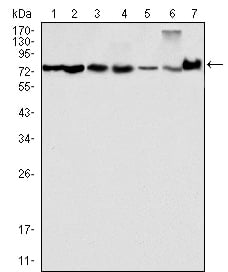
Figure 1: Western blot analysis using LPP mouse mAb against Hela (1), NIH/3T3 (2), COS (3), Caki (4), MCF-7 (5), HepG2 (6) and SMMC-7721 (7) cell lysate.
LPP Antibody – Mouse Monoclonal
For Research Use Only. Not for use in diagnostic procedures. Catalog #: MBS9602535Description: LIM domain containing preferred translocation partner in lipoma. The Zyxin family of proteins contains five members, Ajuba, LIMD1, LPP, TRIP6 and Zyxin. LPP (LIM-containing lipoma-preferred partner), a LIM domain-containing scaffolding protein… More details
Product Overview
Online Datasheet in PDFProduct Name
LPP, Monoclonal Antibody
Full Product Name
LPP Antibody
Product Gene Name
anti-LPP antibody
Product Synonym Names
DKFZp779O0231; FLJ30652; FLJ41512; LIM domain containing preferred translocation partner in lipoma; LIM domain-containing preferred translocation partner in lipoma; LIM protein; Lipoma preferred partner; Lipoma-preferred partner; lpp; LPP_HUMAN
Clonality
Monoclonal
Isotype
IgG1
Host
Mouse
Species Reactivity
Human, Mouse, Monkey, Hamster
Form/Format
Phosphate buffered saline (without Mg2+ and Ca2+), pH 7.4, 150mM NaCl, 0.02% sodium azide and 50% glycerol.
Purity/Purification
Affinity-Chromatography
Concentration
1mg/ml (lot specific)
Specificity
LPP antibody detects endogenous levels of total LPP
Preparation and Storage
Store at -20 degree C. Stable for 12 months from date of receipt.
Antibody/Peptide Pairs
LPP peptide (MBS9619988) is used for blocking the activity of LPP antibody (MBS9602535)
Molecular Weight
Observed: 66 kDa
Predicted: 66 kDa
Predicted: 66 kDa
Supply Chain Verification
Manufactured in a lab with traceable raw materials manufactured on site. Coordinated product portfolio of antibodies, pairs, conjugates, recombinant proteins, and immunoassay materials available, please inquire.
Immunogen
Purified recombinant fragment of human LPP expressed in E. Coli
Subcellular Location
Nucleus. Cytoplasm. Cell Junction. Cell Membrane. Found in the nucleus, in the cytoplasm and at cell adhesion sites. Shuttles between the cytoplasm and the nucleus. It has been found in sites of cell adhesion such as cell-to-cell contact and focal adhesion which are membrane attachment sites of cells to the extracellular matrix. Mainly nuclear when fused with HMGA2/HMGIC and MLL.
Tissue Specificity
Expressed in a wide variety of tissues but no or very low expression in brain and peripheral leukocytes.
ISO Certification
Manufactured in an ISO 9001:2015 Certified Laboratory.
Applications Tested/Suitable for anti-LPP antibody
Western Blot (WB), Immunohistochemisty (IHC), Immunofluorescence (IF), Immunocytochemistry (ICC), ELISA (EIA)
Application Notes for anti-LPP antibody
ELISA: 1:10000
WB: 1:500-1:2000
IHC: 1:200-1:1000
ICC: 1:200-1:1000
WB: 1:500-1:2000
IHC: 1:200-1:1000
ICC: 1:200-1:1000
Other Notes
Small volumes of anti-LPP antibody vial(s) may occasionally become entrapped in the seal of the product vial during shipment and storage. If necessary, briefly centrifuge the vial on a tabletop centrifuge to dislodge any liquid in the container`s cap. Certain products may require to ship with dry ice and additional dry ice fee may apply.
Searchable Terms for LPP purchase
MBS9602535 is an antibody targeting LPP. Also known as LPP Antibody. Reactive in Human, Mouse, Monkey, Hamster. Host: Mouse.
Additional Details
NCBI/Uniprot data below describe general gene information for LPP. It may not necessarily be applicable to this product.
NCBI Official Full Name
lipoma-preferred partner isoform a
NCBI Official Synonym Full Names
LIM domain containing preferred translocation partner in lipoma
NCBI Official Symbol
LPP
UniProt Protein Name
Lipoma-preferred partner
UniProt Synonym Protein Names
LIM domain-containing preferred translocation partner in lipoma
Protein Family
Lipoma-preferred partner
UniProt Gene Name
LPP
NCBI Protein Information
lipoma-preferred partner
NCBI Summary for LPP
This gene encodes a member of a subfamily of LIM domain proteins that are characterized by an N-terminal proline-rich region and three C-terminal LIM domains. The encoded protein localizes to the cell periphery in focal adhesions and may be involved in cell-cell adhesion and cell motility. This protein also shuttles through the nucleus and may function as a transcriptional co-activator. This gene is located at the junction of certain disease-related chromosomal translocations, which result in the expression of chimeric proteins that may promote tumor growth. Alternative splicing results in multiple transcript variants. [provided by RefSeq, Jul 2014]
Show more UniProt Comments for LPP
May play a structural role at sites of cell adhesion in maintaining cell shape and motility. In addition to these structural functions, it may also be implicated in signaling events and activation of gene transcription. May be involved in signal transduction from cell adhesion sites to the nucleus allowing successful integration of signals arising from soluble factors and cell-cell adhesion sites. Also suggested to serve as a scaffold protein upon which distinct protein complexes are assembled in the cytoplasm and in the nucleus.
Show more Precautions
All of MyBioSource's Products are for scientific laboratory research purposes and are not for diagnostic, therapeutics, prophylactic or in vivo use. Through your purchase, you expressly represent and warrant to MyBioSource that you will properly test and use any Products purchased from MyBioSource in accordance with industry standards. MyBioSource and its authorized distributors reserve the right to refuse to process any order where we reasonably believe that the intended use will fall outside of our acceptable guidelines.
Disclaimer
While every efforts were made to ensure the accuracy of the information provided in this datasheet, MyBioSource will not be liable for any omissions or errors contained herein. MyBioSource reserves the right to make changes to this datasheet at any time without prior notice.
It is the responsibility of the customer to report product performance issues to MyBioSource within 30 days of receipt of the product. Please visit our Terms & Conditions page for more information.
It is the responsibility of the customer to report product performance issues to MyBioSource within 30 days of receipt of the product. Please visit our Terms & Conditions page for more information.
Product Note
Select online data sheet information is drawn from bioinformatics databases, occasionally resulting in ambiguous or non-relevant product information. It is the responsibility of the customer to review, verify, and evaluate the information to make sure it matches their requirements before purchasing the kit. Our ELISA Kit assays are dynamic research tools and sometimes they may be updated and improved. If the format of this assay is important to you then please request the current manual or contact our technical support team with a presales inquiry before placing an order. We will confirm the current details of the assay. We cannot guarantee the sample manual posted online is the most current manual, it is intended to serve as an example only. Please refer to the instructions For Use provided with the assay kit for precise details.
Product PubMed Publications
Products associated with anti-LPP antibody
| Reference Product | PubMed Publications |
|---|---|
| HMGA2 antibody | >28 publications with LPP and HMGA2 |
| VASP antibody | >7 publications with LPP and VASP |
| SCRIB antibody | >3 publications with LPP and SCRIB |
Pathways associated with anti-LPP antibody
| Products by Pathway | Pathway Diagram |
|---|---|
| Stabilization And Expansion Of The E-cadherin Adherens Junction Pathway antibodies | Stabilization And Expansion Of The E-cadherin Adherens Junction Pathway Diagram |
Diseases associated with anti-LPP antibody
| Disease Name | Pubmed Publications |
|---|---|
| Disease Models, Animal Antibodies | >58 publications with LPP and Disease Models, Animal |
| Nervous System Diseases Antibodies | >46 publications with LPP and Nervous System Diseases |
| Inflammation Antibodies | >26 publications with LPP and Inflammation |
| Cardiovascular Diseases Antibodies | >16 publications with LPP and Cardiovascular Diseases |
| Brain Diseases Antibodies | >12 publications with LPP and Brain Diseases |
| Congenital Abnormalities Antibodies | >11 publications with LPP and Congenital Abnormalities |
| Necrosis Antibodies | >10 publications with LPP and Necrosis |
| Lung Neoplasms Antibodies | >9 publications with LPP and Lung Neoplasms |
| Kidney Diseases Antibodies | >7 publications with LPP and Kidney Diseases |
| Nervous System Malformations Antibodies | >6 publications with LPP and Nervous System Malformations |
Organs/Tissues associated with anti-LPP antibody
| Organ/Tissue Name | Pubmed Publications |
|---|---|
| Brain Antibodies | >291 publications with LPP and Brain |
| Blood Antibodies | >128 publications with LPP and Blood |
| Skin Antibodies | >87 publications with LPP and Skin |
| Muscle Antibodies | >83 publications with LPP and Muscle |
| Bladder Antibodies | >61 publications with LPP and Bladder |
| Nerve Antibodies | >55 publications with LPP and Nerve |
| Vascular Antibodies | >41 publications with LPP and Vascular |
| Bone Antibodies | >31 publications with LPP and Bone |
| Kidney Antibodies | >31 publications with LPP and Kidney |
| Lung Antibodies | >30 publications with LPP and Lung |