

Biovalley > Mouse CD117/c-kit Antibody : CY5
Mouse CD117/c-kit Antibody : CY5

Cat# OASB00659
Size : 0.1mg
Contact local distributor :

Phone : +1 850 650 7790
Brand : Aviva Systems Biology
Contact local distributor :
Phone : +1 850 650 7790
Bulk
Order
Order
Aviva's
Satisfaction
Guarantee
Satisfaction
Guarantee
Contact Us:
- Toll Free: 888-880-0001
- Phone: 858-552-6979
- Email: info@avivasysbio.com
Shipping Info:
- : Antibody & Protein in US
- + /Kit in US
- Contact us for international orders.
Mouse CD117/c-kit Antibody : CY5 (OASB00659)
| Datasheets/Manuals | Printable datasheet for Mouse CD117/c-kit Antibody : CY5 (OASB00659) |
|---|
| Tested Species Reactivity | Mouse |
|---|---|
| Predicted Species Reactivity | Mouse |
| Clonality | Monoclonal |
| Clone | 2B8 |
| Isotype | IgG2b |
| Host | Rat |
| Conjugation | Cyanine 5 |
| Application | FC, IHC-F, ICC |
| Additional Information | Description: The CD117 (c-Kit) antigen is the cell-surface receptor for stem cell factor (SCF). Together these molecules constitute a ligand/receptor pair which functions to maintain normal hematopoiesis in the adult. Signaling through SCF/c-Kit has an important role in stimulating myeloid and erythroid production of primitive hematopoietic progenitor cells. A variety of cytokines act synergistically with SCF to stimulate proliferation and differentiation of bone marrow progenitor cells. For example, SCF plus IL-7 can stimulate the combined myeloid and B cell differentiation of uncommitted hematopoietic progenitor cells. SCF/c-Kit also participates in erythropoiesis in both the bone marrow and spleen. Loss-of-function mutations for SCF/c-Kit lead to a variety of pleiotropic developmental defects while gain-of-function mutations can lead to constitutive activation of the kit receptor and links to cancer. Examples of the former are mast cell deficiency and severe macrocytic anemia while the latter mutation has been identified in mastocytomas. |
| Reconstitution and Storage | Store at 2-8C |
| Immunogen | Mouse IL-3-dependent bone marrow mast cells |
| Concentration | 0.1 mg/mL |
| Specificity | CD117 |
| Characterization | To ensure lot- to- lot consistency, each batch of product is tested for conformance to characteristics of astandard reference reagent by flow cytometry. |
| Warning | Reagents contain sodium azide. Sodium azide is very toxic if ingested or inhaled. Avoid contact with skin,eyes, or clothing. Wear eye or face protection when handling. If skin or eye contact occurs, wash withcopious amounts of water. If ingested or inhaled, contact a physician immediately. Sodium azide yieldstoxic hydrazoic acid under acidic conditions. Dilute azide- containing compounds in running water beforediscarding to avoid accumulation of potentially explosive deposits in lead or copper plumbing. |
| Dilution | Flow Cytometry: Fluorescein conjugate Biotin conjugate R-phycoerythrin conjugate Allophycocyanin conjugate Spectral Red conjugate Cyanine 5 conjugate Allophycocyanin -Cyanine 5.5 conjugate Allophycocyanin -Cyanine 7 conjugate <= 1 ug/106 cells <= 1 ug/106 cells <= 0.2 ug/106 cells <= 0.2 ug/106 cells <= 0.2 ug/106 cells <= 0.2 ug/106 cells <= 0.2 ug/106 cells <= 0.2 ug/106 cells |
| Application Info | Flow cytometry 6, Cell homing studies 5, Hematopoiesis and development studies 5 |
| Other Applications Data | Since applications vary, you should determine the optimum working dilution of theproduct that is appropriate for your specific need. |
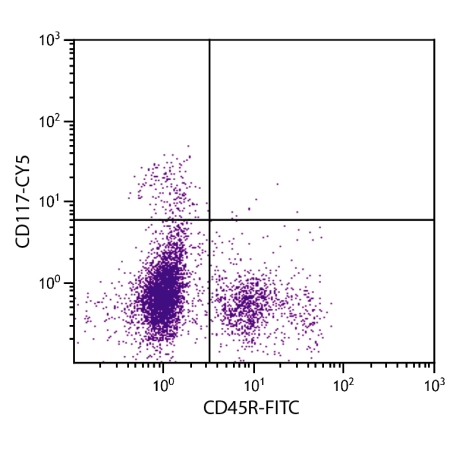
| Other Applications Image 1 Data | Amount Used: 0.03 Ug/106 cells BALB/c bone marrow cells were double-stained with rat anti-mouse CD117-R-PE and rat anti-mouse Ly-6G-FITC, following which total cells were analyzed by flow cytometry. |
| Storage | - The purified (UNLB) antibody is supplied as 0.5 mg of purified immunoglobulin in 1.0 mL of 100 mMborate buffered saline, pH 8.2. No preservatives or amine- containing buffer salts added. Store at 2- 8 C - The fluorescein (FITC) conjugate is supplied as 0.5 mg in 1.0 mL of PBS/NaN3. Store at 2- 8 C - The biotin (BIOT) conjugate is supplied as 0.5 mg in 1.0 mL of PBS/NaN3. Store at 2- 8 C - The R- phycoerythrin (R- PE) conjugate is supplied as 0.1 mg in 1.0 mL or 0.2 mg in 2.0 mL ofPBS/NaN3 and a stabilizing agent. Store at 2- 8 C. Do not freeze! - The allophycocyanin (APC) conjugate is supplied as 0.1 mg in 1.0 mL of PBS/NaN3 and a stabilizingagent. Store at 2- 8 C. Do not freeze! - The Spectral Red (SPRD) , Allophycocyanin- Cyanine 5.5 (APC- CY 5.5) and Allophycocyanin- Cyanine 7 (APC- CY 7) conjugates are supplied as 0.1 mg in 1.0 mL of PBS/NaN3 and a stabilizingagent. Store at 2- 8 C. Do not freeze! - The low endotoxin, azide- free (LE/AF) antibody is supplied as 0.5 mg purified immunoglobulin in 1.0 mLof PBS. Aliquot and store at or below - 20 C - The Cyanine 5 (CY 5) conjugate is supplied as 0.1 mg in 1.0 mL of PBS/NaN3. Store at 2- 8 C - Protect conjugated forms from light. Aliquot and freeze the low endotoxin, azide- free product at - 20 Cimmediately upon receipt. Each reagent is stable for the period shown on the bottle label if stored asdirected. |
| Reference | 1. Broudy, V.C., et al, 1996. Blood 88:75 2. Veiby, O.P., S. D. Lyman and S. E. Jacobsen. 1996. Blood 88:1256 3. Sudo, T., et al. 1995. Oncogene 11:2469 4. Yoshida, H., et al. 1996. Development 122: 1207 5. Filip, S., J. Mokry, J. Vavrova, D. Cizkova, Z. Sinkorova, V. Tosnerova, and M. Blaha. 2009. Transfus. Apher. Sci 41:183 6. Min, H., E. Montecino- Rodriguez, and K. Dorshkind. 2004. J. Immunol 173:245. |
|---|---|
| Gene Symbol | KIT |
| Gene Full Name | Mast/stem cell growth factor receptor Kit |
| Alias Symbols | W, Bs, SC, SO, Fdc, Ssm, Gsfs, SCO1, SCO5, SOW3, Tr-k, c-KI, CD117, belly, c-KIT, Tr-kit, Gsfsco1, Gsfsco5, Gsfsow3 |
| NCBI Gene Id | 16590 |
| Protein Name | mast/stem cell growth factor receptor Kit |
| Description of Target | The c-Kit proto-oncogene is the cellular homolog of the transforming gene of a feline retrovirus (v-Kit). The c-kit protein includes characteristics of a protein kinase transmembrane receptor. Alternatively spliced transcript variants encoding different isoforms have been found for this gene. |
| Uniprot ID | P05532 |
| Protein Accession # | NP_001116205.1 |
| Nucleotide Accession # | NM_001122733.1 |
Protein interactions
| Name | # of Products |
|---|---|
| ABL1 | 260 |
| BTK | 167 |
| CBL | 471 |
| CBLB | 108 |
| CD81 | 115 |
| CISH | 50 |
| CRKL | 155 |
| CSF2RA | 29 |
| DOK1 | 120 |
| GRAP | 44 |
| GRAP2 | 107 |
| GRB10 | 74 |
| GRB7 | 109 |
| INPP5D | 106 |
| KITLG | 50 |
| LYN | 366 |
| MATK | 35 |
| MPDZ | 44 |
| PIK3CG | 93 |
| PIK3R1 | 517 |
| PIK3R2 | 182 |
| PLCE1 | 22 |
| PLCG1 | 274 |
| PRKCA | 529 |
| PRKCB | 206 |
| PTPN11 | 309 |
| PTPN6 | 335 |
| PTPRO | 23 |
| PTPRU | 18 |
| SH2B2 | 63 |
| SH2B3 | 44 |
| SOCS1 | 152 |
| SOCS5 | 17 |
| SOCS6 | 53 |
| SPRED1 | 20 |
| SPRED2 | 12 |
| SRC | 773 |
| STAP1 | 15 |
| STAT1 | 201 |
| STAT5A | 180 |
| STAT5B | 184 |
| TEC | 47 |
| UBC | 7030 |
Biological pathways
| Name | # of Products |
|---|---|
| Activation of MAPK activity | 317 |
| Cytokine-mediated signaling pathway | 103 |
| Male gonad development | 99 |
| Mast cell differentiation | 9 |
| Mast cell proliferation | 9 |
| Melanocyte differentiation | 34 |
| Peptidyl-tyrosine phosphorylation | 165 |
| Positive regulation of MAPKKK cascade | 189 |
| Positive regulation of phosphatidylinositol 3-kinase activity | 98 |
| Positive regulation of phosphatidylinositol 3-kinase cascade | 210 |
| Positive regulation of phospholipase C activity | 65 |
| Positive regulation of sequence-specific DNA binding transcription factor activity | 174 |
| Positive regulation of tyrosine phosphorylation of Stat1 protein | 52 |
| Positive regulation of tyrosine phosphorylation of Stat3 protein | 101 |
| Positive regulation of tyrosine phosphorylation of Stat5 protein | 127 |
| Protein autophosphorylation | 356 |
| Regulation of cell proliferation | 115 |
| Stem cell maintenance | 32 |
| Transmembrane receptor protein tyrosine kinase signaling pathway | 153 |
Biological process
| Name | # of Products |
|---|---|
| Activation of MAPK activity | 105 |
| Cytokine-mediated signaling pathway | 229 |
| Germ cell programmed cell death | 9 |
| Glycosphingolipid metabolic process | 27 |
| Hemopoiesis | 78 |
| Intracellular protein kinase cascade | 91 |
| Lymphoid progenitor cell differentiation | 8 |
| Male gonad development | 78 |
| Mast cell differentiation | 2 |
| Mast cell proliferation | 1 |
| Melanocyte differentiation | 35 |
| Myeloid progenitor cell differentiation | 6 |
| Negative regulation of programmed cell death | 12 |
| Peptidyl-tyrosine phosphorylation | 72 |
| Positive regulation of cell proliferation | 483 |
| Positive regulation of gene expression | 160 |
| Positive regulation of JAK-STAT cascade | 38 |
| Positive regulation of MAPK cascade | 81 |
| Positive regulation of phosphatidylinositol 3-kinase activity | 39 |
| Positive regulation of phosphatidylinositol 3-kinase cascade | 60 |
| Positive regulation of phospholipase C activity | 10 |
| Positive regulation of sequence-specific DNA binding transcription factor activity | 92 |
| Positive regulation of tyrosine phosphorylation of Stat1 protein | 19 |
| Positive regulation of tyrosine phosphorylation of Stat3 protein | 43 |
| Positive regulation of tyrosine phosphorylation of Stat5 protein | 37 |
| Protein autophosphorylation | 150 |
| Regulation of cell proliferation | 128 |
| Regulation of developmental pigmentation | 6 |
| Response to radiation | 32 |
| Signal transduction | 1058 |
| Signal transduction by phosphorylation | 12 |
| Spermatid development | 35 |
| Spermatogenesis | 230 |
| Stem cell maintenance | 24 |
| Transmembrane receptor protein tyrosine kinase signaling pathway | 67 |
Cellular components
| Name | # of Products |
|---|---|
| Cytoplasm | 4549 |
| External side of plasma membrane | 261 |
| Extracellular space | 884 |
| Integral to membrane | 2793 |
| Nucleus | 4914 |
| Plasma membrane | 2678 |
Protein function
| Name | # of Products |
|---|---|
| ATP binding | 2814 |
| Cytokine binding | 74 |
| Metal ion binding | 5514 |
| Nucleotide binding | 3928 |
| Protease binding | 376 |
| Protein binding | 12191 |
| Protein homodimerization activity | 1852 |
| Protein tyrosine kinase activity | 369 |
| Receptor activity | 3624 |
| Receptor signaling protein tyrosine kinase activity | 83 |
| Stem cell factor receptor activity | 14 |
| Transmembrane receptor protein tyrosine kinase activity | 157 |
Diseases
| Name | # of Products |
|---|---|
| Disease mutation | 5332 |
| Proto-oncogene | 793 |
-
 KIT Antibody - N-terminal region (OAAB04732)Catalog #: OAAB04732Application: FC,IHC-P,WBFormat: Purified polyclonal antibody supplied in PBS with 0.09% (W/V) sodium azide. This antibody is prepared by Saturated Ammonium Sulfate (SAS) precipitation followed by dialysis against PBS.
-
 KIT Antibody (Phospho-Tyr719) (OAAB16312)Catalog #: OAAB16312Application: DBFormat: Purified polyclonal antibody supplied in PBS with 0.09% (W/V) sodium azide. This antibody is purified through a protein A column, followed by peptide affinity purification.
-
 KIT Antibody (Phospho-Tyr730) (OAAB16313)Catalog #: OAAB16313Application: DBFormat: Purified polyclonal antibody supplied in PBS with 0.09% (W/V) sodium azide. This antibody is purified through a protein A column, followed by peptide affinity purification.
-
 KIT Antibody (Phospho-Tyr823) (OAAB16314)Catalog #: OAAB16314Application: DBFormat: Purified polyclonal antibody supplied in PBS with 0.09% (W/V) sodium azide. This antibody is purified through a protein A column, followed by peptide affinity purification.
-
 c - KIT Antibody - N - terminal region (OAAB17172)Catalog #: OAAB17172Application: FC,IHC-P,WBFormat: Purified polyclonal antibody supplied in PBS with 0.09% (W/V) sodium azide. This antibody is prepared by Saturated Ammonium Sulfate (SAS) precipitation followed by dialysis against PBS.