

Biovalley > Mouse CD45R/B220 Antibody : APC/CY5.5
Mouse CD45R/B220 Antibody : APC/CY5.5

Cat# OASB00470
Size : 0.1mg
Contact local distributor :
 Phone : +1 850 650 7790
Brand : Aviva Systems Biology
Contact local distributor :
Phone : +1 850 650 7790
Mouse CD45R/B220 Antibody : APC/CY5.5 (OASB00470)
| Datasheets/Manuals | Printable datasheet for Mouse CD45R/B220 Antibody : APC/CY5.5 (OASB00470) |
|---|
| Tested Species Reactivity | Mouse |
|---|---|
| Predicted Species Reactivity | Mouse |
| Clonality | Monoclonal |
| Clone | RA3-6B2 |
| Isotype | IgG2a |
| Host | Rat |
| Conjugation | APC|Cyanine 5.5 |
| Application | FC |
| Additional Information | Description: CD45R, also known as B220, a member of the protein tyrosine phosphate family and a major cell surface glycoprotein, represents a restricted form of the CD45 family which primarily recognizes only cells of B-lineage from pro-B cell through mature B lymphocytes and prior to the availability of anti-CD19 monoclonal antibodies was commonly used as a pan B-cell marker. It also reacts with certain activated T cells as well as non-MHC-restricted lytically active lymphokine-activated killer (LAK) cells. In vivo administration of RA3-6B2 has been shown to affect differentiation of both T and B cells in normal mice and reduce the level of anti-DNA antibodies and lymphadenopathies in MRL/lpr mice. |
| Reconstitution and Storage | Store at 2-8C |
| Immunogen | Abelson murine leukemia virus-induced pre-B cell lymphoma |
| Concentration | 0.1 mg/mL |
| Specificity | CD45R |
| Characterization | To ensure lot- to- lot consistency, each batch of monoclonal antibody is tested by flow cytometry to conform tocharacteristics of a standard reference reagent. Representative data are included in this product insert. |
| Warning | Reagents contain sodium azide. Sodium azide is very toxic if ingested or inhaled. Avoid contact with skin, eyes, or clothing.Wear eye or face protection when handling. If skin or eye contact occurs, wash with copious amounts of water. If ingestedor inhaled, contact a physician immediately. Sodium azide yields toxic hydrazoic acid under acidic conditions. Dilute azidecontainingcompounds in running water before discarding to avoid accumulation of potentially explosive deposits in lead orcopper plumbing. |
| Dilution | Flow Cytometry: Fluorescein conjugate <= 1 ug/106 cells Biotin conjugate <= 1 ug/106 cells R-phycoerythrin conjugate <= 0.2 ug/106 cells R-phycoerythrin conjugate-Texas Red® <= 0.2 ug/106 cells Allophycocyanin conjugate <= 0.2 ug/106 cells Spectral Red conjugate <= 0.2 ug/106 cells Cyanine 5 conjugate <= 0.2 ug/106 cells R-phycoerythrin-Cyanine 5.5 conjugate <= 0.2 ug/106 cells R-phycoerythrin-Cyanine 7 conjugate <= 0.2 ug/106 cells Allophycocyanin-Cyanine 5.5 conjugate Allophycocyanin-Cyanine 7 conjugate Alexa Fluor 488 <= 0.2 ug/106 cells <= 0.2 ug/106 cells <= 0.2 ug/106 cells |
| Application Info | Flow cytometry 9,10, Immunohistochemistry (frozen sections) 10 |
| Other Applications Data | Since applications vary, you should determine the optimum working dilution for theproduct that is appropriate for your specific need. |
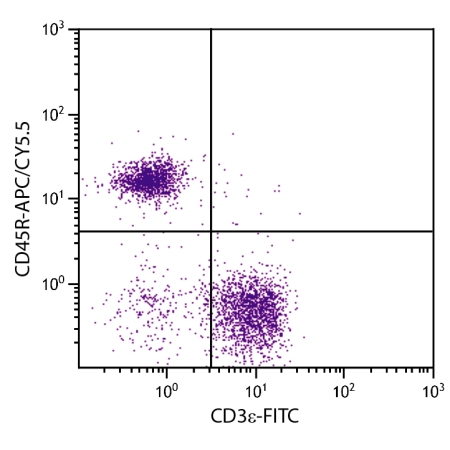
| Other Applications Image 1 Data | Amount Used: 0.3 Ug/106 cells Cells from BALB/c mesenteric lymph nodes were double-stained with rat anti-mouse CD45/B220-PE and rat anti-mouse CD3epsilon-FITC. Small lymphocytes were then gated and analyzed on a FACScan flow cytometer (BDIS, San J |
| Storage | - The purified (UNLB) antibody is supplied as 0.5 mg of purifiedimmunoglobulin in 1.0 mL of 100 mM borate buffered saline, pH 8.2. Nopreservatives or amine- containing buffer salts added. Store at 2- 8 C - The fluorescein (FITC) conjugate is supplied as 0.5 mg or 0.1 mg in 1.0 mL of PBS/NaN3. Store at 2- 8 C - The biotin (BIOT) conjugate is supplied as 0.5 mg in 1.0 mL of PBS/NaN3. Store at 2- 8 C - The R- phycoerythrin (R- PE) conjugate is supplied as 0.1 mg in 1.0 mL or 0.2 mg in 2.0 mL of PBS/NaN3 and astabilizing agent. Store at 2- 8 C. Do not freeze! - The allophycocyanin (APC) conjugate is supplied as 0.1 mg in 1.0 mL of PBS/NaN3 and a stabilizing agent. Store at2- 8 C. Do not freeze! - The Spectral Red (SPRD), R- phycoerythrin - Texas Red (R- PE- TXRD), R- phycoerythrin- Cyanine 7 (R- PE- CY 7),R- phycoerythrin- Cyanine 5.5 (R- PE- CY 5.5), Allophycocyanin- Cyanine 5.5 (APC- CY 5.5) and Allophycocyanin- Cyanine 7 (APC- CY 7) conjugates are supplied as 0.1 mg in 1.0 mL of PBS/NaN3 and a stabilizing agent. Store at 2- 8 C. Do not freeze! - The low endotoxin, azide- free (LE/AF) antibody is supplied as 0.5 mg purified immunoglobulin in 1.0 mL of PBS. Aliquotand store at or below - 20 C - The Cyanine 5 (CY 5) conjugate is supplied as 0.1 mg in 1.0 mL of PBS/NaN3. Store at 2- 8 C - The Alexa Fluor 488 (AF488) conjugate is supplied as 0.1mg in 0.2mL of PBS/NaN3. Store at 2- 8 C - Protect conjugated forms from light. Aliquot and freeze the low endotoxin, azide- free product at - 20 C immediately uponreceipt. Each reagent is stable for the period shown on the bottle label if stored as directed. |
| Reference | 1. Coffman, R. L. 1982. Immunol. Rev. 69:5 2. Ballas, Z. K. and W. Rasmussen. 1990. J. Immunol. 144:386 3. Morse, H. C. III, W. F. Davidson, R. A. Yetter, and R. L. Coffman. 1982. Cell Immunol. 70:311 4. Johnson, P., L. Greenbaum, K. Bottomly, and I. S. Trowbridge. 1989. J. Exp. Med. 169:1179 5. Kincade, P. W., L. Grace, W. Takeshi, S. Leslie, and M. P. Scheid. 1981. J. Immunol. 127:2262 6. Watanabe, Y. and T. Akaike. 1994. Scand. J. Immunol. 39:419 7. Asensi, V., K. Himeno, I. Kawamura, M. Sakumoto, and K. Nomoto. 1990. Clin. Exp. Immunol. 80:268 8. Asensi, V., K. Kimeno, I. Kawamura, M. Sakumoto, and K. Nomoto. 1989. Immunology 68:204 9. Hardy, R. R., C. E. Carmack, S. A. Shinton, J. D. Kemp, and K. Hayakawa. 1991. J. Exp. Med 173:1213 10. Ermak, T.H., P.J. Giannasca, R. Nichols, G.A. Myers, J. Nedrud, R. Weltzin, C.K. Lee, H. Kleanthous, and T.P. Monath. 1998. J. Exp. Med 188(12):2277. |
|---|---|
| Gene Symbol | PTPRC |
| Gene Full Name | Receptor-type tyrosine-protein phosphatase C |
| Alias Symbols | Ly-, loc, B220, Cd45, L-CA, Ly-5, Lyt-, T200, CD45R, Lyt-4 |
| NCBI Gene Id | 19264; 5788 |
| Protein Name | receptor-type tyrosine-protein phosphatase C |
| Uniprot ID | P06800, P08575 |
| Protein Accession # | NP_001104786.2 |
| Nucleotide Accession # | NM_001111316.2 |
Protein interactions
| Name | # of Products |
|---|---|
| ANP32A | 89 |
| C | 150 |
| CD1D | 104 |
| CD2 | 157 |
| CD247 | 234 |
| CD28 | 117 |
| CD4 | 497 |
| CD8A | 170 |
| CSNK2A1 | 551 |
| CSNK2A2 | 274 |
| CXCR4 | 126 |
| DPP4 | 131 |
| EZR | 276 |
| FCGR3A | 132 |
| FYN | 597 |
| GANAB | 68 |
| GRB2 | 1020 |
| IFNAR1 | 93 |
| INSR | 215 |
| IRS1 | 138 |
| ITGAL | 131 |
| JAK1 | 208 |
| JAK2 | 257 |
| JAK3 | 169 |
| LCK | 537 |
| LCP2 | 128 |
| LGALS1 | 190 |
| LSM1 | 97 |
| LYN | 366 |
| MBL2 | 86 |
| PAEP | 72 |
| PPFIA1 | 88 |
| PPFIBP2 | 62 |
| PRKCSH | 77 |
| PTPN6 | 335 |
| PTPRC | 283 |
| PTPRCAP | 60 |
| RASA1 | 218 |
| RNF11 | 156 |
| SEMA4D | 79 |
| SKAP1 | 83 |
| TYK2 | 111 |
| UBC | 7030 |
| UHRF2 | 207 |
| ZAP70 | 252 |
Biological pathways
| Name | # of Products |
|---|---|
| Axon guidance | 739 |
| B cell proliferation | 243 |
| B cell receptor signaling pathway | 217 |
| Defense response to virus | 284 |
| Immunoglobulin biosynthetic process | 61 |
| Negative regulation of cytokine-mediated signaling pathway | 119 |
| Negative regulation of protein kinase activity | 216 |
| Negative regulation of T cell mediated cytotoxicity | 120 |
| Positive regulation of antigen receptor-mediated signaling pathway | 113 |
| Positive regulation of B cell proliferation | 254 |
| Positive regulation of protein kinase activity | 132 |
| Positive regulation of T cell proliferation | 211 |
| Regulation of S phase | 64 |
| Release of sequestered calcium ion into cytosol | 160 |
| T cell differentiation | 128 |
| T cell receptor signaling pathway | 453 |
Biological process
| Name | # of Products |
|---|---|
| Axon guidance | 286 |
| B cell proliferation | 22 |
| B cell receptor signaling pathway | 35 |
| Bone marrow development | 7 |
| Cell surface receptor signaling pathway | 179 |
| Defense response to virus | 72 |
| Dephosphorylation | 39 |
| Hemopoietic progenitor cell differentiation | 18 |
| Immunoglobulin biosynthetic process | 5 |
| Negative regulation of cell adhesion involved in substrate-bound cell migration | 5 |
| Negative regulation of cytokine-mediated signaling pathway | 13 |
| Negative regulation of protein kinase activity | 53 |
| Negative regulation of T cell mediated cytotoxicity | 7 |
| Peptidyl-tyrosine dephosphorylation | 56 |
| Positive regulation of antigen receptor-mediated signaling pathway | 4 |
| Positive regulation of B cell proliferation | 66 |
| Positive regulation of hematopoietic stem cell migration | 3 |
| Positive regulation of protein kinase activity | 36 |
| Positive regulation of stem cell proliferation | 8 |
| Positive regulation of T cell proliferation | 93 |
| Protein dephosphorylation | 88 |
| Regulation of cell cycle | 69 |
| Regulation of S phase | 9 |
| Release of sequestered calcium ion into cytosol | 29 |
| Stem cell development | 12 |
| T cell differentiation | 39 |
| T cell receptor signaling pathway | 90 |
Cellular components
| Name | # of Products |
|---|---|
| External side of plasma membrane | 261 |
| Focal adhesion | 101 |
| Integral to plasma membrane | 817 |
| Membrane raft | 140 |
| Plasma membrane | 2678 |
Protein function
| Name | # of Products |
|---|---|
| Hydrolase activity | 1739 |
| Protein binding | 12191 |
| Protein kinase binding | 1101 |
| Protein tyrosine phosphatase activity | 281 |
| Receptor activity | 3624 |
| Transmembrane receptor protein tyrosine phosphatase activity | 116 |
Diseases
| Name | # of Products |
|---|---|
| Disease mutation | 5332 |
| SCID | 125 |
-
 Human CD45RA Antibody : SPRD (OASB01115)Catalog #: OASB01115Conjugation: Spectral Red®Clone: F8-11-13Species Tested: HumanApplication: FC
 -
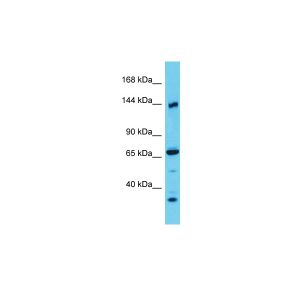 Ptprc Antibody - middle region (ARP59108_P050)Catalog #: ARP59108_P050Species Tested: Human, RatApplication: WBFormat: Liquid. Purified antibody supplied in 1x PBS buffer with 0.09% (w/v) sodium azide and 2% sucrose.
 -
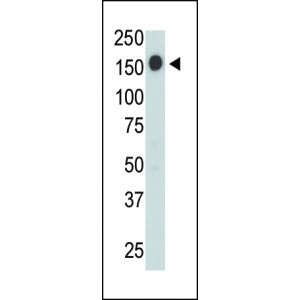 CD45 Antibody - C-terminal region (OAAB11608)Catalog #: OAAB11608Application: FC,IHC-P,WBFormat: Purified polyclonal antibody supplied in PBS with 0.09% (W/V) sodium azide. This antibody is prepared by Saturated Ammonium Sulfate (SAS) precipitation followed by dialysis against PBS.
 -
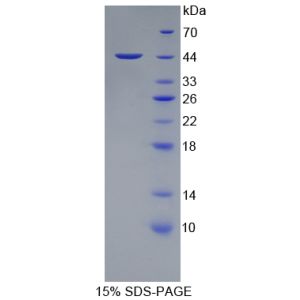 PTPRC Recombinant Protein (OPCD06515)Catalog #: OPCD06515Conjugation: UnconjugatedApplication: Ctrl (+), SDS-PAGE, WBFormat: Freeze-dried Powder. PBS, pH7.4, containing 0.01% SKL, 5% Trehalose.
 -
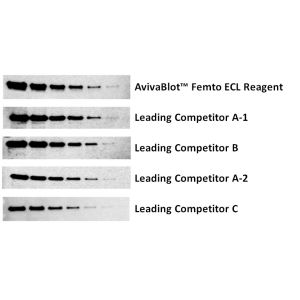 AvivaBlot Femto ECL Reagent (OKCF00002)Catalog #: OKCF00002Application: WBFormat: LiquidSize: 250 mL