



G-Series Mouse Cytokine Array 4 Kit. Semi-quantitative measurement of 40 mouse cytokines. Suitable for all liquid sample types.
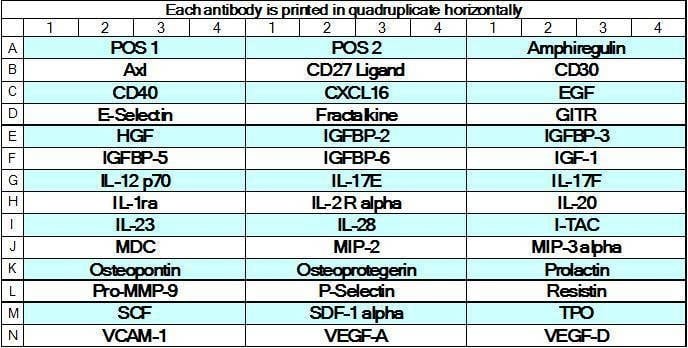
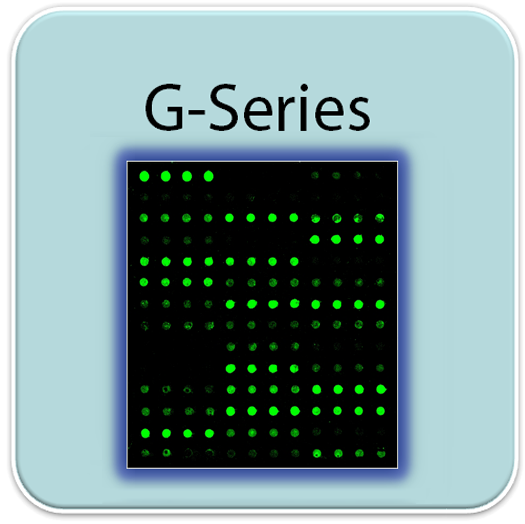
Mouse Cytokine Array GS4
Mouse Cytokine Array GS4
Contact Us for Bulk Request
Product Description
Specifications
| Size | 16 Sample Kit, 32 Sample Kit, 64 Sample Kit |
| Species | Mouse |
| Compatible Sample Types | Cell Culture Supernatants, Plasma, Serum, Tissue Lysates, Cell Lysates |
| Quantitative/Semi-Quantitative | Semi-Quantitative |
| Number of Targets Detected | 40 |
| Solid Support | Glass Slide |
| Design Principle | Sandwich-based |
| Method Of Detection | Fluorescence Laser Scanner |
| Shipping Type | Blue ice |
| Storage | -20°C |
Introduction
RayBio® G-Series Arrays are glass slide-based antibody arrays which allow researchers to conduct rapid, accurate expression profiling of hundreds of cytokines, chemokines, growth factors, proteases, soluble receptors and other proteins from any biological fluid. Like a traditional sandwich-based ELISA, this array uses a matched pair of cytokine-specific antibodies for detection. Like the Quantibody® Multiplex ELISA Arrays, G-Series utilizes a highly sensitive and stable fluorescent readout which can be detected by most laser fluorescent scanner systems (see below for more info). After capturing the spot densities with a laser scanner, normalization of the raw data can be easily calculated by the researcher, or by a quick copy-paste into our excel-based Analysis Tool software.
This array as well as all catalog numbers beginning with 'GS' differ from the classic G-Series Arrays in a few important ways. First, each capture antibody is printed in quadruplicate instead of duplicate, delivering higher precision. Secondly, this array features the same antibody panels used in our Quantibody Arrays, allowing a seamless transition to our quantitative multiplex assay platform. Lastly, all 16 wells are spotted as sub-arrays, delivering easy handling of 16 samples simultaneously while consuming low sample volumes (10 - 100 µl per array).
This array as well as all catalog numbers beginning with 'GS' differ from the classic G-Series Arrays in a few important ways. First, each capture antibody is printed in quadruplicate instead of duplicate, delivering higher precision. Secondly, this array features the same antibody panels used in our Quantibody Arrays, allowing a seamless transition to our quantitative multiplex assay platform. Lastly, all 16 wells are spotted as sub-arrays, delivering easy handling of 16 samples simultaneously while consuming low sample volumes (10 - 100 µl per array).
Product Features
- High sensitivity (pg/mL to ng/mL levels)
- High specificity and system reproducibility
- Suitable for diverse sample types
- Low sample volume requirement: 50 µL or less
- Get results same day (6-hour processing time)
- Well-suited for high throughput assays
- Test 16 samples on each slide
- Data analysis software provides one-step computation
Target Names
| Scroll over each target protein for more information | ||||
|---|---|---|---|---|
| Amphiregulin
| Axl
| CD27 Ligand (TNFSF7)
| CD30 (TNFRSF8)
| CD40 (TNFRSF5)
|
| CXCL16
| EGF
| E-Selectin
| Fractalkine (CX3CL1)
| GITR (TNFRSF18)
|
| HGF
| IGF-1
| IGFBP-2
| IGFBP-3
| IGFBP-5
|
| IGFBP-6
| IL-1 ra (IL-1 F3)
| IL-12 p70
| IL-17E (IL-25)
| IL-17F
|
| IL-2 R alpha
| IL-20
| IL-23
| IL-28A (IFN-lambda 2)
| I-TAC (CXCL11)
|
| MDC (CCL22)
| MIP-2
| MIP-3 alpha (CCL20)
| Osteopontin (SPP1)
| Osteoprotegerin (TNFRSF11B)
|
| Prolactin
| Pro-MMP-9
| P-Selectin
| Resistin
| SCF
|
| SDF-1 alpha (CXCL12 alpha)
| Thrombopoietin (TPO)
| VCAM-1 (CD106)
| VEGF-A
| VEGF-D
|
Application Notes
Suggested Application
- Multiplexed Protein Detection
- Detection of Relative Protein Expression
- Detecting Patterns of Cytokine Expression
- Biomarker Screening
- Identifying Key Factors
- Confirming a Biological Process
Kit Components
- Antibody Array Slide/s
- Blocking Buffer
- Wash Buffer 1
- Wash Buffer 2
- Biotinylated Detection Antibody Cocktail
- Streptavidin-Conjugated Fluor
- 30 ml Centrifuge Tube
- Adhesive Plastic Strips
- Manual
Other Materials Required
- Distilled or deionized water
- Small plastic boxes or containers
- Pipettors, pipette tips and other common lab consumables
- Orbital shaker or oscillating rocker
- Aluminum foil
- Gene microarray scanner or similar laser fluorescence scanner
View Compatible Laser Scanners
Don't have a compatible scanner? RayBiotech now offers FREE scanning service for all RayBio glass slide antibody arrays! Learn More
Protocol Outline
- Dry the glass slide
- Prepare Standards
- Block array surface
- Incubate with samples
- Incubate with Biotinylated Detection Antibody Cocktail
- Incubate with Streptavidin-Conjugated Fluor
- Disassemble the glass slide
- Scan with a gene microarray laser scanner
- Perform densitometry and analysis
Storage/Stability
For best results, store the entire kit frozen at -20°C upon arrival. Stored frozen, the kit will be stable for at least 6 months which is the duration of the product warranty period. Once thawed, store array slide(s), detection antibody cocktail, and Cy3-Conjugated Streptavidin at -20°C and all other reagents undiluted at 4°C for no more than 3 months.
documents
GAL (GAL-QAM-CYT-4.gal)
Excel (GSM-CYT-4_Analysis_Tool.xlsx)
citations
RAS/MEK/PI3K pathway inhibition augments response to CD40 agonism by targeting CD11b+ Bregs thereby overcoming melanoma PD1-resistance
- Species:
- Mouse
- Sample Type:
- Cell Culture Supernatant (culture supernatants of CD11b+, CD11b- B cells)
- Year:
- 2026
- Journal Name:
- Nature Communications
- PubMed ID:
- 41526341
FAM3A drives uncoupling of muscle lipid accumulation and insulin resistance depending on insulin receptor
- Year:
- 2025
- Journal Name:
- Cell Death & Disease
- PubMed ID:
- 41353211
Multi-omic analysis reveals Wharton's jelly mesenchymal stem cells shift the pro-inflammatory phenotype of fibroblast subpopulation to induce skin rejuvenation
- Species:
- Mouse
- Sample Type:
- Cell Culture Supernatant (skin tissues lysate supernatant)
- Year:
- 2026
- Journal Name:
- Cell and Bioscience
- PubMed ID:
- 42271436
Bacterial Lysate-Based Bifunctional mRNA Nanoformulation for Efficient Colon Cancer Immunogene Therapy
- Year:
- 2024
- Journal Name:
- ACS Applied Materials & Interfaces
- PubMed ID:
- 39397736
Inducing the “re-development state” of periodontal ligament cells via tuning macrophage mediated immune microenvironment
- Species:
- Mouse
- Sample Type:
- RAW264.7 cell
- Year:
- 2023
- Journal Name:
- Journal of advanced research
Dynamic YAP expression in the non-parenchymal liver cell compartment controls heterologous cell communication
- Species:
- Mouse
- Sample Type:
- Serum (WT vs YAPKO mice)
- Year:
- 2024
- Journal Name:
- Cellular and Molecular Life Sciences
- PubMed ID:
- 38436764
Injury-induced interleukin-1 alpha promotes Lgr5 hair follicle stem cells de novo regeneration and proliferation via regulating regenerative microenvironment in mice
- Species:
- Mouse
- Sample Type:
- Dorsal skin tissues
- Year:
- 2023
- Journal Name:
- Inflammation and regeneration
Aging-elevated inflammation promotes DNMT3A R878H-driven clonal hematopoiesis
- Species:
- Mouse
- Sample Type:
- Cell Culture Supernatant (bone marrow supernatant flushed femurs and tibias)
- Year:
- 2022
- Journal Name:
- Acta Pharmaceutica Sinica B
- PubMed ID:
- 35256939
Characteristics of Neutrophil Migration and Function in Acute Inflammation Induced by Zymosan and Carrageenan in the Mice Air Pouch Model
- Species:
- Mouse
- Sample Type:
- Other Body Fluid (air pouch lavage fluid exudate)
- Year:
- 2024
- Journal Name:
- Inflammation
- PubMed ID:
- 38902540
Correction: A novel lymphatic pattern promotes metastasis of cervical cancer in a hypoxic tumour-associated macrophage-dependent manner
- Species:
- Human
- Sample Type:
- THP-1 cell, Human Dermal Lymphatic Endothelial Cells (HDLEC)
- Year:
- 2022
- Journal Name:
- Angiogenesis