

Biovalley > Mouse TCRb Antibody : LE/AF
Mouse TCRb Antibody : LE/AF

Cat# OASB01716
Size : 0.5mg
Contact local distributor :
 Phone : +1 850 650 7790
Brand : Aviva Systems Biology
Contact local distributor :
Phone : +1 850 650 7790
Bulk
Order
Order
Aviva's
Satisfaction
Guarantee
Satisfaction
Guarantee
Contact Us:
- Toll Free: 888-880-0001
- Phone: 858-552-6979
- Email: info@avivasysbio.com
Shipping Info:
- : Antibody & Protein in US
- + /Kit in US
- Contact us for international orders.
Mouse TCRb Antibody : LE/AF (OASB01716)
| Datasheets/Manuals | Printable datasheet for Mouse TCRb Antibody : LE/AF (OASB01716) |
|---|
| Tested Species Reactivity | Mouse |
|---|---|
| Predicted Species Reactivity | Mouse |
| Clonality | Monoclonal |
| Clone | H57-597 |
| Isotype | IgG |
| Host | Hamster |
| Conjugation | LE: Low Endotoxin, AF: Azide Free |
| Application | FC, IHC, ICC, IP, STIM |
| Additional Information | Description: The alpha/beta TCR is expressed on T lymphocytes of all mouse strains tested. The H57-597 monoclonal antibody does not react with gamma/delta TCR-bearing cells. Plate-bound or soluble H57-597 activates alpha/beta TCR-bearing T cells. In vitro and in vivo, H57-597 can induce immature thymocytes to undergo apoptosis. In vivo administration of H57-597 has been shown to deplete alpha/beta TCR-bearing cells to near completion and prevent graft rejection. |
| Reconstitution and Storage | Store at -20C |
| Immunogen | TCR affinity purified from mouse T-cell hybridoma DO-11.10 |
| Concentration | 0.5 mg/mL |
| Specificity | TCRb |
| Characterization | To ensure lot- to- lot consistency, each batch of monoclonal antibody is tested by flow cytometry to conformto characteristics of a standard reference reagent. Representative flow data are included in this productinsert. |
| Warning | Reagents contain sodium azide. Sodium azide is very toxic if ingested or inhaled. Avoid contact with skin, eyes, orclothing. Wear eye or face protection when handling. If skin or eye contact occurs, wash with copious amounts ofwater. If ingested or inhaled, contact a physician immediately. Sodium azide yields toxic hydrazoic acid underacidic conditions. Dilute azide- containing compounds in running water before discarding to avoid accumulation ofpotentially explosive deposits in lead or copper plumbing. |
| Dilution | Flow Cytometry: Fluorescein conjugate <= 2 ug/106 cells Biotin conjugate <= 2 ug/106 cells R-phycoerythrin conjugate <= 0.2 ug/106 cells Allophycocyanin conjugate <= 0.2 ug/106 cells Spectral Red conjugate <= 0.2 ug/106 cells R-phycoerythrin-Cyanine 5.5 conjugate AF488 and AF647 <= 0.2 ug/106 cells <= 0.2 ug/106 cells |
| Application Info | Flow cytometry 2,6,7, Immunohistochemistry 10, Immunoprecipitation 2,8, In vitro stimulation of Alpha TCR-expressing T cells 2, In vitro and in vivo depletion of Alpha TCR-bearing cells 9 |
| Other Applications Data | Since applications vary, you should determine the optimum working dilution forthe product that is appropriate for your specific need. |
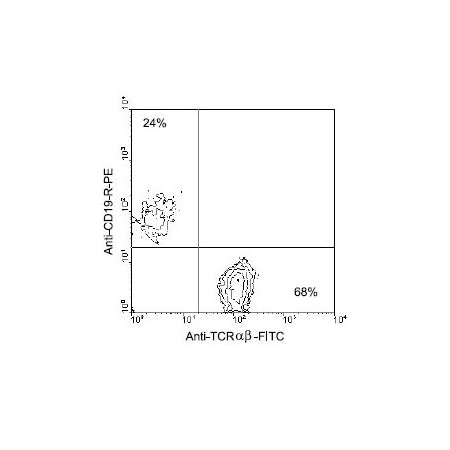
| Other Applications Image 1 Data | Amount Used: 1 Ug/106 cells BALB/c splenocytes were double-stained with hamster antimouse TCRαβ-FITC and rat anti-mouse CD19-R-PE , gated on small lymphocytes and analyzed on a FACScan flow cytometer (BDIS, San Jose, CA). |
| Storage | - The purified (UNLB) antibody is supplied as 0.5 mg of purified immunoglobulin in 1.0 mL of 100 mM boratebuffered saline, pH 8.2. No preservatives or amine- containing buffer salts added. Store at 2- 8 C - The fluorescein (FITC) conjugate is supplied as 0.5 mg or 0.1 mg in 1.0 mL of PBS/NaN3. Store at 2- 8 C - The biotin (BIOT) conjugate is supplied as 0.5 mg in 1.0 mL of PBS/NaN3. Store at 2- 8 C - The R- phycoerythrin (R- PE) and allophycocyanin (APC) conjugates are supplied as 0.1 mg in 1.0 mL ofPBS/NaN3 and a stabilizing agent. Store at 2- 8 C. Do not freeze! - The Spectral Red (SPRD) and R- phycoerythrin- Cyanine 5.5 (R- PE- CY 5.5) conjugates are supplied as 0.1mg in 1.0 mL of PBS/NaN3 and a stabilizing agent. Store at 2- 8 C. Do not freeze! - The low endotoxin, azide- free (LE/AF) antibody is supplied as 0.5 mg purified immunoglobulin in 1.0 mL of PBS Aliquot and store at or below - 20 C - The Alexa Fluor 488 (AF488) and Alexa Fluor 647 (AF647) conjugates are supplied as 0.1mg in 0.2mL ofPBS/NaN3. Store at 2- 8 C - Protect conjugated forms from light. Aliquot and freeze the low endotoxin, azide- free product at - 20 Cimmediately upon receipt. Each reagent is stable for the period shown on the bottle label if stored as directed. |
| Reference | 1. Gascoigne, N. R. J. 1990. J. Biol. Chem. 265:9296 2. Kubo, R. T., W. Born, J. W. Kappler, P. Marrack, and M. Pigeon. 1989. J. Immunol. 142:2736 3. Finkel, T. H., J. C. Cambier, R. T. Kubo, W. K. Born, P. Marrack, and J. W. Kappler. 1989. Cell 58:1047 4. Shi, Y. F., R. P. Bissonnette, N. Parfrey, M. Szalay, R. T. Kubo, and D. R. Green. 1991. J. Immunol. 146:3340 5. Murosaki, S., Y. Yoshikai, A. Ishida, T. Nakamura, G. Matsuzaki, H. Takimoto, H. Yuuki, and K. Nomoto. 1991. Int. Immunol. 3:1005 6. Finkel, T. H., P. Marrack, J. W. Kappler, R. T. Kubo, and J. C. Cambier. 1989. J. Immunol. 142:3006 7. Iwata, M., K. Katamura, R. T. Kubo, and K. Ishizaka. 1989. J. Immunol. 143:3909 8. Iwata, M., K. Katamura, R. T. Kubo, H. M. Grey, and K. Ishizaka. 1989. J. Immunol. 143:3917 9. Byrne, J. A., J. L. Butler, E. L. Reinherz, and M. D. Cooper. 1989. Int. Immunol. 1:29 10. Ellmeier, W., S. Jung, M.J. Sunshine, F. Hatam, Y. Xu, D. Baltimore, H. Mano, and D.R. Littman. 2000. J. Exp. Med. 192(11):1611. |
|---|---|
| Gene Symbol | TCRB |
| Gene Full Name | T-complex protein 1 subunit beta |
| Alias Symbols | Ti, Tib, TCRbe, TCRbeta |
| NCBI Gene Id | 21577 |
| Description of Target | T cell receptors recognize foreign antigens which have been processed as small peptides and bound to major histocompatibility complex (MHC) molecules at the surface of antigen presenting cells (APC). Each T cell receptor is a dimer consisting of one alpha and one beta chain or one delta and one gamma chain. In a single cell, the T cell receptor loci are rearranged and expressed in the order delta, gamma, beta, and alpha. If both delta and gamma rearrangements produce functional chains, the cell expresses delta and gamma. If not, the cell proceeds to rearrange the beta and alpha loci. This region represents the germline organization of the T cell receptor beta locus. The beta locus includes V (variable), J (joining), diversity (D), and C (constant) segments. During T cell development, the beta chain is synthesized by a recombination event at the DNA level joining a D segment with a J segment; a V segment is then joined to the D-J gene. The C segment is later joined by splicing at the RNA level. Recombination of many different V segments with several J segments provides a wide range of antigen recognition. Additional diversity is attained by junctional diversity, resulting from the random additional of nucleotides by terminal deoxynucleotidyltransferase. Several V segments of the beta locus are known to be incapable of encoding a protein and are considered pseudogenes. The beta locus also includes several trypsinogen genes. |
Protein interactions
| Name | # of Products |
|---|---|
| ACTB | 306 |
| ATG16L1 | 50 |
| CCNE1 | 82 |
| CDK7 | 109 |
| CTTNBP2 | 29 |
| FBXW8 | 105 |
| HDAC5 | 906 |
| IGBP1 | 29 |
| Mapk13 | 300 |
| MEPCE | 356 |
| MLST8 | 27 |
| MOB4 | 96 |
| MYC | 816 |
| PCK1 | 184 |
| PPP2CA | 290 |
| PPP2CB | 67 |
| PPP2R2A | 114 |
| PPP2R2B | 86 |
| PPP2R2C | 42 |
| PPP2R2D | 74 |
| PPP2R4 | 66 |
| PPP4C | 86 |
| PRPF40A | 218 |
| PSMA3 | 438 |
| RFWD2 | 86 |
| STK24 | 61 |
| STRN | 49 |
| STRN3 | 50 |
| SUMO4 | 252 |
| TCP1 | 44 |
| UBC | 7030 |
| VHL | 414 |
| YWHAG | 596 |
Biological pathways
| Name | # of Products |
|---|---|
| Protein folding | 257 |
Biological process
| Name | # of Products |
|---|---|
| Cellular protein metabolic process | 268 |
| Chaperone-mediated protein complex assembly | 10 |
| De novo posttranslational protein folding | 31 |
| Protein folding | 164 |
Cellular components
| Name | # of Products |
|---|---|
| Chaperonin-containing T-complex | 9 |
| Cytoplasm | 4549 |
| Cytosol | 1868 |
| Nucleolus | 1179 |
| Nucleus | 4914 |
Protein function
| Name | # of Products |
|---|---|
| ATP binding | 2814 |
| Nucleotide binding | 3928 |
| Unfolded protein binding | 252 |
-
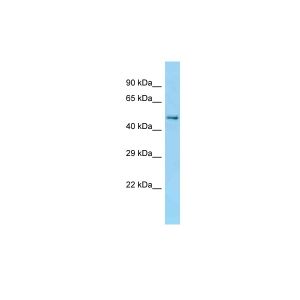 CCT2 Antibody - N-terminal region (ARP63402_P050)Catalog #: ARP63402_P050Species Tested: Human, MouseApplication: WB, IHCFormat: Liquid. Purified antibody supplied in 1x PBS buffer with 0.09% (w/v) sodium azide and 2% sucrose.
 -
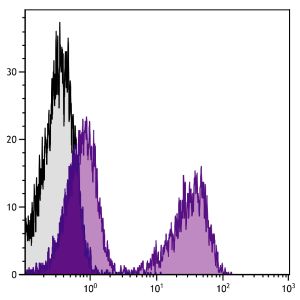 Mouse TCRb Antibody : SPRD (OASB01715)Catalog #: OASB01715Conjugation: Spectral Red®Clone: H57-597Species Tested: MouseApplication: FC
 -
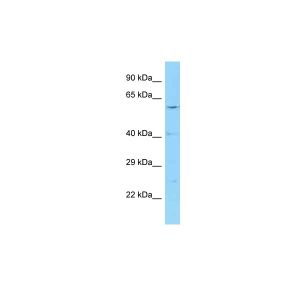 CCT2 Antibody - middle region (ARP63403_P050)Catalog #: ARP63403_P050Species Tested: Human, MouseApplication: WBFormat: Liquid. Purified antibody supplied in 1x PBS buffer with 0.09% (w/v) sodium azide and 2% sucrose.