

PDGF Receptor beta (Phospho-Tyr751) Antibody

Cat# MBS859673-0,1mL-AF647
Size : 0.1mL(AF647)
Brand : MyBiosource
Contact local distributor :

Phone : +1 850 650 7790
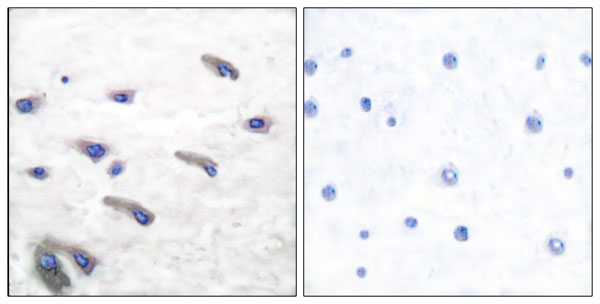
Immunohistochemical analysis of paraffin-embedded human brain tissue using PDGF Receptor beta (phospho-Tyr751) antibody.
P-peptide: -(left) +(right)
P-peptide: -(left) +(right)
PDGF Receptor Beta (PDGFR-beta) Antibody – Rabbit
For Research Use Only. Not for use in diagnostic procedures. Catalog #: MBS859673MBS859673 is an antibody targeting PDGFR-beta. Also known as PDGF Receptor beta (Phospho-Tyr751) Antibody. Reactive in Human, Mouse, Rat. Host: Rabbit. More details
Product Overview
Online Datasheet in PDFProduct Name
PDGF Receptor beta (PDGFR-beta), Antibody
Full Product Name
PDGF Receptor beta (Phospho-Tyr751) Antibody
Product Gene Name
anti-PDGFR-beta antibody
Product Synonym Names
CD140b; PDGF-R-beta; PDGFR; PGFRB; kinase PDGFR-beta
Host
Rabbit
Species Reactivity
Human, Mouse, Rat
Form/Format
In phosphate buffered saline (without Mg2+ and Ca2+), pH 7.4, 150mM NaCl, 0.02% sodium azide and 50% glycerol.
Purity/Purification
Affinity-purified from rabbit antiserum by affinity-chromatography using epitope-specific phosphopeptide. The antibody against non-phosphopeptide was removed by chromatography using non-phosphopeptide corresponding to the phosphorylation site.
Specificity
PDGF Receptor beta (phospho-Tyr751) antibody detects endogenous levels of Tau only when phosphorylated at tyrosine 751.
Preparation and Storage
Store at-20 degree C for 1 year
OMIM
131440
Immunogen
The antiserum was produced against synthesized phosphopeptide derived from human PDGF Receptor beta around the phosphorylation site of tyrosine (V-D-YP-V-P).
All Sites
Human: Tyr751
Mouse: Tyr750
Rat: Tyr750
Mouse: Tyr750
Rat: Tyr750
Product Categories/Family for anti-PDGFR-beta antibody
Autophagy antibody; Cancer; Cardiovascular; Cell Biology; Epigenetics & Nuclear Signaling; Developmental Biologys; Immunology; Drug Discovery Products; Metabolism; Neuroscience; Signal Transduction; Stem Cells
ISO Certification
Manufactured in an ISO 9001:2015 Certified Laboratory.
Applications Tested/Suitable for anti-PDGFR-beta antibody
Immunohistochemistry (IHC), ELISA (EIA)
Application Notes for anti-PDGFR-beta antibody
IHC: 1:50~100
ELISA: 1:10000
ELISA: 1:10000
Product References and Citations for anti-PDGFR-beta antibody
Keyvan Mahboubi and Jordan S. Pober, J. Biol. Chem., Mar 2002; 277: 8012-8021. Sara Rankin, J. Biol. Chem., Mar 1996; 271: 7829. Jeffrey J. Seidel and Barbara J. Graves, Genes & Dev., Jan 2002; 16: 127.
Other Notes
Small volumes of anti-PDGFR-beta antibody vial(s) may occasionally become entrapped in the seal of the product vial during shipment and storage. If necessary, briefly centrifuge the vial on a tabletop centrifuge to dislodge any liquid in the container`s cap. Certain products may require to ship with dry ice and additional dry ice fee may apply.
Additional Details
NCBI/Uniprot data below describe general gene information for PDGFR-beta. It may not necessarily be applicable to this product.
UniProt Primary Accession #
UniProt Related Accession #
GenBank Nucleotide #
NCBI Official Full Name
platelet-derived growth factor receptor beta isoform 1
NCBI Official Synonym Full Names
platelet derived growth factor receptor beta
NCBI Official Symbol
PDGFRB
NCBI Official Synonym Symbols
IMF1; KOGS; IBGC4; JTK12; PDGFR; PENTT; CD140B; PDGFR1; PDGFR-1
UniProt Protein Name
Platelet-derived growth factor receptor beta
UniProt Synonym Protein Names
Beta platelet-derived growth factor receptor; Beta-type platelet-derived growth factor receptor; CD140 antigen-like family member B; Platelet-derived growth factor receptor 1; PDGFR-1; CD_antigen: CD140b
UniProt Gene Name
PDGFRB
UniProt Synonym Gene Names
PDGFR; PDGFR1; PDGF-R-beta; PDGFR-beta; PDGFR-1
NCBI Protein Information
platelet-derived growth factor receptor beta
NCBI Summary for PDGFR-beta
The protein encoded by this gene is a cell surface tyrosine kinase receptor for members of the platelet-derived growth factor family. These growth factors are mitogens for cells of mesenchymal origin. The identity of the growth factor bound to a receptor monomer determines whether the functional receptor is a homodimer (PDGFB or PDGFD) or a heterodimer (PDGFA and PDGFB). This gene is essential for normal development of the cardiovascular system and aids in rearrangement of the actin cytoskeleton. This gene is flanked on chromosome 5 by the genes for granulocyte-macrophage colony-stimulating factor and macrophage-colony stimulating factor receptor; all three genes may be implicated in the 5-q syndrome. A translocation between chromosomes 5 and 12, that fuses this gene to that of the ETV6 gene, results in chronic myeloproliferative disorder with eosinophilia. [provided by RefSeq, Aug 2017]
Show more UniProt Comments for PDGFR-beta
Tyrosine-protein kinase that acts as cell-surface receptor for homodimeric PDGFB and PDGFD and for heterodimers formed by PDGFA and PDGFB, and plays an essential role in the regulation of embryonic development, cell proliferation, survival, differentiation, chemotaxis and migration. Plays an essential role in blood vessel development by promoting proliferation, migration and recruitment of pericytes and smooth muscle cells to endothelial cells. Plays a role in the migration of vascular smooth muscle cells and the formation of neointima at vascular injury sites. Required for normal development of the cardiovascular system. Required for normal recruitment of pericytes (mesangial cells) in the kidney glomerulus, and for normal formation of a branched network of capillaries in kidney glomeruli. Promotes rearrangement of the actin cytoskeleton and the formation of membrane ruffles. Binding of its cognate ligands - homodimeric PDGFB, heterodimers formed by PDGFA and PDGFB or homodimeric PDGFD -leads to the activation of several signaling cascades; the response depends on the nature of the bound ligand and is modulated by the formation of heterodimers between PDGFRA and PDGFRB. Phosphorylates PLCG1, PIK3R1, PTPN11, RASA1/GAP, CBL, SHC1 and NCK1. Activation of PLCG1 leads to the production of the cellular signaling molecules diacylglycerol and inositol 1,4,5-trisphosphate, mobilization of cytosolic Ca2+ and the activation of protein kinase C. Phosphorylation of PIK3R1, the regulatory subunit of phosphatidylinositol 3-kinase, leads to the activation of the AKT1 signaling pathway. Phosphorylation of SHC1, or of the C-terminus of PTPN11, creates a binding site for GRB2, resulting in the activation of HRAS, RAF1 and down-stream MAP kinases, including MAPK1/ERK2 and/or MAPK3/ERK1. Promotes phosphorylation and activation of SRC family kinases. Promotes phosphorylation of PDCD6IP/ALIX and STAM. Receptor signaling is down-regulated by protein phosphatases that dephosphorylate the receptor and its down-stream effectors, and by rapid internalization of the activated receptor.
Show more Research Articles on PDGFR-beta
Precautions
All of MyBioSource's Products are for scientific laboratory research purposes and are not for diagnostic, therapeutics, prophylactic or in vivo use. Through your purchase, you expressly represent and warrant to MyBioSource that you will properly test and use any Products purchased from MyBioSource in accordance with industry standards. MyBioSource and its authorized distributors reserve the right to refuse to process any order where we reasonably believe that the intended use will fall outside of our acceptable guidelines.
Disclaimer
While every efforts were made to ensure the accuracy of the information provided in this datasheet, MyBioSource will not be liable for any omissions or errors contained herein. MyBioSource reserves the right to make changes to this datasheet at any time without prior notice.
It is the responsibility of the customer to report product performance issues to MyBioSource within 30 days of receipt of the product. Please visit our Terms & Conditions page for more information.
It is the responsibility of the customer to report product performance issues to MyBioSource within 30 days of receipt of the product. Please visit our Terms & Conditions page for more information.
Product Note
Select online data sheet information is drawn from bioinformatics databases, occasionally resulting in ambiguous or non-relevant product information. It is the responsibility of the customer to review, verify, and evaluate the information to make sure it matches their requirements before purchasing the kit. Our ELISA Kit assays are dynamic research tools and sometimes they may be updated and improved. If the format of this assay is important to you then please request the current manual or contact our technical support team with a presales inquiry before placing an order. We will confirm the current details of the assay. We cannot guarantee the sample manual posted online is the most current manual, it is intended to serve as an example only. Please refer to the instructions For Use provided with the assay kit for precise details.
Product PubMed Publications
Products associated with anti-PDGFR-beta antibody
| Reference Product | PubMed Publications |
|---|---|
| PDGFRA antibody | >1533 publications with PDGFR-beta and PDGFRA |
| PDGFB antibody | >636 publications with PDGFR-beta and PDGFB |
| SRC antibody | >216 publications with PDGFR-beta and SRC |
| EGFR antibody | >133 publications with PDGFR-beta and EGFR |
| JAK2 antibody | >43 publications with PDGFR-beta and JAK2 |
| PDGFD antibody | >32 publications with PDGFR-beta and PDGFD |
| STAT3 antibody | >30 publications with PDGFR-beta and STAT3 |
| PTPN11 antibody | >29 publications with PDGFR-beta and PTPN11 |
| GRB2 antibody | >26 publications with PDGFR-beta and GRB2 |
| STAT1 antibody | >24 publications with PDGFR-beta and STAT1 |
Pathways associated with anti-PDGFR-beta antibody
| Products by Pathway | Pathway Diagram |
|---|---|
| Adaptive Immune System Pathway antibodies | Adaptive Immune System Pathway Diagram |
| Calcium Signaling Pathway antibodies | Calcium Signaling Pathway Diagram |
| Calcium Signaling Pathway antibodies | Calcium Signaling Pathway Diagram |
| Constitutive PI3K/AKT Signaling In Cancer Pathway antibodies | Constitutive PI3K/AKT Signaling In Cancer Pathway Diagram |
| Cytokine-cytokine Receptor Interaction Pathway antibodies | Cytokine-cytokine Receptor Interaction Pathway Diagram |
| Cytokine-cytokine Receptor Interaction Pathway antibodies | Cytokine-cytokine Receptor Interaction Pathway Diagram |
| DAP12 Interactions Pathway antibodies | DAP12 Interactions Pathway Diagram |
| DAP12 Signaling Pathway antibodies | DAP12 Signaling Pathway Diagram |
| Disease Pathway antibodies | Disease Pathway Diagram |
| Downstream Signaling Events Of B Cell Receptor (BCR) Pathway antibodies | Downstream Signaling Events Of B Cell Receptor (BCR) Pathway Diagram |
Diseases associated with anti-PDGFR-beta antibody
| Disease Name | Pubmed Publications |
|---|---|
| Neoplasms Antibodies | >1049 publications with PDGFR-beta and Neoplasms |
| Fibrosis Antibodies | >302 publications with PDGFR-beta and Fibrosis |
| Cardiovascular Diseases Antibodies | >248 publications with PDGFR-beta and Cardiovascular Diseases |
| Brain Diseases Antibodies | >160 publications with PDGFR-beta and Brain Diseases |
| Necrosis Antibodies | >143 publications with PDGFR-beta and Necrosis |
| Kidney Diseases Antibodies | >141 publications with PDGFR-beta and Kidney Diseases |
| Lung Diseases Antibodies | >140 publications with PDGFR-beta and Lung Diseases |
| Inflammation Antibodies | >137 publications with PDGFR-beta and Inflammation |
| Liver Diseases Antibodies | >135 publications with PDGFR-beta and Liver Diseases |
| Hypertension Antibodies | >109 publications with PDGFR-beta and Hypertension |
Organs/Tissues associated with anti-PDGFR-beta antibody
| Organ/Tissue Name | Pubmed Publications |
|---|---|
| Vascular Antibodies | >1180 publications with PDGFR-beta and Vascular |
| Muscle Antibodies | >852 publications with PDGFR-beta and Muscle |
| Blood Antibodies | >675 publications with PDGFR-beta and Blood |
| Kidney Antibodies | >293 publications with PDGFR-beta and Kidney |
| Lung Antibodies | >268 publications with PDGFR-beta and Lung |
| Liver Antibodies | >250 publications with PDGFR-beta and Liver |
| Bone Antibodies | >248 publications with PDGFR-beta and Bone |
| Brain Antibodies | >244 publications with PDGFR-beta and Brain |
| Embryonic Tissue Antibodies | >221 publications with PDGFR-beta and Embryonic Tissue |
| Skin Antibodies | >163 publications with PDGFR-beta and Skin |