

PRKDC, phosphorylated (Thr2609) (DNA-dependent Protein Kinase Catalytic Subunit, DNA-PK Catalytic Subunit, DNA-PKcs, DNPK1, p460, HYRC, HYRC1)

Cat# P9003-01C-200ul
Size : 200ul
Brand : US Biological
Contact local distributor :
 Phone : +1 850 650 7790
P9003-01C PRKDC, phosphorylated (Thr2609) (DNA-dependent Protein Kinase Catalytic Subunit, DNA-PK Catalytic Subunit, DNA-PKcs, DNPK1, p460, HYRC, HYRC1)
Clone Type
PolyclonalHost
rabbitSource
humanSwiss Prot
P78527Isotype
IgGGrade
Affinity PurifiedApplications
DB ECrossreactivity
HuShipping Temp
Blue IceStorage Temp
-20°CProtein kinases are enzymes that transfer a phosphate group from a phosphate donor, generally the g phosphate of ATP, onto an acceptor amino acid in a substrate protein. By this basic mechanism, protein kinases mediate most of the signal transduction in eukaryotic cells, regulating cellular metabolism, transcription, cell cycle progression, cytoskeletal rearrangement and cell movement, apoptosis, and differentiation. With more than 500 gene products, the protein kinase family is one of the largest families of proteins in eukaryotes. The family has been classified in 8 major groups based on sequence comparison of their tyrosine (PTK) or serine/threonine (STK) kinase catalytic domains. The STE group (homologs of yeast Sterile 7, 11, 20 kinases) consists of 50 kinases related to the mitogen-activated protein kinase (MAPK) cascade families (Ste7/MAP2K, Ste11/MAP3K, and Ste20/MAP4K). MAP kinase cascades, consisting of a MAPK and one or more upstream regulatory kinases (MAPKKs) have been best characterized in the yeast pheromone response pathway. Pheromones bind to Stem cell surface receptors and activate yeast MAPK pathway.
Applications:
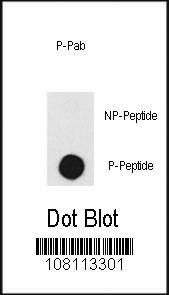
Suitable for use in ELISA and Dot Blot. Other applications not tested.
Recommended Dilution:
ELISA: 1:1,000
Dot Blot: 1:500
Optimal dilutions to be determined by the researcher.
Storage and Stability:
May be stored at 4°C for short-term only. Aliquot to avoid repeated freezing and thawing. Store at -20°C. Aliquots are stable for at least 12 months. For maximum recovery of product, centrifuge the original vial after thawing and prior to removing the cap.