



Inquiry
Dispatch Time: About 3 working days
- Product Name
- PerCP Anti-Human CD16 Antibody(3G8)
- Catalogue No.
- PCP-30061
- Form
- liquid
- Conjugation
- PerCP
- Conjugation Information
- PerCP is designed to be excited by the blue laser (488 nm) and detected using an optical filter centered near 675 nm (e.g., a 690/50 nm bandpass filter).
- Clonality
- Monoclonal
- Isotype
- IgG1, κ
- Clone ID
- 3G8
- Storage
- PBS with 0. 1% sodium azide, 1%BSA, pH 7.3, 2-8℃ for 12 months (Avoid repeated freeze / thaw cycles.)
Immunogen
Application
- Tested Applications
- FC
- Recommended dilution
- Volume per test: 5μL. Each lot of this antibody is quality control tested by flow cytometric analysis. The amount of the reagent is suggested to be used 5 µL of antibody per test (million cells in 100 µL staining volume or per 100 µL of whole blood). Please check your vial before the experiment. Since applications vary, the appropriate dilutions must be determined for individual use.
Validated Images
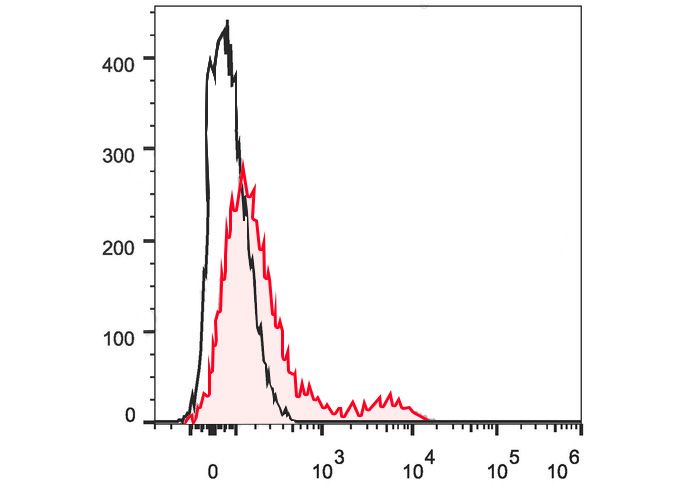 Human peripheral blood lymphocytes are stained with PerCP Anti-Human CD16 Antibody (filled gray histogram). Unstained splenocytes (black histogram) are used as control.
 - Background
- CD16 is a 60 kD highly glycosylated protein. It is a member of the Ig superfamily and is also known as B7-1, B7, and Ly-53. CD16 is constitutively expressed on dendritic cells and monocytes/macrophages, and inducibly expressed on activated B and T cells. The ligation of CD28 on T cells with CD16 and CD86 (B7-2) on antigen presenting cells (such as dendritic cells, macrophages, and B cells) elicits co-stimulation of T cells resulting in enhanced cell activation, proliferation, and cytokine production. CD16 appears to be expressed later in the immune response than CD86. CD16 can also bind to CD152, also known as CTLA-4, to deliver an inhibitory signal to T cells.