

Recombinant Apolipoprotein B (APOB)

Cat# MBS2105389-0,2mg
Size : 0.2mg
Brand : MyBiosource
Contact local distributor :

Phone : +1 850 650 7790

Apolipoprotein B (APOB) Mus Musculus (Mouse) Recombinant Protein
For Research Use Only. Not for use in diagnostic procedures. Special Promotion Catalog #: MBS2105389SPECIAL PROMOTION: Get FREE Starbucks gift card (Maximum 5 gift cards/product). Gift card(s) will be included with shipment
MBS2105389 is a recombinant protein targeting APOB. Also known as Recombinant Apolipoprotein B (APOB). Reactive in Mus musculus (Mouse). Host: E.coli. More details
Product Overview
Online Datasheet in PDFProduct Name
Apolipoprotein B (APOB), Recombinant Protein
Full Product Name
Recombinant Apolipoprotein B (APOB)
Product Gene Name
APOB recombinant protein
Product Synonym Names
Apo-B; FLDB; Apo B-100; Apo B-48
Host
E.coli
Species Reactivity
Mus musculus (Mouse)
Form/Format
PBS, pH7.4, containing 0.01% Sarcosyl, 5% Trehalose.
Purity/Purification
> 95%
Concentration
Original Concentration: 800ug/mL (lot specific)
Preparation and Storage
Storage:
Avoid repeated freeze/thaw cycles.
Store at 2-8 degree C for one month.
Aliquot and store at -80 degree C for 12 months.
Stability Test:
The thermal stability is described by the loss rate. The loss rate was determined by accelerated thermal degradation test, that is, incubate the protein at 37 degree C for 48h, and no obvious degradation and precipitation were observed. The loss rate is less than 5% within the expiration date under appropriate storage condition.
Matching Pairs
Unconjugated Antibody: APOB (MBS2112198)
Immunogen: APOB (MBS2105389)
Immunogen: APOB (MBS2105389)
Matching Pairs
Biotin Conjugated Antibody: APOB (MBS2113455)
Immunogen: APOB (MBS2105389)
Immunogen: APOB (MBS2105389)
Molecular Weight
Predicted Molecular Mass: 44.7kDa
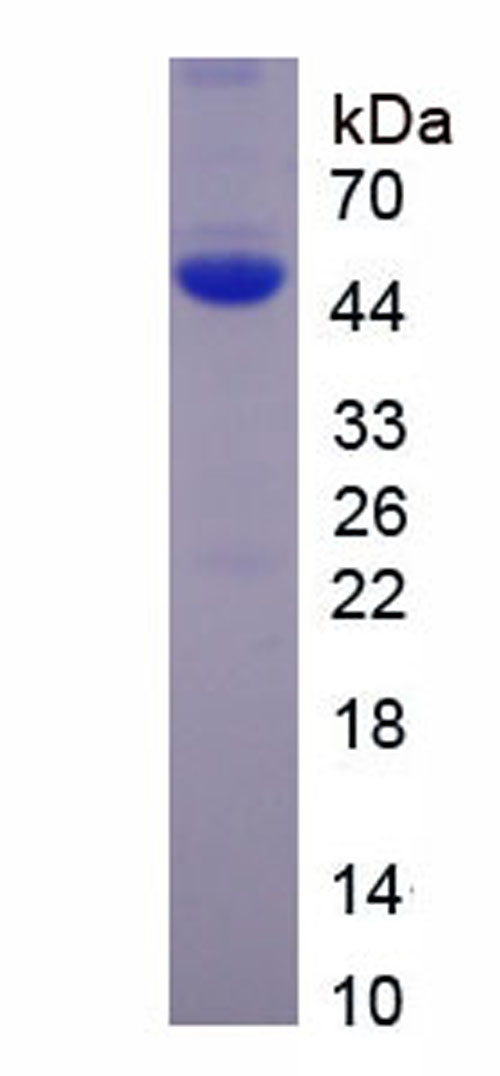
Accurate Molecular Mass: 50kDa as determined by SDS-PAGE reducing conditions.
Accurate Molecular Mass: 50kDa as determined by SDS-PAGE reducing conditions.
Supply Chain Verification
Manufactured in a lab with traceable raw materials. Bulk orders can typically be prepared to the customer’s specifications, please inquire.
Source
Prokaryotic expression
Residues
Leu32~Met306
Tags
Two N-terminal Tags, His-tag and SUMO-tag
Subcellular Location
Secreted, Cytoplasm
Traits
Freeze-dried powder
Predicted isoelectric point
8.2
Phenomenon explanation
The possible reasons that the actual band size differs from the predicted are as follows:
1.Splice variants: Alternative splicing may create different sized proteins from the same gene.
2. Relative charge: The composition of amino acids may affects the charge of the protein.
3. Post-translational modification: Phosphorylation, glycosylation, methylation etc.
4. Post-translation cleavage: Many proteins are synthesized as pro-proteins, and then cleaved
to give the active form.
5. Polymerization of the target protein: Dimerization, multimerization etc.
Usage
Reconstitute in 10mM PBS (pH7.4) to a concentration of 0.1-1.0 mg/mL. Do not vortex.
ISO Certification
Manufactured in an ISO 9001:2015 and ISO 13485:2016 Certified Laboratory.
Applications Tested/Suitable for APOB recombinant protein
Positive Control; Immunogen; SDS-PAGE; Western Blot (WB).
Application Notes for APOB recombinant protein
(May be suitable for use in other assays to be determined by the end user.)
Other Notes
Small volumes of APOB recombinant protein vial(s) may occasionally become entrapped in the seal of the product vial during shipment and storage. If necessary, briefly centrifuge the vial on a tabletop centrifuge to dislodge any liquid in the container`s cap. Certain products may require to ship with dry ice and additional dry ice fee may apply.
Additional Details
NCBI/Uniprot data below describe general gene information for APOB. It may not necessarily be applicable to this product.
NCBI Official Full Name
apolipoprotein B-100
NCBI Official Synonym Full Names
apolipoprotein B
NCBI Official Symbol
Apob
NCBI Official Synonym Symbols
apob-48; AI315052; apob-100; Apo B-100
UniProt Protein Name
Apolipoprotein B-100
Protein Family
Apolipoprotein
UniProt Gene Name
Apob
UniProt Synonym Gene Names
Apo B-100; Apo B-48
NCBI Protein Information
apolipoprotein B-100
NCBI Summary for APOB
This gene product is the main apolipoprotein of chylomicrons and low density lipoproteins. It occurs in plasma as two main isoforms, apoB-48 and apoB-100. Unlike the apoB-48 and apoB-100 structural equivalents in human, which are synthesized exclusively in the gut and liver, respectively, the mouse apoB-48 isoform is also found in mouse liver. The intestinal and the hepatic forms of apoB are encoded by a single gene from a single, very long mRNA. The two isoforms share a common N-terminal sequence. The shorter apoB-48 protein is produced after RNA editing of the apoB-100 transcript at residue 2179 (CAA->UAA), resulting in the creation of a stop codon, and early translation termination. [provided by RefSeq, Jul 2008]
Show more UniProt Comments for APOB
Apolipoprotein B is a major protein constituent of chylomicrons (apo B-48), LDL (apo B-100) and VLDL (apo B-100). Apo B-100 functions as a recognition signal for the cellular binding and internalization of LDL particles by the apoB/E receptor.
Research Articles on APOB
Precautions
All of MyBioSource's Products are for scientific laboratory research purposes and are not for diagnostic, therapeutics, prophylactic or in vivo use. Through your purchase, you expressly represent and warrant to MyBioSource that you will properly test and use any Products purchased from MyBioSource in accordance with industry standards. MyBioSource and its authorized distributors reserve the right to refuse to process any order where we reasonably believe that the intended use will fall outside of our acceptable guidelines.
Disclaimer
While every efforts were made to ensure the accuracy of the information provided in this datasheet, MyBioSource will not be liable for any omissions or errors contained herein. MyBioSource reserves the right to make changes to this datasheet at any time without prior notice.
It is the responsibility of the customer to report product performance issues to MyBioSource within 30 days of receipt of the product. Please visit our Terms & Conditions page for more information.
It is the responsibility of the customer to report product performance issues to MyBioSource within 30 days of receipt of the product. Please visit our Terms & Conditions page for more information.
Product Note
Select online data sheet information is drawn from bioinformatics databases, occasionally resulting in ambiguous or non-relevant product information. It is the responsibility of the customer to review, verify, and evaluate the information to make sure it matches their requirements before purchasing the kit. Our ELISA Kit assays are dynamic research tools and sometimes they may be updated and improved. If the format of this assay is important to you then please request the current manual or contact our technical support team with a presales inquiry before placing an order. We will confirm the current details of the assay. We cannot guarantee the sample manual posted online is the most current manual, it is intended to serve as an example only. Please refer to the instructions For Use provided with the assay kit for precise details.
Product PubMed Publications
Products associated with APOB recombinant protein
| Reference Product | PubMed Publications |
|---|---|
| Apoe recombinant protein | >1561 publications with APOB and Apoe |
| Apoa1 recombinant protein | >584 publications with APOB and Apoa1 |
| Ldlr recombinant protein | >532 publications with APOB and Ldlr |
| Lpl recombinant protein | >251 publications with APOB and Lpl |
| Mttp recombinant protein | >65 publications with APOB and Mttp |
| Apoc3 recombinant protein | >65 publications with APOB and Apoc3 |
| Apoa2 recombinant protein | >24 publications with APOB and Apoa2 |
| Plg recombinant protein | >4 publications with APOB and Plg |
Pathways associated with APOB recombinant protein
| Products by Pathway | Pathway Diagram |
|---|---|
| Binding And Uptake Of Ligands By Scavenger Receptors Pathway antibodies | Binding And Uptake Of Ligands By Scavenger Receptors Pathway Diagram |
| Cargo Recognition For Clathrin-mediated Endocytosis Pathway antibodies | Cargo Recognition For Clathrin-mediated Endocytosis Pathway Diagram |
| Cell Surface Interactions At The Vascular Wall Pathway antibodies | Cell Surface Interactions At The Vascular Wall Pathway Diagram |
| Chylomicron-mediated Lipid Transport Pathway antibodies | Chylomicron-mediated Lipid Transport Pathway Diagram |
| Clathrin-mediated Endocytosis Pathway antibodies | Clathrin-mediated Endocytosis Pathway Diagram |
| Fat Digestion And Absorption Pathway antibodies | Fat Digestion And Absorption Pathway Diagram |
| Fat Digestion And Absorption Pathway antibodies | Fat Digestion And Absorption Pathway Diagram |
| Hemostasis Pathway antibodies | Hemostasis Pathway Diagram |
| Immune System Pathway antibodies | Immune System Pathway Diagram |
| Innate Immune System Pathway antibodies | Innate Immune System Pathway Diagram |
Diseases associated with APOB recombinant protein
| Disease Name | Pubmed Publications |
|---|---|
| Cardiovascular Diseases Antibodies | >3782 publications with APOB and Cardiovascular Diseases |
| Dyslipidemias Antibodies | >3249 publications with APOB and Dyslipidemias |
| Atherosclerosis Antibodies | >2793 publications with APOB and Atherosclerosis |
| Hyperlipidemias Antibodies | >2614 publications with APOB and Hyperlipidemias |
| Coronary Disease Antibodies | >1991 publications with APOB and Coronary Disease |
| Heart Diseases Antibodies | >1743 publications with APOB and Heart Diseases |
| Hypercholesterolemia Antibodies | >1618 publications with APOB and Hypercholesterolemia |
| Insulin Resistance Antibodies | >814 publications with APOB and Insulin Resistance |
| Hyperlipoproteinemia Type II Antibodies | >775 publications with APOB and Hyperlipoproteinemia Type II |
| Hypertriglyceridemia Antibodies | >667 publications with APOB and Hypertriglyceridemia |
Organs/Tissues associated with APOB recombinant protein
| Organ/Tissue Name | Pubmed Publications |
|---|---|
| Liver Antibodies | >2419 publications with APOB and Liver |
| Intestine Antibodies | >635 publications with APOB and Intestine |
| Kidney Antibodies | >461 publications with APOB and Kidney |
| Muscle Antibodies | >287 publications with APOB and Muscle |
| Lung Antibodies | >156 publications with APOB and Lung |
| Embryonic Tissue Antibodies | >61 publications with APOB and Embryonic Tissue |
| Spleen Antibodies | >59 publications with APOB and Spleen |
| Bone Marrow Antibodies | >39 publications with APOB and Bone Marrow |
| Lymph Node Antibodies | >15 publications with APOB and Lymph Node |
| Extraembryonic Tissue Antibodies | >1 publications with APOB and Extraembryonic Tissue |
You might also be interested by the following products:
Cat#
Description
Cond.
Price Bef. VAT