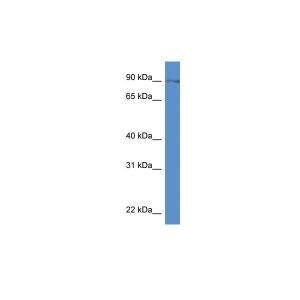

SLC9A7 antibody - N-terminal region

Cat# ARP44066_P050
Size : 100ul
Brand : Aviva Systems Biology
Contact local distributor :
 Phone : +1 850 650 7790
SLC9A7 Antibody - N-terminal region (ARP44066_P050)
Click here to learn more about Aviva's By-Request Conjugation Service.
| Datasheets/Manuals | Printable datasheet for anti-SLC9A7 (ARP44066_P050) antibody |
|---|
| Tested Species Reactivity | Human |
|---|---|
| Predicted Species Reactivity | Human, Mouse, Dog, Goat, Guinea Pig, Rabbit, Zebrafish |
| Product Format | Liquid. Purified antibody supplied in 1x PBS buffer with 0.09% (w/v) sodium azide and 2% sucrose. |
| Clonality | Polyclonal |
| Host | Rabbit |
| Application | WB |
| Reconstitution and Storage | For short term use, store at 2-8C up to 1 week. For long term storage, store at -20C in small aliquots to prevent freeze-thaw cycles. |
| Immunogen | The immunogen is a synthetic peptide directed towards the N terminal region of human SLC9A7 |
| Purification | Affinity Purified |
| Predicted Homology Based on Immunogen Sequence | Dog: 100%; Goat: 85%; Guinea Pig: 100%; Human: 100%; Mouse: 100%; Rabbit: 100%; Zebrafish: 100% |
| Peptide Sequence | Synthetic peptide located within the following region: LGWGLRVAAAASASSSGAAAEDSSAMEELATEKEAEESHRQDSVSLLTFI |
| Concentration | 0.5 mg/ml |
| Blocking Peptide | For anti-SLC9A7 (ARP44066_P050) antibody is Catalog # AAP44066 (Previous Catalog # AAPP25512) |
| Reference | Lin,P.J., J. Cell. Sci. 118 (PT 9), 1885-1897 (2005) |
|---|---|
| Gene Symbol | SLC9A7 |
| Gene Full Name | Solute carrier family 9, subfamily A (NHE7, cation proton antiporter 7), member 7 |
| Alias Symbols | NHE7, NHE-7, MRX108, SLC9A6 |
| NCBI Gene Id | 84679 |
| Protein Name | Sodium/hydrogen exchanger 7 |
| Description of Target | Organelles of the secretory and endocytic pathways are distinguished by their luminal acidity, which is generated by the activity of an electrogenic vacuolar-type hydrogen ATPase. Progressive acidification of vesicles in the endocytic pathway is essential for the redistribution and degradation of internalized membrane proteins, such as ligand receptor complexes and fluid-phase solutes. It may play an important role in maintaining cation homeostasis and function of the trans-Golgi network.Organelles of the secretory and endocytic pathways are distinguished by their luminal acidity, which is generated by the activity of an electrogenic vacuolar-type hydrogen ATPase. Progressive acidification of vesicles in the endocytic pathway is essential for the redistribution and degradation of internalized membrane proteins, such as ligand receptor complexes and fluid-phase solutes. This gene is expressed predominantly in the trans-Golgi network, and mediates the influx of sodium or potassium in exchange for hydrogen. It may thus play an important role in maintaining cation homeostasis and function of the trans-Golgi network. This gene is part of a gene cluster on chromosome Xp11.23.Organelles of the secretory and endocytic pathways are distinguished by their luminal acidity, which is generated by the activity of an electrogenic vacuolar-type hydrogen ATPase. Progressive acidification of vesicles in the endocytic pathway is essential for the redistribution and degradation of internalized membrane proteins, such as ligand receptor complexes and fluid-phase solutes. This gene is expressed predominantly in the trans-Golgi network, and mediates the influx of sodium or potassium in exchange for hydrogen. It may thus play an important role in maintaining cation homeostasis and function of the trans-Golgi network. This gene is part of a gene cluster on chromosome Xp11.23. |
| Uniprot ID | Q96T83 |
| Protein Accession # | NP_115980 |
| Nucleotide Accession # | NM_032591 |
| Protein Size (# AA) | 725 |
| Molecular Weight | 80kDa |
| Protein Interactions | UBC; SCAMP5; SCAMP2; SCAMP1; SLC9A7; |