

SMAD3 Mouse Monoclonal Antibody [Clone PCRP-SMAD3-1A2]

Cat# MBS4382064-0,02mg-BSA-AZ
Size : 0.02mg(WithBSA&Azideat0.2mg/mL)
Brand : MyBiosource
Contact local distributor :
 Phone : +1 850 650 7790
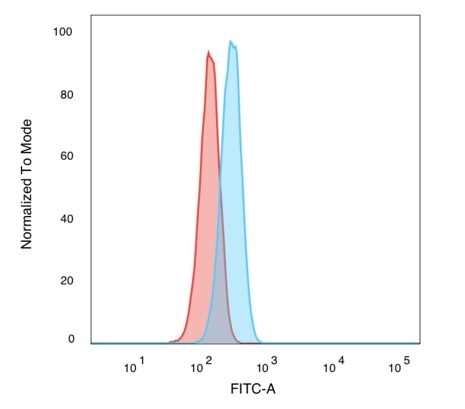
Flow Cytometric Analysis of PFA-fixed HeLa cells. SMAD3 Mouse Monoclonal Antibody (PCRP-SMAD3-1A2) followed by goat anti-mouse IgG-CF488 (blue); unstained cells (red).
SMAD3 Antibody – Mouse Monoclonal
For Research Use Only. Not for use in diagnostic procedures. Catalog #: MBS4382064Smad proteins, the mammalian homologs of the Drosophila mothers against dpp (Mad) have been implicated as downstream effectors of TGFbeta/BMP signaling. Smad1 (also designated Madr1 or JV4-1), Smad5 and mammalian Smad8 (also designated Smad9 or MadH6) are… More details
Product Overview
Product Name
SMAD3, Monoclonal Antibody
Full Product Name
SMAD3 Mouse Monoclonal Antibody [Clone PCRP-SMAD3-1A2]
Product Gene Name
anti-SMAD3 antibody
Product Synonym Names
hMAD-3; hSMAD3; JV152; LDS1C; LDS3; MAD (mothers against decapentaplegic Drosophila) homolog 3; MADH3; SMA and MAD related protein 3; SMAD, mothers against DPP homolog 3
Clonality
Monoclonal
Isotype
Mouse/IgG1
Clone Number
PCRP-SMAD3-1A2
Host
Mouse
Species Reactivity
Human
Form/Format
200ug/ml of Ab purified from Bioreactor Concentrate by Protein A/G. Prepared in 10mM PBS with 0. 05% BSA & 0. 05% azide. Also available WITHOUT BSA & azide at 1.0mg/ml.
Concentration
Purified Ab with BSA and Azide at 200ug/ml
OR
Purified Ab WITHOUT BSA and Azide at 1.0mg/ml (lot specific)
OR
Purified Ab WITHOUT BSA and Azide at 1.0mg/ml (lot specific)
Preparation and Storage
Antibody with azide: store at 2 to 8 degree C
Antibody without azide: store at -20 to -80 degree C
Antibody is stable for 24 months. Non-hazardous. No MSDS required.
Antibody without azide: store at -20 to -80 degree C
Antibody is stable for 24 months. Non-hazardous. No MSDS required.
Molecular Weight
48,081 Da
Chromosome Location
Chromosome: 15; NC_000015.9 (67358195..67487533). Location: 15q22.33
OMIM
114500
Immunogen
Recombinant full-length human SMAD3 protein
Cellular Localization
Cytoplasm, Nucleus
Positive Control
HeLa or HepG2 cells.
Hu-chromosome Location
15q22.33
Unigene
727986
Applications Tested/Suitable for anti-SMAD3 antibody
Flow Cytometry (FC/FACS), Immunofluorescence (IF)
Application Notes for anti-SMAD3 antibody
FC/FACS: 1-2ug/million cells
IF: 1-2ug/ml
IF: 1-2ug/ml
Other Notes
Small volumes of anti-SMAD3 antibody vial(s) may occasionally become entrapped in the seal of the product vial during shipment and storage. If necessary, briefly centrifuge the vial on a tabletop centrifuge to dislodge any liquid in the container`s cap. Certain products may require to ship with dry ice and additional dry ice fee may apply.
Searchable Terms for SMAD3 purchase
MBS4382064 is an antibody targeting SMAD3. Also known as SMAD3 Mouse Monoclonal Antibody [Clone PCRP-SMAD3-1A2]. Reactive in Human. Host: Mouse.
Additional Details
NCBI/Uniprot data below describe general gene information for SMAD3. It may not necessarily be applicable to this product.
NCBI Official Full Name
mothers against decapentaplegic homolog 3 isoform 2
NCBI Official Synonym Full Names
SMAD family member 3
NCBI Official Symbol
SMAD3
NCBI Official Synonym Symbols
LDS3; LDS1C; MADH3; JV15-2; HSPC193; HsT17436
UniProt Protein Name
Mothers against decapentaplegic homolog 3
UniProt Synonym Protein Names
JV15-2; SMAD family member 3
Protein Family
Mothers against decapentaplegic
UniProt Gene Name
SMAD3
UniProt Synonym Gene Names
MADH3; MAD homolog 3; Mad3; Mothers against DPP homolog 3; hMAD-3; SMAD 3; Smad3; hSMAD3
UniProt Entry Name
SMAD3_HUMAN
NCBI Protein Information
mothers against decapentaplegic homolog 3; mad3; hMAD-3; hSMAD3; MAD homolog 3; mad homolog JV15-2; mad protein homolog; mothers against DPP homolog 3; SMA- and MAD-related protein 3; SMAD, mothers against DPP homolog 3; MAD, mothers against decapentapleg
NCBI Summary for SMAD3
The protein encoded by this gene belongs to the SMAD, a family of proteins similar to the gene products of the Drosophila gene 'mothers against decapentaplegic' (Mad) and the C. elegans gene Sma. SMAD proteins are signal transducers and transcriptional modulators that mediate multiple signaling pathways. This protein functions as a transcriptional modulator activated by transforming growth factor-beta and is thought to play a role in the regulation of carcinogenesis. [provided by RefSeq, Apr 2009]
Show more UniProt Comments for SMAD3
SMAD3: transcription factor phosphorylated and activated by TGF-beta-type receptors. A receptor-regulated Smad (R-smad). Binds directly to consensus DNA-binding elements in the promoters of target genes. In mouse required for establishemnt of the mucosal immune response and proper development of skeleton.
Protein type: DNA-binding; Transcription factor; Nuclear receptor co-regulator
Chromosomal Location of Human Ortholog: 15q22.33
Cellular Component: nucleoplasm; transcription factor complex; nuclear chromatin; cytoplasm; plasma membrane; nuclear inner membrane; cytosol; nucleus; receptor complex
Molecular Function: identical protein binding; ubiquitin binding; protein homodimerization activity; zinc ion binding; chromatin DNA binding; beta-catenin binding; protein kinase binding; transcription factor binding; phosphatase binding; transforming growth factor beta receptor, pathway-specific cytoplasmic mediator activity; collagen binding; protein binding; sequence-specific DNA binding; ubiquitin protein ligase binding; double-stranded DNA binding; bHLH transcription factor binding; transforming growth factor beta receptor binding; transcription factor activity
Biological Process: developmental growth; positive regulation of positive chemotaxis; positive regulation of transcription, DNA-dependent; activin receptor signaling pathway; paraxial mesoderm morphogenesis; embryonic pattern specification; regulation of transforming growth factor beta receptor signaling pathway; transforming growth factor beta receptor signaling pathway; positive regulation of stress fiber formation; embryonic foregut morphogenesis; negative regulation of mitotic cell cycle; negative regulation of osteoblast differentiation; cell cycle arrest; regulation of striated muscle development; pericardium development; somitogenesis; transcription, DNA-dependent; embryonic cranial skeleton morphogenesis; osteoblast development; regulation of transcription from RNA polymerase II promoter; positive regulation of chondrocyte differentiation; mesoderm formation; negative regulation of osteoblast proliferation; positive regulation of transcription from RNA polymerase II promoter; negative regulation of protein catabolic process; endoderm development; negative regulation of apoptosis; evasion of host defenses by virus; wound healing; T cell activation; negative regulation of transcription from RNA polymerase II promoter; primary microRNA processing; regulation of epithelial cell proliferation; positive regulation of focal adhesion formation; negative regulation of protein amino acid phosphorylation; ureteric bud development; transport; positive regulation of transforming growth factor-beta3 production; thyroid gland development; positive regulation of transcription factor import into nucleus; heart looping; caspase activation; transcription initiation from RNA polymerase II promoter; intercellular junction assembly and maintenance; regulation of transforming growth factor-beta2 production; regulation of immune response; regulation of binding; protein stabilization; in utero embryonic development; positive regulation of bone mineralization; liver development; SMAD protein complex assembly; immune system development; positive regulation of interleukin-1 beta production; negative regulation of inflammatory response; response to hypoxia; gene expression; immune response; negative regulation of cell growth; negative regulation of transforming growth factor beta receptor signaling pathway; positive regulation of cell migration
Disease: Loeys-dietz Syndrome 3
Show more Protein type: DNA-binding; Transcription factor; Nuclear receptor co-regulator
Chromosomal Location of Human Ortholog: 15q22.33
Cellular Component: nucleoplasm; transcription factor complex; nuclear chromatin; cytoplasm; plasma membrane; nuclear inner membrane; cytosol; nucleus; receptor complex
Molecular Function: identical protein binding; ubiquitin binding; protein homodimerization activity; zinc ion binding; chromatin DNA binding; beta-catenin binding; protein kinase binding; transcription factor binding; phosphatase binding; transforming growth factor beta receptor, pathway-specific cytoplasmic mediator activity; collagen binding; protein binding; sequence-specific DNA binding; ubiquitin protein ligase binding; double-stranded DNA binding; bHLH transcription factor binding; transforming growth factor beta receptor binding; transcription factor activity
Biological Process: developmental growth; positive regulation of positive chemotaxis; positive regulation of transcription, DNA-dependent; activin receptor signaling pathway; paraxial mesoderm morphogenesis; embryonic pattern specification; regulation of transforming growth factor beta receptor signaling pathway; transforming growth factor beta receptor signaling pathway; positive regulation of stress fiber formation; embryonic foregut morphogenesis; negative regulation of mitotic cell cycle; negative regulation of osteoblast differentiation; cell cycle arrest; regulation of striated muscle development; pericardium development; somitogenesis; transcription, DNA-dependent; embryonic cranial skeleton morphogenesis; osteoblast development; regulation of transcription from RNA polymerase II promoter; positive regulation of chondrocyte differentiation; mesoderm formation; negative regulation of osteoblast proliferation; positive regulation of transcription from RNA polymerase II promoter; negative regulation of protein catabolic process; endoderm development; negative regulation of apoptosis; evasion of host defenses by virus; wound healing; T cell activation; negative regulation of transcription from RNA polymerase II promoter; primary microRNA processing; regulation of epithelial cell proliferation; positive regulation of focal adhesion formation; negative regulation of protein amino acid phosphorylation; ureteric bud development; transport; positive regulation of transforming growth factor-beta3 production; thyroid gland development; positive regulation of transcription factor import into nucleus; heart looping; caspase activation; transcription initiation from RNA polymerase II promoter; intercellular junction assembly and maintenance; regulation of transforming growth factor-beta2 production; regulation of immune response; regulation of binding; protein stabilization; in utero embryonic development; positive regulation of bone mineralization; liver development; SMAD protein complex assembly; immune system development; positive regulation of interleukin-1 beta production; negative regulation of inflammatory response; response to hypoxia; gene expression; immune response; negative regulation of cell growth; negative regulation of transforming growth factor beta receptor signaling pathway; positive regulation of cell migration
Disease: Loeys-dietz Syndrome 3
Precautions
All of MyBioSource's Products are for scientific laboratory research purposes and are not for diagnostic, therapeutics, prophylactic or in vivo use. Through your purchase, you expressly represent and warrant to MyBioSource that you will properly test and use any Products purchased from MyBioSource in accordance with industry standards. MyBioSource and its authorized distributors reserve the right to refuse to process any order where we reasonably believe that the intended use will fall outside of our acceptable guidelines.
Disclaimer
While every efforts were made to ensure the accuracy of the information provided in this datasheet, MyBioSource will not be liable for any omissions or errors contained herein. MyBioSource reserves the right to make changes to this datasheet at any time without prior notice.
It is the responsibility of the customer to report product performance issues to MyBioSource within 30 days of receipt of the product. Please visit our Terms & Conditions page for more information.
It is the responsibility of the customer to report product performance issues to MyBioSource within 30 days of receipt of the product. Please visit our Terms & Conditions page for more information.
Product Note
Select online data sheet information is drawn from bioinformatics databases, occasionally resulting in ambiguous or non-relevant product information. It is the responsibility of the customer to review, verify, and evaluate the information to make sure it matches their requirements before purchasing the kit. Our ELISA Kit assays are dynamic research tools and sometimes they may be updated and improved. If the format of this assay is important to you then please request the current manual or contact our technical support team with a presales inquiry before placing an order. We will confirm the current details of the assay. We cannot guarantee the sample manual posted online is the most current manual, it is intended to serve as an example only. Please refer to the instructions For Use provided with the assay kit for precise details.
Product PubMed Publications
Products associated with anti-SMAD3 antibody
| Reference Product | PubMed Publications |
|---|---|
| SMAD2 antibody | >1384 publications with SMAD3 and SMAD2 |
| SMAD4 antibody | >729 publications with SMAD3 and SMAD4 |
| JUN antibody | >407 publications with SMAD3 and JUN |
| SMAD1 antibody | >169 publications with SMAD3 and SMAD1 |
| MYC antibody | >88 publications with SMAD3 and MYC |
| CTNNB1 antibody | >85 publications with SMAD3 and CTNNB1 |
| SP1 antibody | >72 publications with SMAD3 and SP1 |
| SKI antibody | >63 publications with SMAD3 and SKI |
| MAPK1 antibody | >44 publications with SMAD3 and MAPK1 |
| RUNX2 antibody | >37 publications with SMAD3 and RUNX2 |
Pathways associated with anti-SMAD3 antibody
| Products by Pathway | Pathway Diagram |
|---|---|
| AGE/RAGE Pathway antibodies | AGE/RAGE Pathway Diagram |
| Adherens Junction Pathway antibodies | Adherens Junction Pathway Diagram |
| Adherens Junction Pathway antibodies | Adherens Junction Pathway Diagram |
| Adipogenesis Pathway antibodies | Adipogenesis Pathway Diagram |
| Alpha6-Beta4 Integrin Signaling Pathway antibodies | Alpha6-Beta4 Integrin Signaling Pathway Diagram |
| Androgen Receptor Signaling Pathway antibodies | Androgen Receptor Signaling Pathway Diagram |
| Cell Cycle Pathway antibodies | Cell Cycle Pathway Diagram |
| Cell Cycle Pathway antibodies | Cell Cycle Pathway Diagram |
| Cell Cycle Pathway antibodies | Cell Cycle Pathway Diagram |
| Chagas Disease (American Trypanosomiasis) Pathway antibodies | Chagas Disease (American Trypanosomiasis) Pathway Diagram |
Diseases associated with anti-SMAD3 antibody
| Disease Name | Pubmed Publications |
|---|---|
| Fibrosis Antibodies | >674 publications with SMAD3 and Fibrosis |
| Neoplasms Antibodies | >581 publications with SMAD3 and Neoplasms |
| Disease Models, Animal Antibodies | >245 publications with SMAD3 and Disease Models, Animal |
| Inflammation Antibodies | >244 publications with SMAD3 and Inflammation |
| Liver Diseases Antibodies | >175 publications with SMAD3 and Liver Diseases |
| Kidney Diseases Antibodies | >152 publications with SMAD3 and Kidney Diseases |
| Cardiovascular Diseases Antibodies | >145 publications with SMAD3 and Cardiovascular Diseases |
| Breast Neoplasms Antibodies | >100 publications with SMAD3 and Breast Neoplasms |
| Necrosis Antibodies | >92 publications with SMAD3 and Necrosis |
| Liver Cirrhosis Antibodies | >91 publications with SMAD3 and Liver Cirrhosis |
Organs/Tissues associated with anti-SMAD3 antibody
| Organ/Tissue Name | Pubmed Publications |
|---|---|
| Muscle Antibodies | >452 publications with SMAD3 and Muscle |
| Lung Antibodies | >276 publications with SMAD3 and Lung |
| Skin Antibodies | >195 publications with SMAD3 and Skin |
| Heart Antibodies | >143 publications with SMAD3 and Heart |
| Embryonic Tissue Antibodies | >137 publications with SMAD3 and Embryonic Tissue |
| Intestine Antibodies | >56 publications with SMAD3 and Intestine |
| Thyroid Antibodies | >28 publications with SMAD3 and Thyroid |
| Ascites Antibodies | >1 publications with SMAD3 and Ascites |
| Uncharacterized Tissue Antibodies | >1 publications with SMAD3 and Uncharacterized Tissue |