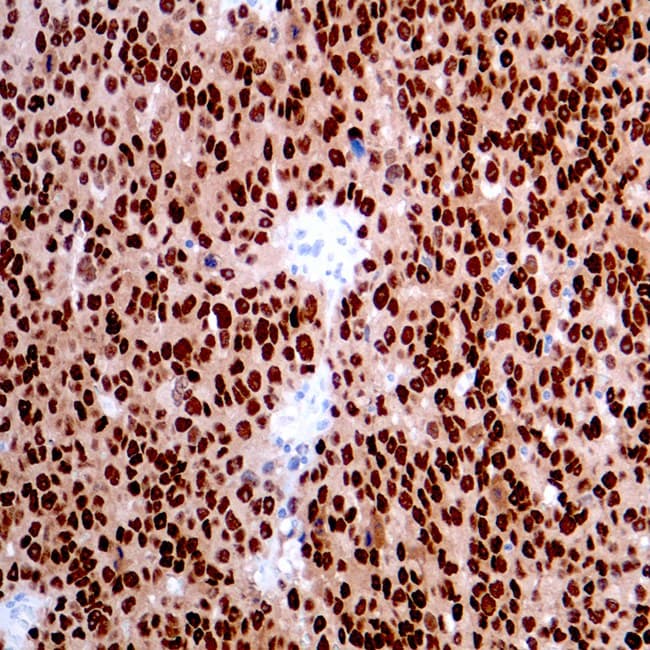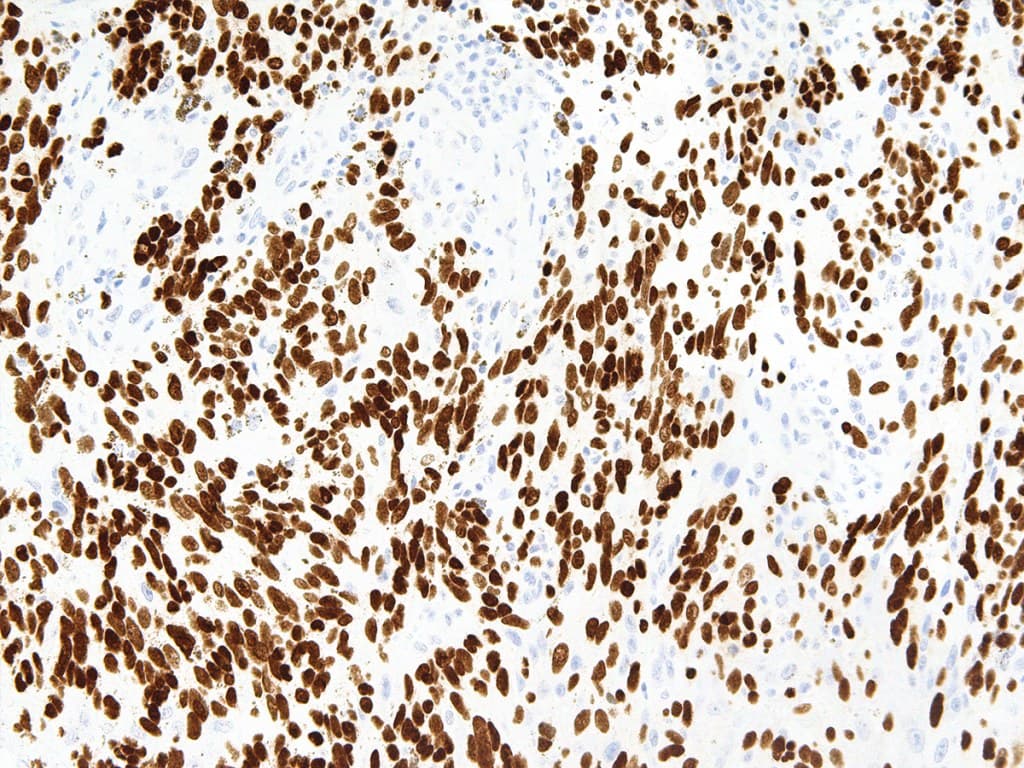

SRY (Sex Determining Region Y)-Box 10 (SOX10) is a nuclear transcription factor belonging to the SOXE family and plays an essential role in the development, survival, and differentiation of neural crest-derived lineages, particularly melanocytes and Schwann cells. SOX10 regulates melanocytic differentiation through transcriptional control of key downstream targets, including MITF and other pigmentation-associated genes, making it a highly sensitive and relatively lineage-restricted biomarker in diagnostic pathology.
Biological Significance of SOX10
- Master regulator of neural crest development and lineage specification.
- Critical for the differentiation, maintenance, and survival of melanocytes and Schwann cells.
- Maintains transcriptional programs involved in melanocytic lineage commitment, differentiation, and cellular homeostasis.
- Expressed predominantly in melanocytic and Schwannian cell populations, as well as selected myoepithelial cells and their corresponding neoplasms.
Diagnostic Utility of SOX10 in Dermatopathology
- Highly sensitive marker for cutaneous melanoma, including desmoplastic, spindle cell, and metastatic variants.
- Particularly valuable for detecting desmoplastic melanoma, where conventional melanocytic markers such as HMB-45 and Melan-A may show reduced sensitivity.
- Useful for identifying melanoma in situ and subtle junctional melanocytic proliferations.
- Supports the diagnosis and characterization of benign melanocytic nevi and other melanocytic tumors.
- Demonstrates strong nuclear staining in Schwannian and peripheral nerve sheath tumors, including schwannoma and neurofibroma.
- Assists in distinguishing melanocytic and Schwannian lesions from histologic mimics lacking SOX10 expression.
Key Features of CE/IVD Anti-SOX10 Antibodies
- Distinct nuclear staining pattern facilitating clear and reproducible interpretation.
- Validated for use on formalin-fixed, paraffin-embedded (FFPE) tissue sections.
- Optimized for automated immunohistochemistry platforms and standardized laboratory workflows.
- High analytical sensitivity with excellent signal-to-background characteristics.
- Available as reproducible CE/IVD reagents suitable for routine diagnostic and reference laboratory applications.