

Mouse CD63 antigen(CD63) ELISA kit

Cat# CSB-EL004950MO-96T
Size : 96T
Brand : Cusabio
Contact local distributor :

Phone : +1 850 650 7790
 SDS
| Size | 96T,5×96T,10×96T |
Product Details
Target Name
CD63 molecule
Associated names
Cd63CD63 antigen ELISA kit; CD antigen CD63 ELISA kit
Abbreviation
Uniprot No.
Species
Mus musculus (Mouse)
Sample Types
serum, plasma, tissue homogenates
Detection Range
62.5 pg/mL-4000 pg/mL
Sensitivity
15.6 pg/mL
Assay Time
1-5h
Sample Loading Volume
50-100ul
Detection Wavelength
450 nm
Research Area
Immunology
Assay Principle
quantitative
Measurement
Sandwich
Precision
| Intra-assay Precision (Precision within an assay): CV%<8% | ||||||
| Three samples of known concentration were tested twenty times on one plate to assess. | ||||||
| Inter-assay Precision (Precision between assays): CV%<10% | ||||||
| Three samples of known concentration were tested in twenty assays to assess. | ||||||
Linearity
| To assess the linearity of the assay, samples were spiked with high concentrations of mouse CD63 in various matrices and diluted with the Sample Diluent to produce samples with values within the dynamic range of the assay. | ||||||
| Sample | Serum(n=4) | |||||
| 1:1 | Average % | 92 | ||||
| Range % | 88-96 | |||||
| 1:2 | Average % | 95 | ||||
| Range % | 90-104 | |||||
| 1:4 | Average % | 99 | ||||
| Range % | 95-105 | |||||
| 1:8 | Average % | 95 | ||||
| Range % | 89-99 | |||||
Recovery
| The recovery of mouse CD63 spiked to levels throughout the range of the assay in various matrices was evaluated. Samples were diluted prior to assay as directed in the Sample Preparation section. | ||||||
| Sample Type | Average % Recovery | Range | ||||
| Serum (n=5) | 101 | 98-107 | ||||
| EDTA plasma (n=4) | 94 | 90-104 | ||||
Typical Data
| These standard curves are provided for demonstration only. A standard curve should be generated for each set of samples assayed. | |||||||||||||||||||||||||||||||||||||||||||||||||||||||||||||||
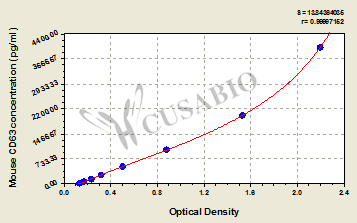
| |||||||||||||||||||||||||||||||||||||||||||||||||||||||||||||||
ELISA Data Analysis
Troubleshooting
and FAQs
and FAQs
Storage
Store at 2-8°C. Please refer to protocol.
Shelf Life
6 months
Description
This Mouse CD63 ELISA Kit was designed for the quantitative measurement of Mouse CD63 protein in serum, plasma, tissue homogenates. It is a Sandwich ELISA kit, its detection range is 62.5 pg/mL-4000 pg/mL and the sensitivity is 15.6 pg/mL .
Citations
- NUPR1 packaged in extracellular vesicles promotes murine triple-negative breast cancer in a type 1 interferon-independent manner E Segura-Cervantes,Extracellular Vesicles and Circulating Nucleic Acids,2024
- J Guo,Journal of psychiatric research,2023
Customer Reviews and Q&A
There are currently no reviews for this product.
■ Q&A
Q:
What is the typical sample dilution for detection in serum?
A:
Thanks for your inquiry!
CSB-EL004476HU
We tested the mentioned sample stated in the manual. We suggest you follow the manual.If you want to test human fecal samplee ,we suggest you do a pretest . Pls find following sample preparation method.
Feces Dilute samples with appropriate Sample Diluent. This can be achieved by adding 0.1g sample to appropriate Sample Diluent. Remove...
Target Background
Function
(From Uniprot)
(From Uniprot)
Functions as cell surface receptor for TIMP1 and plays a role in the activation of cellular signaling cascades. Plays a role in the activation of ITGB1 and integrin signaling, leading to the activation of AKT, FAK/PTK2 and MAP kinases. Promotes cell survival, reorganization of the actin cytoskeleton, cell adhesion, spreading and migration, via its role in the activation of AKT and FAK/PTK2. Plays a role in VEGFA signaling via its role in regulating the internalization of KDR/VEGFR2. Plays a role in intracellular vesicular transport processes, and is required for normal trafficking of the PMEL...
Gene References into Functions
- In renal proximal tubules, CD63 determines the insertion of OCT2 into the proper membrane domain and mediates transporter regulation by trafficking processes.
- TIMP1 signaling via CD63 leads to activation of hepatic stellate cells, which create an environment in the liver that increases its susceptibility to pancreatic tumor cells.
- The Muted protein is important for the steady-state level of CD63.
- Data show that CD63 is a crucial player in the regulation of the tumor cell-intrinsic metastatic potential by affecting cell plasticity.
- These findings identify CD63 as an important component of allergic inflammation.
- CD63 serves to bridge between beta1 integrin and VEGFR2 because CD63 silencing disrupted VEGFR2-beta1 integrin complex formation identified using proximity ligation assay
- Loss of CD63 is associated impairment of amyloidogenesis and downstream melanosome morphogenesis.
- Loss of CD63 has a similar phenotype to loss of P-selectin itself, thus CD63 is an essential cofactor to P-selectin.
- CXCR4 can be downregulated on activated B cells by IL-21-induced endocytosis and CD63-mediated endosomal recruitment.
- The findings identify palmitoylation-dependent association with the tetraspanin CD63 as the mechanism by which Syt VII is targeted to lysosomes.
- CD63, but not RILP, is recruited to the phagosomes in macrophages expressing the dominant negative form of Rab7.
- CD63 is recruited to already-budded Weibel-Palade bodies by an AP-3-dependent route
- Upon phagocytosis of Cryptococcus neoformans and polystyrene beads, CD63 was recruited selectively to C. neoformans-containing phagosomes in a MyD88-independent acidification-dependent manner
- protein region defined by amino acid residues 103-205 for CD63 interacts with amelogenin
- CD63 knockout mice show an increased urinary flow, water intake, reduced urine osmolality, and a higher fecal water content.
- the activation-induced degranulation of Fas ligand has distinct requirements and involves different mechanisms than those of the granule markers CD63 and CD107a/Lamp-1
Subcellular Location
Cell membrane; Multi-pass membrane protein. Lysosome membrane; Multi-pass membrane protein. Late endosome membrane; Multi-pass membrane protein. Endosome, multivesicular body. Melanosome. Secreted, extracellular exosome. Cell surface.
Protein Families
Tetraspanin (TM4SF) family
Tissue Specificity
Ubiquitous. Strongly expressed in kidney. Detected in spleen, bone marrow, peripheral blood mononuclear cells and macrophages.
Database Links
KEGG:
STRING:
UniGene: