



Recombinant SARS-CoV-2 S2 Subunit Protein with C-terminal tag, derived from the transfected human HEK293 cells.
Recombinant SARS-CoV-2 S2 Subunit Protein (full length)
Recombinant SARS-CoV-2 S2 Subunit Protein (full length)
Contact Us for Bulk Request
Product Description
Specifications
| Size | 10 µg, 50 µg |
| Species | SARS-CoV-2 |
| Accession Number | QHD43416 |
| Protein Name / Synonyms | Spike protein, S Protein, S2 Subunit |
| Expressed Region | Met697-Pro1213 |
| Expression System | HEK293 cells |
| Tag | C-terminal his-tag |
| Purity | >90 % |
| Purity Determined By | SDS-PAGE under reducing conditions and visualized by Coomassie blue staining |
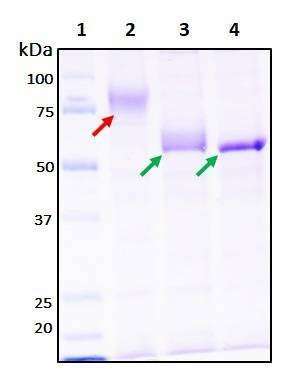
| Molecular Weight (kDa) | Recombinant protein product has a calculated molecular mass of ∼60 kDa. Due to the abundant glycosylation, it migrates as approximately 80 kDa protein bands in SDS-PAGE under DTT, beta-mercaptoethanol reducing conditions. See deglycosylation analysis image below. |
| Format | Liquid |
| Formulation | Supplied as a 0.2 µm filtered solution in PBS (pH 7.4) |
| Concentration (lot specific) | Lot specific (see the label on the vial), determined by BCA protein assay |
| Research Area | Infectious Disease, COVID-19 |
| Shipping Type | Blue ice |
| Storage | -20°C |
SDS-PAGE Image
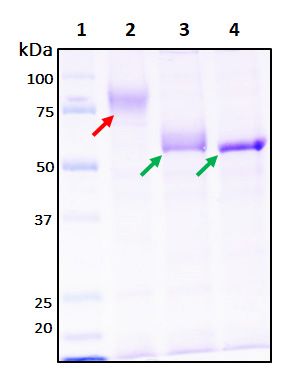
Lane 1: Protein standard ladder (kDa)
Lane 2: Untreated protein (˜80 kDa, red arrow) under reducing conditions
Lane 3: Partially cleaved protein (˜60 kDa, green arrow) with deglycosylation enzymes under native conditions
Lane 4: Fully cleaved protein (˜60 kDa, green arrow) with deglycosylation enzymes under reducing conditions
Stability & Storage
Storage/Stability
Upon arrival, the protein may be stored for 2 weeks at 4°C. For long term storage, it is recommended to store at -20°C or -80°C in appropriate aliquots. Avoid repeated freeze-thaw cycles.
Related Coronavirus Proteins
Spike Protein, S1 Subunit
230-01101
Spike Protein, S2 Subunit
230-01103
Nucleocapsid Protein
230-01104
S1 Subunit Protein (RBD) with C-terminal Fc tag
230-20405
S1 Subunit Protein (RBD) with C-terminal His-tag
230-20406
S1 Subunit Protein with C-terminal His-tag
230-20407
S2 Subunit Protein with C-terminal His-tag
230-20408
Nucleocapsid Protein with C-terminal His-tag
230-20409
Custom Labeling Request
We can custom label this protein with biotin or fluorescent dyes (choose from violet, blue, green or red). Request now.
citations
Titers of IgG and IgA against SARS-CoV-2 proteins and their association with symptoms in mild COVID-19 infection
- Species:
- Human
- Sample Type:
- Serum (mild COVID-19 patients, T1 and T2)
- Year:
- 2024
- Journal Name:
- Scientific Reports
- PubMed ID:
- 38830902
Post-Vaccination Detection of SARS-CoV-2 Antibody Response with Magnetic Nanoparticle-Based Electrochemical Biosensor System
- Year:
- 2023
- Journal Name:
- Biosensors-Basel
SARS-CoV-2 spike S1 subunit induces neuroinflammatory, microglial and behavioral sickness responses: Evidence of PAMP-like properties
- Species:
- Rat
- Sample Type:
- Other / Unspecified (administered to rats)
- Year:
- 2022
- Journal Name:
- Brain Behavior and Immunity
- PubMed ID:
- 34915155
Deducing the N- and O- glycosylation profile of the spike protein of novel coronavirus SARS-CoV-2
- Year:
- 2020
A glycosaminoglycan microarray identifies the binding of SARS-CoV-2 spike protein to chondroitin sulfate E
- Species:
- Other
- Sample Type:
- Purified / Recombinant Protein (glycosaminoglycan microarray recombinant protein probe)
- Year:
- 2021
- Journal Name:
- FEBS Letters
- PubMed ID:
- 34375459
Identification of Immunohistochemical Reagents for In Situ Protein Expression Analysis of Coronavirus-associated Changes in Human Tissues
- Species:
- Human
- Year:
- 2020
- Journal Name:
- Applied Immunohistochemistry & Molecular Morphology
- PubMed ID:
- 33086222
SARS-CoV-2 spike protein induces inflammation via TLR2-dependent activation of the NF-κB pathway
- Species:
- Human
- Sample Type:
- Other / Unspecified (THP-1 macrophage-like cells, HEK293T, A549, Calu3 cells)
- Year:
- 2021
- Journal Name:
- eLife
- PubMed ID:
- 34866574