


Threose is a tetrose monosaccharide with the molecular formula C4H8O4 and belongs to the aldose family, characterized by the presence of an aldehyde group at the terminal carbon. Structurally, threose contains four carbon atoms, two of which are chiral centers, giving rise to stereoisomers, including D-threose and L-threose. The stereochemical configuration of D-threose is (2S,3R)-2,3,4-trihydroxybutanal, whereas L-threose corresponds to the (2R,3S) configuration.
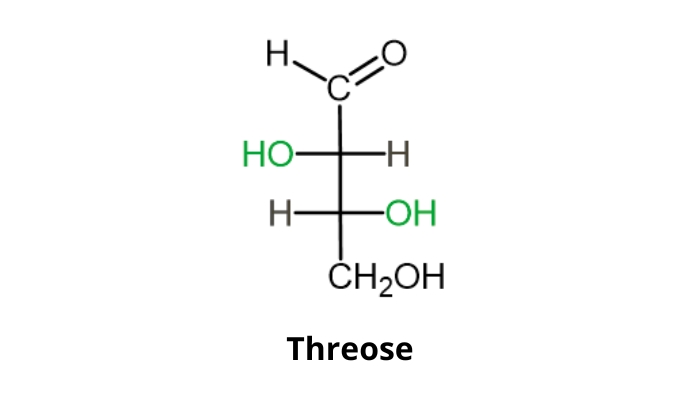
Threose is a colorless to light yellow syrup with good solubility in water and slight solubility in methanol. It displays optical activity with opposite rotations for its enantiomers: D-threose exhibits a specific optical rotation of around -12.9°, while L-threose shows around +13.2°. The compound mainly exists in equilibrium between its linear aldehyde form and its hydrated cyclic forms in aqueous solution. Its physicochemical properties include a melting point around 130°C for D-threose and 162–163°C for L-threose.
Biochemical and Structural Significance
Biochemically, threose is notable as a four-carbon sugar involved in synthetic and prebiotic chemistry rather than mainstream metabolic pathways. Its structural isomer, erythrose, differs by the stereochemical arrangement of its hydroxyl groups and serves different biochemical roles. Threose has gained significant interest as a backbone component in threose nucleic acid (TNA), an artificial genetic polymer studied as a model for the origins of life due to its simpler structure and ability to store genetic information akin to DNA and RNA.
In summary, threose is a small, structurally simple aldose carbohydrate with key stereochemical features and emerging importance in synthetic biology research. It exists as two enantiomers with distinct optical properties and primarily serves as a molecule of interest in non-standard genetic systems rather than classical metabolism.
