



RayBio® C-Series Human Chemokine Antibody Array 1 Kit. Detects 38 Human Chemokines. Suitable for all liquid sample types.

Human Chemokine Array C1
Human Chemokine Array C1
Contact Us for Bulk Request
Product Description
Specifications
| Size | 2 Sample Kit, 4 Sample Kit, 8 Sample Kit |
| Species | Human |
| Compatible Sample Types | Cell Culture Supernatants, Plasma, Serum, Tissue Lysates, Cell Lysates |
| Quantitative/Semi-Quantitative | Semi-Quantitative |
| Number of Targets Detected | 38 |
| Solid Support | Membrane |
| Design Principle | Sandwich-based |
| Method Of Detection | Chemiluminescence |
| Research Area | Inflammation, Chemokine Biology |
| Shipping Type | Blue ice |
| Storage | -20°C |
Product Features
- Easy to use
- No specialized equipment needed
- Compatible with nearly any liquid sample
- Proven technology (many publications)
- Highly sensitive (pg/ml)
- Sandwich ELISA specificity
- Higher density than ELISA, Western blot or bead-based multiplex
Target Names
| Scroll over each target protein for more information | ||||
|---|---|---|---|---|
BLC (CXCL13)
| CCL28 (MEC)
| Ck beta 8-1 (CCL23)
| CTACK (CCL27)
| CXCL16
|
ENA-78 (CXCL5)
| Eotaxin-1 (CCL11)
| Eotaxin-2 (MPIF-2/CCL24)
| Eotaxin-3 (CCL26)
| Fractalkine (CX3CL1)
|
GCP-2 (CXCL6)
| GRO alpha/beta/gamma
| GRO alpha (CXCL1)
| HCC-4 (CCL16)
| I-309 (TCA-3/CCL1)
|
I-TAC (CXCL11)
| IL-8 (CXCL8)
| IP-10 (CXCL10)
| Lymphotactin (XCL1)
| MCP-1 (CCL2)
|
MCP-2 (CCL8)
| MCP-3 (MARC/CCL7)
| MCP-4 (CCL13)
| MDC (CCL22)
| MIG (CXCL9)
|
MIP-1 alpha (CCL3)
| MIP-1 beta (CCL4)
| MIP-1 delta (CCL15)
| MIP-3 alpha (CCL20)
| MIP-3 beta (CCL19)
|
MPIF-1 (CCL23)
| NAP-2 (PPBP/CXCL7)
| PARC (CCL18)
| RANTES (CCL5)
| SDF-1 alpha (CXCL12 alpha)
|
SDF-1 beta (CXCL12 beta)
| TARC (CCL17)
| TECK (CCL25)
| ||
Application Notes
Suggested Application
Multiplexed Protein Detection; Detection of Relative Protein Expression; Detecting Patterns of Cytokine Expression; Biomarker/ Key Factor Screening; Identifying Key Factors; Confirming a Biological Process
Kit Components
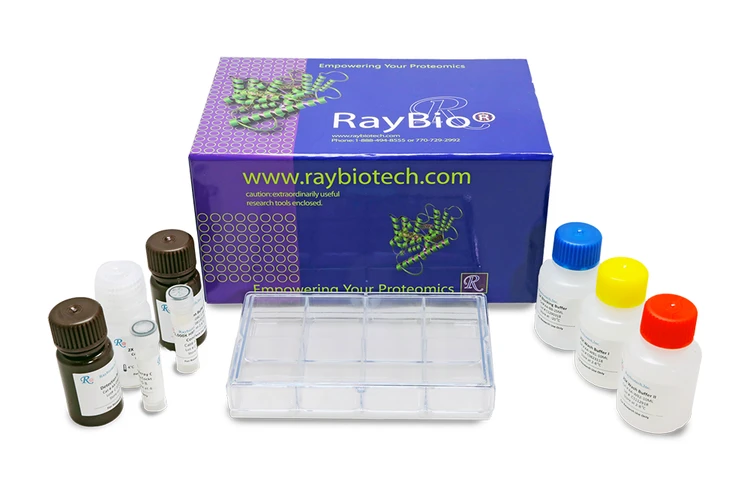
- Human Chemokine Antibody Array C1 Membranes
- Blocking Buffer
- Wash Buffer 1
- Wash Buffer 2
- Biotinylated Detection Antibody Cocktail
- Streptavidin-Conjugated HRP
- Detection Buffer C
- Detection Buffer D
- Lysis Buffer
- 8-Well Incubation Tray
- Plastic Sheets
- Array Templates
- Manual
Other Materials Required
- Pipettors, pipet tips and other common lab consumables
- Orbital shaker or oscillating rocker
- Tissue Paper, blotting paper or chromatography paper
- Adhesive tape or Saran Wrap
- Distilled or de-ionized water
- A chemiluminescent blot documentation system (such as UVP's ChemiDoc-It® or EpiChem II Benchtop Darkroom or GE's ImageQuant™ LAS 4000 or Amersham Imagers 600 and 680), X-ray Film and a suitable film processor, or another chemiluminescent detection system.
Protocol Outline
- Block membranes
- Incubate with Sample
- Incubate with Biotinylated Detection Antibody Cocktail
- Incubate with HRP-Conjugated Streptavidin
- Incubate with Detection Buffers
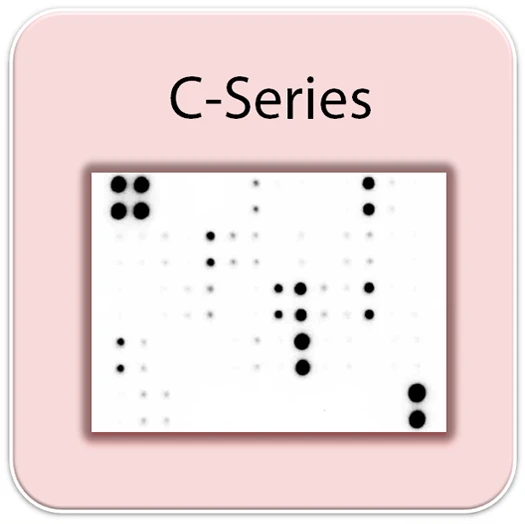
- Image with chemiluminescent imaging system
- Perform densitometry and analysis
Storage/Stability
For best results, store the entire kit frozen at -20°C upon arrival. Stored frozen, the kit will be stable for at least 6 months which is the duration of the product warranty period. Once thawed, store array membranes and 1X Blocking Buffer at -20°C and all other reagents undiluted at 4°C for no more than 3 months.
documents
citations
CCL3 secreted by hepatocytes promotes the metastasis of intrahepatic cholangiocarcinoma by VIRMA-mediated N6-methyladenosine (m6A) modification
- Species:
- Human
- Sample Type:
- hepatocytes
- Year:
- 2023
- Journal Name:
- Journal of Translational Medicine
Wound healing by transplantation of mesenchymal stromal cells loaded on polyethylene terephthalate scaffold: Implications for skin injury treatment
- Species:
- Human
- Sample Type:
- mesenchymal stromal cells (MSCs)
- Year:
- 2023
- Journal Name:
- Injury-international Journal of The Care of The Injured
ASS1 regulates immune microenvironment via CXCL8 signaling in ovarian cancer
- Species:
- Human
- Sample Type:
- HeyA8 cell
- Year:
- 2022
- Journal Name:
- Biochemical and Biophysical Research Communications
CCL3 Promotes Proliferation of Colorectal Cancer Related with TRAF6/NF-κB Molecular Pathway
- Species:
- Human
- Sample Type:
- colorectal cancer tissue
- Year:
- 2022
- Journal Name:
- Contrast Media & Molecular Imaging
Macrophagederived exosomes attenuate the susceptibility of oral squamous cell carcinoma cells to chemotherapeutic drugs through the AKT/GSK3 pathway
- Species:
- Human
- Sample Type:
- Cell Lysate (Exosomes lysates, OSC-4 cells, tongue cancer)
- Year:
- 2020
- Journal Name:
- Oncology Reports
GABRP regulates chemokine signalling, macrophage recruitment and tumour progression in pancreatic cancer through tuning KCNN4-mediated Ca2+ signalling in a GABA-independent manner
- Species:
- Human
- Sample Type:
- Conditioned Media (Pancreatic cancer cells and macrophage infiltration)
- Year:
- 2019
- Journal Name:
- Gut
- PubMed ID:
- 30826748
Topical administration of cryopreserved living micronized amnion accelerates wound healing in diabetic mice by modulating local microenvironment
- Species:
- Human
- Sample Type:
- Conditioned Media (Living Micronized Amniotic Membrane)
- Year:
- 2017
- Journal Name:
- Biomaterials
- PubMed ID:
- 27810642
A niche that triggers aggressiveness within BRCA1-IRIS overexpressing triple negative tumors is supported by reciprocal interactions with the microenvironment
- Species:
- Human
- Sample Type:
- Conditioned Media (Normal Mammary epitehlia cells and BRCA Overexpressing cells (IRIS))
- Year:
- 2017
- Journal Name:
- Oncotarget
- PubMed ID:
- 29262555
CCL17 and CCL22/CCR4 signaling is a strong candidate for novel targeted therapy against nasal natural killer/T-cell lymphoma
- Species:
- Human
- Sample Type:
- Conditioned Media (EBV infected NK like cell lines, SNK6/8/1)
- Year:
- 2015
- Journal Name:
- Cancer Immunology, Immunotherapy
- PubMed ID:
- 25754123
Effect of elevated carbon dioxide on bronchial epithelial innate immune receptor response to organic dust from swine confinement barns
- Species:
- Human
- Sample Type:
- Conditioned Media (BEAS bronchoepithelial Cell line Treated with CO2 and organic dust)
- Year:
- 2015
- Journal Name:
- International Immunopharmacology
- PubMed ID:
- 25921030