

Mouse CD81 antigen(CD81) ELISA kit

Cat# CSB-EL004960MO-96T
Size : 96T
Brand : Cusabio
Contact local distributor :

Phone : +1 850 650 7790
 SDS
| Size | 96T,5×96T,10×96T |
Product Details
| Intra-assay Precision (Precision within an assay): CV%<8% | |||||||
| Three samples of known concentration were tested twenty times on one plate to assess. | |||||||
| Inter-assay Precision (Precision between assays): CV%<10% | |||||||
| Three samples of known concentration were tested in twenty assays to assess. | |||||||
| To assess the linearity of the assay, samples were spiked with high concentrations of mouse CD81 in various matrices and diluted with the Sample Diluent to produce samples with values within the dynamic range of the assay. | |||||||
| Sample | Serum(n=4) | ||||||
| 1:1 | Average % | 97 | |||||
| Range % | 92-101 | ||||||
| 1:2 | Average % | 91 | |||||
| Range % | 85-96 | ||||||
| 1:4 | Average % | 84 | |||||
| Range % | 80-88 | ||||||
| 1:8 | Average % | 95 | |||||
| Range % | 95-99 | ||||||
| The recovery of mouse CD81 spiked to levels throughout the range of the assay in various matrices was evaluated. Samples were diluted prior to assay as directed in the Sample Preparation section. | |||||||
| Sample Type | Average % Recovery | Range | |||||
| Serum (n=5) | 93 | 89-98 | |||||
| EDTA plasma (n=4) | 104 | 100-113 | |||||
| These standard curves are provided for demonstration only. A standard curve should be generated for each set of samples assayed. | |||||||||||||||||||||||||||||||||||||||||||||||||||||||||||||||||||||||
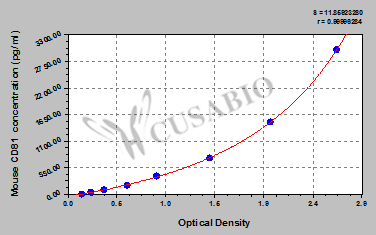
| |||||||||||||||||||||||||||||||||||||||||||||||||||||||||||||||||||||||
and FAQs
This Mouse CD81 ELISA Kit was designed for the quantitative measurement of Mouse CD81 protein in serum, plasma, tissue homogenates, cell lysates. It is a Sandwich ELISA kit, its detection range is 47 pg/mL-3000 pg/mL and the sensitivity is 11.75 pg/mL.
Citations
- Z Liu, H Lai, Q Yang, C Zhang, B Jia, Q Chen,Advanced Science,2026
- JH Baek,Nutrients,2023
- F Wei,Aging (Albany NY),2020
Customer Reviews and Q&A
There are currently no reviews for this product.
I'm interested in co-localizing a protein of interest with an exosomal marker such as CD81 to demonstrate my protein of interest is localized in the exosome membrane. Do you think I can reach this goal by using a kit such as the Mouse CD81 antigen(CD81) ELISA kit (code: CSB-EL004960MO) and replacing the detecting antibody by an anti-protein of interest antibody? Can I use this kit with cell culture medium derived-exosomes or cell culture medium itself?
Target Background
(From Uniprot)
- The species-specific traits in CD9 and CD81 distribution during sperm maturation were compared between mice and humans. A mutual position of CD9/CD81 is shown in human spermatozoa in the acrosomal cap, however in mice, CD9 and CD81 occupy a distinct area.
- adoptive transfer of wild-type regulatory T cells into CD81-deficient mice was sufficient to promote tumor growth and metastasis; these findings suggested that CD81 modulates adaptive and innate immune responses
- CD81-Rac interaction exerts an important regulatory role on the innate and adaptive immunity against bacterial infection and suggests a role for CD81 in the development of novel therapeutic targets during infectious diseases.
- Plasmodium yoelii sporozoite rhoptry discharge occurs only in the presence of CD81, providing the first direct evidence for a role of CD81 during sporozoite productive invasion.
- In vitro myotubes lacking CD9P-1 or both CD9 and CD81 fuse with a higher frequency than normal myotubes
- Data suggest that GPC3 down-regulates hepatocyte proliferation by binding to hedgehog (HH) and down-regulating the HH signaling pathway and binding with CD81, thus making it unavailable to bind to Hhex and causing its nuclear translocation.
- CD81 interacts with the T cell receptor to suppress signaling.
- CD81 promotes the microvillus formation and/or extension while tetraspanin CD82 inhibits these events. In addition, CD81 enhances the outward bending of the plasma membrane while CD82 inhibits it.
- Self-renewing hematopoietic stem cells express CD81 during stress-induced proliferation.
- CD81 is required for the formation of actin membrane protrusions via Rac1 activation in adhesion-dependent immune cell migration.
- data indicate that CD81 plays a significant role in the final stages of RPE development, controlling cell number and overall developmental pattern
- CD81 gene is maternally imprinted, with preferential expression from the paternal allele.
- CD81 plays a negative role in B cell activation in vitro and in vivo.
- CD81 expression by T cells is critical for their induction of IL-4 synthesis by B cells
- Infertility of CD9-deficient mouse eggs is reversed by mouse CD81
- the role of CD81 in the regulation of astrocyte and microglial number, perhaps by regulating cell proliferation by a contact inhibition-dependent mechanism.
- Data show that CD81, a putative receptor for hepatitis C virus, is required on hepatocytes for human Plasmodium falciparum and rodent Plasmodium yoelii sporozoite infectivity.
- CD81 affects expression of its associated partner CD19 beginning at a B-cell postendoplasmic reticulum compartment where CD81 is necessary for normal trafficking or for surface membrane stability of CD19.
- CD81 strengthens multivalent VLA-4 contacts within subsecond integrin occupancy without altering intrinsic adhesive properties to low density ligand. CD81 facilitates both VLA-4-mediated leukocyte rolling and arrest on VCAM-1
- CD81 is required for the association of the B cell antigen receptor and the CD19/CD21 complex with lipid rafts and for enhanced signaling from rafts upon coligation.
- CD81 signaling events could be mediated by 14-3-3 adapter proteins, and these signals may be dependent on cellular redox
- CD9 and CD81 play complementary roles in sperm-egg fusion
- CD81 plays multiple roles in the processing, intracellular trafficking, and membrane functions of CD19.
- Murine CD81 does not mediate hepatitis C virus pseudoparticle entry when transfected into human HepG2 tumor cells.
- Disruption of the mouse CD81 gene led to a reduction in the fecundity of female mice, and CD81-/- eggs had impaired ability to fuse with sperm.
- We conclude that CD81 represents a potential therapeutic target to interfere with leukocyte infiltration and ameliorate inflammatory neurological damage in MS.
- tetraspanins CD9 and CD81 regulate cell motility and protease production of macrophages and that their dysfunction may underlie the progression of COPD
- CD81 is indispensable for an authentic in vivo hepatitis C virus infection.
- CD81 potentially plays a role in macrophage cell line growth regulation.
- Inactivation of CD81 by homologous recombination can increase astrocyte and microglial cell proliferation and can lead to anomalously large brain size (30% larger than normal). The effect depends on genetic background.
KEGG:
STRING:
UniGene: